
AI agents, and what they actually do.
An AI agent is a program that is given a task and works out for itself which steps it takes to finish it. It can look things up in your systems, write a reply, create a ticket or book a meeting, without a person clicking through every step. What separates it from a chatbot is that the agent acts inside your systems instead of only answering questions.
What an AI agent is, and what it is not
Three different things get sold under the same word, and they do not do the same job. Sort them out before the first meeting, because the three sit a long way apart on price.
Ordinary automation follows a rule you wrote in advance. If an email arrives with the word invoice in the subject line, move it to the accounts folder. It does exactly the same thing every time, it is cheap to run, and it stops dead the moment reality stops matching the rule. For a great many tasks that is still the right choice, and an agent would cost more without doing the work any better.
A chatbot answers. It searches a body of text, finds something close to the question, and writes back. Nothing has happened afterwards: no ticket created, no email sent, nothing changed in any system. The conversation was the entire delivery.
An AI agent gets a goal instead of a rule. Work out whether this enquiry fits what we sell. Book a meeting if it does. Refer them elsewhere if it does not. The agent picks the order itself, uses the tools it has been given access to, and leaves something behind when the conversation ends.
There is a test you can use in any sales meeting. Ask what is in your CRM once the conversation is over. If no concrete answer comes back, you are being sold a chatbot.
The three kinds of agent companies actually use
There are more on paper. In practice these are the three that companies buy, and each one solves a different problem.
The agent at the front door
It sits on the website and meets the people who found their own way there. It asks the questions a salesperson would ask, writes the answers into the CRM, books a meeting with the ones who fit, and says a polite no to the ones who do not. A no is worth as much as a yes, because it is hours nobody has to spend reaching the same conclusion next week.
A website AI agent only earns its place once enough enquiries arrive to be worth sorting. Below a couple of hundred visitors a month there is nothing to filter.
The agent inside the workflow
It sits behind the scenes, where the customer never sees it, and takes the part of the job nobody wants. Reading fifteen emails and pulling out what has to go into the system. Drafting a first version of a proposal from something already written before. Collecting what goes into a monthly report from four different places.
AI workflow automation works best right here, because the task is dull, repeated and low in risk, and because a person still sees the result before it goes anywhere. It is also where you feel the difference soonest, since the time is saved for somebody sitting next to you.
The agent that runs on its own
It does not wait for anyone to write to it. It reads through your data on a schedule, reacts when something changes, and does the work without anybody asking for it that day. It is the most valuable of the three and the most demanding.
An agent that runs on its own needs supervision, because nobody notices the mistake at the moment it happens. Left unreviewed, it drifts quietly away from what it was set up to do, and you usually find out at the wrong end. Only put one into production if somebody owns the job of looking at it.
What it costs
Most of this market writes contact us for pricing. Here are the numbers instead.
It always starts with half an hour, and that half hour is free. We talk through what you want solved and I say yes or no to whether an agent is the answer. Nothing is sold in that conversation.
If you decide to go on, the next step is an audit at €670, and it takes a week. You get a written map of where an agent earns its place in your company, and a fixed quote for whatever follows. The audit also writes down how things stand in your company today, and that is the number you hold the project up against afterwards. Without it there is no way to settle whether the work paid off. The fee is credited against the project, so it is the first step of the work rather than an extra bill.
The build itself is fixed price. €4,025 covers one agent, usually the website agent or a single internal workflow, and takes three to four weeks. €7,381 when there are several workflows and a CRM integration. €10,066 when there are multiple agents, integrations and team training on top. No hourly billing. If the work takes longer than I thought, that is my invoice and not yours.
After that there are two running costs, and they are almost always left out of the budget. Model usage you pay directly to Anthropic based on how much the agent works, on your own account, so you can see it and turn it down. And if somebody has to look after the agent, a retainer starts at €1,610 a month. Most companies do not need one for the first few months.
The half hour before it is free. The fee is credited against the project.
Where it goes wrong
This is the part that rarely appears in a proposal.
An agent without access to your real data is a demo. It sounds good in the meeting room, because it answers exactly what it was demonstrated on, and it falls apart the first time a customer asks about something held in a system the agent is not allowed to read. Access is the hard, expensive part of a project like this. The language is the easy part, and the language is what the demo shows you.
Then there is the person in the loop. An agent that sends emails by itself, edits customer records by itself and closes tickets by itself also makes its mistakes at full speed and without asking. Put a person where the consequence is hard to take back, and let the agent run free where it is not. Draw that line before you start, not after the first regrettable email.
GDPR usually gets noticed too late. The moment the agent reads a customer email it is processing personal data, and you then have to answer where that data sits, who has access, how long it is kept, and what happens when the customer asks to be deleted. It can be solved. It just cannot be solved backwards, once the agent has been running for three months and nobody wrote anything down along the way.
What catches most people out is the tone. A language model writes a wrong answer in exactly the same calm voice as a right one. No hesitation, no caveat, nothing that looks different on screen. So reading twenty answers and concluding it is good enough does not hold. Find the questions where a wrong answer costs you money or a customer, and ask them deliberately, before the agent meets anyone from outside.
Last, measurement. Plenty of agents run for months without anybody able to say whether they made a difference. Decide the number before you start. Meetings booked. Hours no longer spent sorting. Tickets closed without a person touching them. If the number does not exist, there is also no way to notice that the agent has stopped working.
Try one
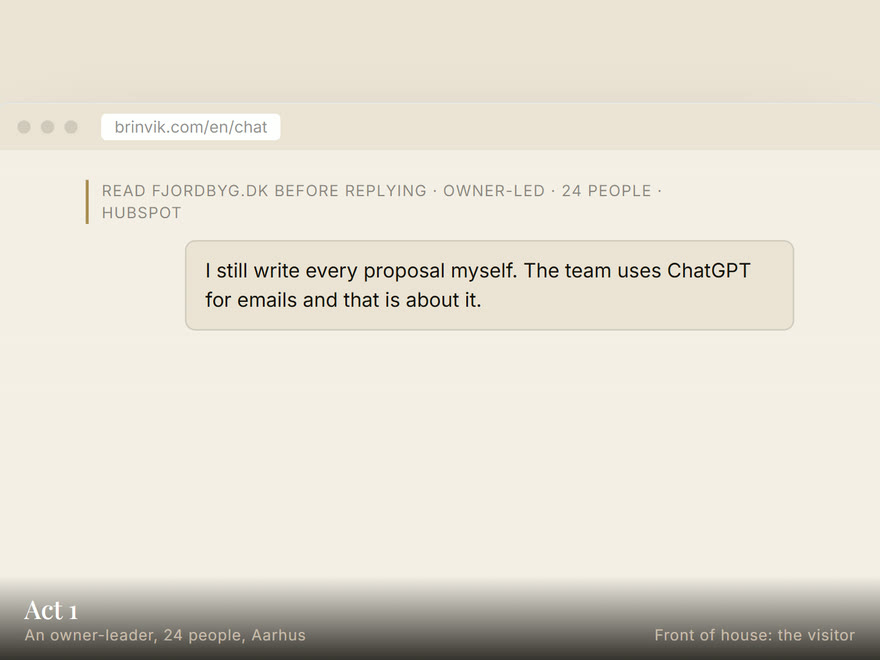
There is an agent running on this site. It is set up to qualify: it asks what you do and what you want solved, and it books a meeting if there is something to meet about. If there is not, it says so and points you elsewhere.
Ask it about something I do not sell and watch what happens. It is the fastest way to understand the difference between an agent and a chatbot, and it takes two minutes.
As an AI consultant in Copenhagen I set up AI agents for Nordic companies, and the agent here is the same kind I build for other people. It runs on Claude, it is wired into my own CRM, and it says no to more people than it says yes to.
Questions I get
What is an AI agent?
An AI agent is a program that is given a goal and chooses the steps needed to reach it. It can look things up in your systems, write replies, create tickets and book meetings, without a person clicking through every step. It differs from ordinary automation in not following a fixed rule, and from a chatbot in acting rather than only answering.
What is the difference between an AI agent and a chatbot?
A chatbot answers questions and leaves nothing behind but the conversation. An AI agent has access to tools and systems and produces something that is still there afterwards: a ticket created, a meeting booked, a customer record updated. The practical test is to ask what is in your CRM once the conversation is over.
What does an AI agent cost?
At Brinvik it starts with a free half hour, and only if you go on does an audit cost €670 for a week, credited against the project. The build itself is fixed price, from €4,025 for a single agent up to €10,066 when there are multiple agents and integrations. On top of that comes model usage, which you pay directly to Anthropic on your own account based on consumption.
How long does it take to get an AI agent running?
A single agent is usually in production after three to four weeks, with the audit week before that. Several workflows with a CRM integration take four to six weeks. What takes the time is almost never the language, it is access to your data and the agreements that have to be in place around it.
Can an AI agent handle our customer data?
Yes, if the groundwork is in place. The agent processes personal data from the moment it reads a customer email, so you need a data processing agreement, a known location for the data, a retention period and a way to delete. Brinvik builds on Claude with EU hosting and writes those agreements into the project from the start, rather than correcting for them afterwards.
An AI agent
that does the work.
Tell me what takes up most of your week. I will tell you whether an agent solves it, or where else to look. Either way, you leave with a plan.
You pick a slot in Kim's calendar. No form, no callback.
Certified by Anthropic · Fixed price on every stage · Invoiced in DKK