On 11 June 2026, Anthropic signed a multi-year global alliance with DXC Technology, one of the world's largest IT services companies. DXC runs the systems that banks, airlines, insurers, manufacturers and public authorities build their operations on. Now they are putting Claude into those systems, and they are training tens of thousands of Claude-certified engineers to do it. I want to be honest about what the real news is here, because it is not the size of the deal. It is the order DXC used, and it is an order you can copy at your own scale, whether you have 20 or 2,000 employees.
Anthropic's official announcement of the DXC alliance →
Anthropic and DXC have entered a multi-year global alliance, and DXC has become part of the Claude Partner Network.
What the deal actually is
The core of the deal is people, not a licence. DXC will train tens of thousands of what Anthropic calls forward-deployed engineers, engineers who sit directly inside the customer's organisation. DXC recruits them from its own development teams and certifies them through Anthropic Academy, Anthropic's training and certification programme. On top of that, DXC adds its own curriculum, aimed at the critical systems its customers run.
The alliance starts in four areas where DXC already runs large operations. Insurance, where Claude is used for agent-based solutions and core-system modernisation. Modernisation as a service, where Claude helps analyse, rewrite and modernise old code. Cybersecurity, where an always-on security engineer as a subagent, built on Claude Security, is rolled out across DXC's security operations centers. And application operations, where Claude is built into the environments DXC maintains for its customers.
What makes it credible is what DXC did first. They used Claude internally across roughly 115,000 employees in 70 countries, under the same strict requirements their customers impose. In April 2026 they launched DXC OASIS, their platform for running customers' IT systems, where AI agents handle much of the routine work. Claude is now the default model behind the platform's agent workflows, and OASIS already serves more than 50 DXC customers.
The order is the whole lesson
Here is my opinion, and it is the only point I want you to take with you. DXC did not sell Claude to a bank before they had run it through their own operation under the same requirements the bank imposes. They proved it from the inside before they took it out to customers. That is the order that lets a bank dare to say yes, and it is exactly the order I work by when I put Claude into Nordic companies.
The security question that makes much of the Nordic mid-market wait has effectively been answered. Not by a startup, but by some of the most regulated buyers on earth: banks, airlines, insurers. The question is no longer whether AI is mature enough for serious work. That question is settled. The question now is whether you build the skill and the governance internally before your competitor does.
And you do not need to be DXC's size to use the logic. A company with 20 or 200 employees can do exactly the same thing at small scale. Pick an internal, boring, repeated task. Run Claude on it under your own data and security requirements. Measure the result. And only expand once it works. It is cheaper to learn on your own operation than on your customer's.
Forward-deployed engineers are a delivery model, not just a deal
Notice that DXC is not selling a model. They are selling people who can implement it. That is a shift in how AI actually reaches production, and it is worth understanding.
For the last two years the AI market has been full of pilots that never reached production. The reason was almost never the model. It was that no one in the organisation could take it from demo to operation under real requirements. DXC's answer is to train and formally certify engineers through Anthropic Academy before they touch a customer's systems. Those are, by the way, the same Anthropic Academy certifications I hold myself at Brinvik. Skill and access control are part of the delivery from day one, not something patched on afterwards.
That is also why DXC became part of the Claude Partner Network. Anthropic is not just building a model, they are building a layer of specialists who can put it into operation. For you as a Nordic company the point is simple: the value is not in having access to Claude, it is in getting it implemented properly in your own business. That is exactly what I do at Brinvik. I put Claude directly into your operation, under your own data and security requirements, and make sure your team can keep building after I leave.
Be honest about the numbers
DXC's own estimate is that Claude made software development roughly 10 times faster, and that more than 95 percent of the code for OASIS was written by Claude and then reviewed by software engineers. Those are impressive numbers, and they point to a real shift. But they come from DXC itself, and they are not independently verified.
I take them as a vendor's own figures, not as a measured result, and you should too. It does not change the conclusion, because even a fraction of those numbers is significant. But when you start yourself, measure on your own operation instead of borrowing someone else's figures. The only percentage that matters to your business is the one you can document yourself.
What it means for Nordic B2B SaaS
For a Nordic B2B SaaS team the point is the order, not the deal. If Claude works in a bank's core systems, it can handle the heavy, repeated work that eats your developers' and your team's hours. One of DXC's four starting areas is modernising old code, and that is not by chance. That is where a large part of the SaaS market is stuck: technical debt that slows new work.
Run a well-thought-out Claude implementation on your own operation first. Pick the research, follow-up or clean-up task that takes the most time and needs the least judgement, hand it to Claude under your own data and security requirements, and measure the hours you get back. Your skilled people should spend their time on what only humans can do. That is the kind of governance that lets you dare to roll out from one team to many.
What it means for telemarketing and sales teams
Claude is now proven in environments far more regulated than a sales team's day. So you can confidently put it into commercial work without waiting for more proof. Research on prospects and accounts, faster follow-up on threads that have stalled, cleaning up data in the CRM and preparing for meetings while you sell.
Those are hours your team spends today on what is not selling. The same base model now running at insurers can take those hours, so people can spend them in front of the customer. Remember that it is still a model with a human in the loop: you decide the access, the boundaries and when it is switched on. It is not a replacement for your salespeople, it is a way to give them their time back.
What it means for professional services firms
DXC did not build a showcase. They put Claude into core systems with governance around it and trained their own people formally before they let them touch customer systems. For a professional services firm that is the template you can copy directly.
Skill and access control belong in the rollout from day one. Start on internal data you own yourself, not on client data, while you learn. Give the people who will use the tool a short, formal training before they are let loose on real cases. It sounds like a compliance requirement, and it is one, but above all it is how you avoid the mistakes that cost a client relationship. That is the order a SOC 2, ISO 27001 or GDPR audit will like.
What it means for founders and scale-ups
DXC's own story is the most important one for a founder. They built the platform with Claude before they sold it. That is the same order you should run yourself: build fast with Claude inside, prove it on your own operation, and expand from there.
Notice too that modernising old code is one of the four starting areas. That is a signal about both demand and who you are competing with. If the big service houses are throwing Claude-certified engineers at legacy modernisation, you know where the market is heading. For a scale-up that is an opportunity: you can move faster and closer to the customer than a house DXC's size ever can. It is not size that wins here, it is the order and the speed.
GDPR, EU hosting and what applies to Danish companies
This deal is American and is about large regulated systems. It does not change your legal position in Denmark. But the method DXC used is exactly the one a Danish audit will like, and there are three concrete things you can take from it.
Run your first AI trial on internal data you own yourself, not on customer data. That keeps you on safe ground while you learn. Keep track of which data goes into the tool, and whether a data processing agreement is in place. That is still what an audit trips over first. And write access and training into your rollout from the start, exactly as DXC certified its people before it gave them access.
For the companies that need EU data residency, it is worth knowing that Claude can be deployed through AWS Bedrock or Google Vertex AI in European regions. Native Claude.ai and Anthropic's API are US-hosted, but residency in the EU is possible when the requirement is there. That is the kind of choice you make deliberately from the start, not one you discover in an audit afterwards.
The real gain is rarely the deal itself. It is in a Claude implementation that fits the workflows and requirements you already have, and that is set up right from the start. That is the kind of work I do for Nordic companies: pick the right task, prove it on your own operation, and expand from there. See more about internal Claude in your workflows, or write to me before you start on real data.
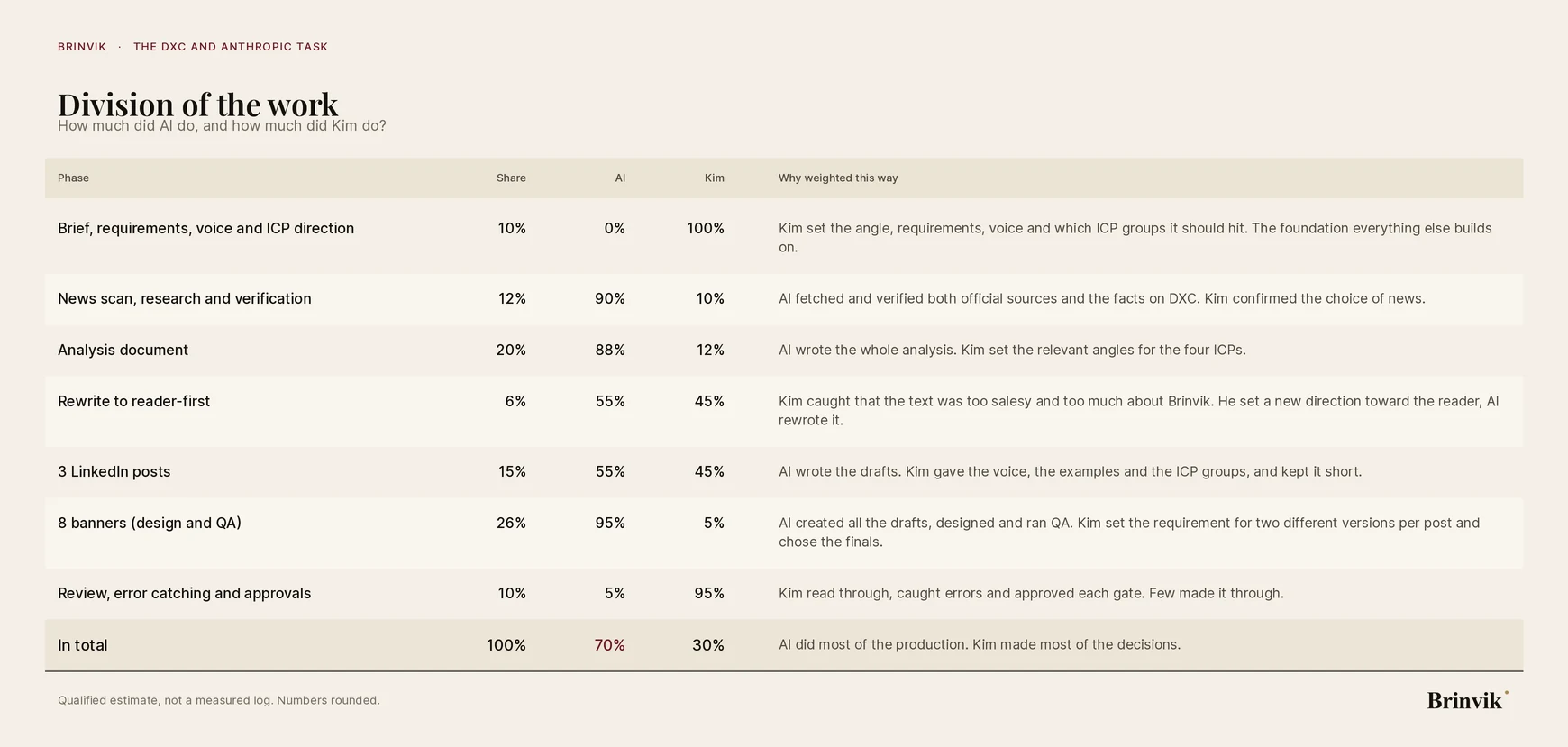
This work was produced in collaboration with AI. Overall: AI roughly 70 percent, Kim roughly 30 percent. Looking only at the production itself: AI roughly 90 percent, Kim roughly 10 percent. The human sets the direction, AI delivers the volume.
FAQ
Frequently asked questions
On 11 June 2026, Anthropic entered a multi-year global alliance with DXC Technology, and DXC became part of the Claude Partner Network. DXC will train tens of thousands of Claude-certified engineers and starts in insurance, code modernisation, cybersecurity and application operations, where they put Claude into customers' systems.
DXC is putting Claude into banks, airlines and insurance, some of the most regulated environments that exist. They ran it on their own operation first under the same requirements before taking it out to customers. That points to Claude being usable in business-critical systems with the right governance and access control.
Start on internal data you own yourself, not on customer data. Pick a repeated task, run Claude on it under your own data and security requirements, measure the result, and only expand once it works. Sort out a data processing agreement, and consider EU data residency via AWS Bedrock or Google Vertex AI before productive use on personal data.