On 12 June 2026, Anthropic received an export control directive from the US government. The directive cites national security and requires access to Fable 5 and Mythos 5 to be cut off for all foreign nationals, both inside and outside the US. To comply, Anthropic has switched off both models for every customer in the world. Every other Claude model keeps running as normal.
The point that matters for you as a company outside the US is simple: you are a foreign national in the directive's sense. If you or your people used Fable 5 or Mythos 5, the access is gone right now. But Opus 4.8, Sonnet 4.6 and Haiku 4.5 still work. And here is the most important reassurance: for most companies this probably changes nothing in practice. Fable 5 launched on 9 June and was shut down on 12 June. The model was three days old. The real lesson is not politics. It is dependency, and that lesson holds whatever model you run.
Anthropic's official statement on the government directive →
After a US government directive, Anthropic has suspended access to Fable 5 and Mythos 5 for all customers globally. Every other Claude model is unaffected.
What happened
Anthropic received the directive at 5:21 pm US Eastern time on 12 June. The letter cites national security but, according to Anthropic, gave no concrete detail about the concern.
Anthropic's own understanding is that the government believes it has seen a method to get around the safety guardrails in Fable 5, what is called a jailbreak. Anthropic writes that they reviewed a demonstration of the technique, and that it only surfaced a small number of known, minor vulnerabilities. They judge that other publicly available models can find the same vulnerabilities without any bypass.
Anthropic is complying with the directive and removing access. But they disagree with the decision itself. They write that if finding a narrow, non-universal jailbreak can revoke a commercial model that has been rolled out to hundreds of millions of people, that standard would in practice stop every new model release from every provider.
Let me be clear about the sources here. The details of the jailbreak, the comparison with other models and the sequence of events are Anthropic's own account. They are not independently verified, and this is a developing story. Take the numbers and the timeline as reported by Anthropic on 12 June 2026, not as a final, confirmed account.
What a jailbreak is, briefly
A jailbreak is a trick that gets a model to do something its safety guardrails are meant to prevent. Anthropic distinguishes between two kinds, and the difference is the whole point of their disagreement.
A universal jailbreak opens up a broad range of blocked capabilities at once. That is the dangerous kind. Anthropic writes that no testers found a universal jailbreak in Fable 5.
A non-universal jailbreak opens up narrowly, in a specific situation. The concrete example the government, according to Anthropic, pointed to is asking the model to read a particular codebase and fix bugs in it. Anthropic writes that they have validated that this level of capability is broadly available in other models, and they name OpenAI's GPT-5.5. They add that it is something security people use every day to keep systems safe.
Again: that comparison and that judgement are Anthropic's own. I am relaying it because it is central to the case, but I am not verifying it here.
This is about dependency, not politics
Here is my opinion, and it is the only point I want you to take with you. It is tempting to read this case as a fight between a company and a government. For your operation, that is not the interesting part.
The interesting part is how exposed you are when one provider or one model disappears without warning. Today it was a US directive. Tomorrow it could be a price change, a regional restriction or a model being retired. The cause changes. The risk is the same.
The company that felt the least today is the one that had thought the switch through in advance. It does not take a big contingency plan. It takes a simple one: which model do we use, what do we switch to if it goes away, and who presses the button. That is exactly the kind of resilience I build in when I set up Claude for Nordic companies. Not dependency on one model, but a main model and a known alternative, written into your governance alongside access and data.
What still works, and what to do today
This is the part that matters for your operation. Fable 5 and Mythos 5 are gone for now. Everything else from Anthropic keeps running. And remember: the models were only three days old, so very few had time to build daily work on top of them. If you had a workflow on Fable 5 or Mythos 5, the fastest answer is to switch to a model that is still available.
| What you used | What you switch to now |
|---|---|
| Mythos 5 for the heaviest tasks | Opus 4.8, the strongest model in the regular Claude family |
| Fable 5 for advanced work | Opus 4.8 for the heavy work, Sonnet 4.6 for most daily work |
| Fast, cheap tasks | Haiku 4.5 |
For most practical workflows, text, analysis, research, coding and drafts, a switch to Opus 4.8 or Sonnet 4.6 will get the job done. You lose the top layer of capacity, but you are not standing still. One concrete tip: test your switch on a real task before you tell everyone internally that all is well. A model does not behave identically across versions, and your prompts may need a small adjustment.
What it means for Nordic B2B SaaS
For a Nordic B2B SaaS team the point is preparedness, not panic. If you used Fable 5 or Mythos 5 for heavy tasks, move them to Opus 4.8 today and test on a real case before you signal green internally. But the more important exercise is to look at your whole stack. Which features in the product or in your internal operation hang on one specific model, and what happens if it disappears tomorrow.
The answer should not be to slow down. It should be an abstraction layer, so a model switch becomes a configuration change and not a rebuild. That is the kind of setup I build for SaaS teams: a main model for the daily work, a known alternative ready, and governance that turns the switch into five minutes of work. Then a piece of news like this one is a non-event for you.
What it means for telemarketing and sales teams
If you run Claude in pipeline work or as an agent on your site, check which model sits behind it and whether it is still running. Most commercial workflows did not use Fable 5 or Mythos 5 day to day, so you are probably unaffected. But do the check anyway.
Note an alternative next to each workflow, so a model switch is five minutes of work and not a bad day in the middle of a campaign. Research on accounts, follow-up on threads, cleaning up CRM data and meeting preparation can run on Opus 4.8 or Sonnet 4.6 without you noticing a difference day to day. What matters is that you know it in advance, not that you find out while a salesperson waits.
What it means for professional services firms
For a professional services firm this is a free fire drill, and you should use it. You work on client data and under the client's trust. A model that disappears without warning in the middle of a delivery is not just annoying, it hits an engagement.
Ask one question of every AI workflow you have put into operation: what happens if the model behind it disappears tomorrow morning. If the process stops, you have found a risk you can close now, while it is free. Write model choice and an alternative into your governance, alongside access and data. That is exactly the documentation a SOC 2, ISO 27001 or ISO 42001 audit will increasingly ask for.
What it means for founders and scale-ups
This hits hardest if you have built a product on top of one specific model. Learn from it now, while you are small and can still fix it. Put in an abstraction layer so you can switch model without tearing the product apart. Test against more than one model, so you are not left with a single point that can fail.
It costs a little more to build, and it saves you a genuinely bad day the day access changes. And it will change, sooner or later, whatever the cause. For a scale-up, the difference between a model switch and an outage is exactly the layer you chose to build in while you still had time.
GDPR, data retention and continuity for European companies
There are two things to keep track of here, and they pull in different directions.
The first is data processing. As part of their security strategy, Anthropic required 30-day retention of customer data for Mythos-class models, so they could investigate and mitigate jailbreaks. That is a relevant detail for a European company: if you used Fable 5 or Mythos 5, your inputs were retained for up to 30 days under a policy that differs from Anthropic's other models. Check what you managed to send in, and whether it was compatible with your data processing agreement and your own data classification. For other Claude models this 30-day policy does not apply in the same way, but always verify the current policy for the model you actually use.
The second is continuity, and it is new on your risk list. A model that disappears without warning is not a data breach, but it is an operational outage. A SOC 2, ISO 27001 or ISO 42001 audit will increasingly ask about exactly that: do you have a handle on your vendor dependency, and do you have a plan if a critical service goes away. Spend fifteen minutes today writing a short answer down. Which processes depend on which model, what is the alternative, and how fast can you switch. It is cheap insurance and good audit practice.
This case is not a reason to pull back from AI. It is a good occasion to make your use more resilient. That is exactly the work I do for Nordic companies: a main model chosen with care, an alternative ready, and governance that turns a model switch into a configuration and not a crisis. See more about internal Claude in your workflows, or write to me if you want your AI setup stress-tested before the market does it for you.
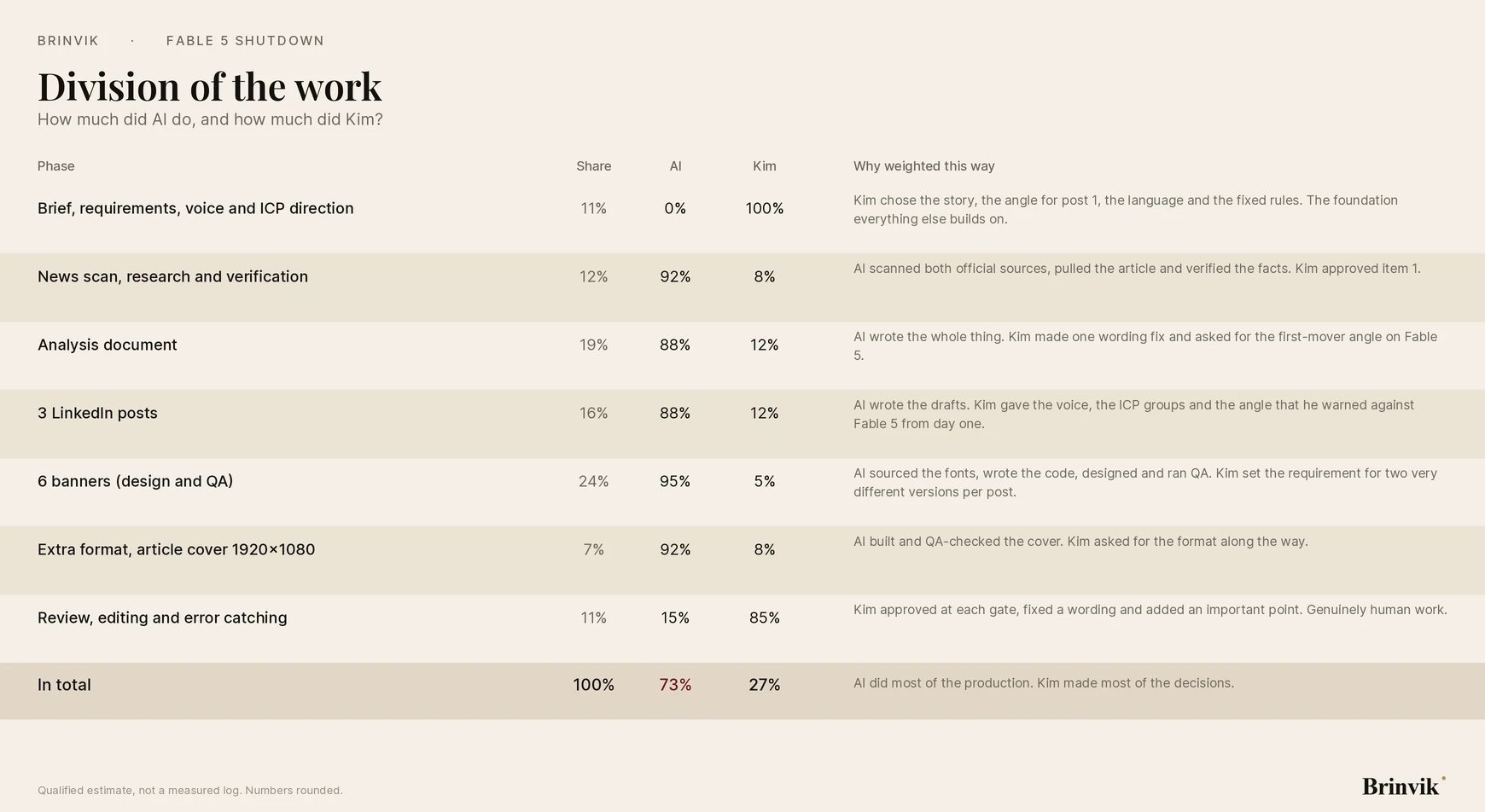
This work was produced in collaboration with AI. Overall: AI roughly 73 percent, Kim roughly 27 percent. Looking only at the production itself: AI roughly 91 percent, Kim roughly 9 percent. The human sets the direction, AI delivers the volume.
FAQ
Frequently asked questions
On 12 June 2026, Anthropic received an export control directive from the US government that cites national security and requires access to be cut off for all foreign nationals. To comply, Anthropic switched off both models for all customers globally. Anthropic is complying with the directive but disagrees with the decision. The account is Anthropic's own and is not independently verified.
Yes. Opus 4.8, Sonnet 4.6 and Haiku 4.5 keep running as normal. Only Fable 5 and Mythos 5 are suspended. If you used one of the two, you can move heavy tasks to Opus 4.8 and most daily work to Sonnet 4.6.
Switch any workflows from Fable 5 or Mythos 5 to an available model, and test on a real task before you announce it. Then write model choice and an alternative into your governance, so a future switch is quick. Also check whether you sent sensitive data in under the Mythos-class 30-day retention policy.