On 30 June 2026 Anthropic announced that the US export controls on Claude Fable 5 and Mythos 5 have been lifted. Export control is a government restriction on who may access a technology. From today, 1 July, Fable 5 is back for users worldwide.
This is the end of a story that began on 12 June, when access was shut off from one day to the next. But the real lesson is not the drama itself. It is that access to a model can vanish overnight, for reasons that have nothing to do with you.
So at heart this is a question of preparedness and of GDPR compliant AI consulting: never build a business-critical workflow on a single model alone.
Anthropic: Redeploying Fable 5 (30 June 2026) →
Fable 5 is back worldwide from 1 July. For Pro, Max, Team and select Enterprise it is included for up to half of weekly usage through 7 July, then via usage credits. Mythos 5 is restored only for a set of US organisations.
What actually happened
Fable 5 and Mythos 5 launched on 9 June. They share the same underlying model, but Fable 5 shipped with strong safeguards so it was safe for general use. Mythos 5, with fewer safeguards, went only to a small set of trusted partners for defensive cyber work.
On 12 June the export control arrived. The background was a report in which researchers at Amazon had found a way to bypass Fable 5 safeguards and, in one case, got it to write code demonstrating how a vulnerability could be exploited. Because the order took effect immediately and Anthropic could not verify nationality in real time, they shut off both models entirely.
Here is the most important detail. Anthropic own testing showed that several weaker models could find the same vulnerabilities, including Opus 4.8 and models from other vendors. So the reported technique exposed no unique capability, and according to Anthropic it concerned routine, defensive cyber work. Anthropic still trained an improved safety classifier, a smaller AI system that monitors and blocks dangerous requests. According to Anthropic the new classifier blocks the technique in over 99 percent of cases, and a blocked request is routed to Opus 4.8 instead. The US Department of Commerce Center for AI Standards and Innovation, CAISI, has tested the safeguards and judges them very strong.
It is worth being clear that this whole security account is Anthropic own telling. It is well documented, but it is not an independent third-party audit.
How Anthropic thinks about safeguards
To understand why the case arose at all, it helps to know Anthropic approach. They describe it as defense in depth, several layers of security where no single layer is perfect but the whole is hard to break. A central layer is classifiers that, during a conversation, detect when the model is asked to perform a potentially dangerous cyber task, and then block the response.
To be on the safe side, Anthropic deliberately sets the classifier to also block a share of requests that are probably harmless. They call this a safety margin. A request has to look very clearly safe to get through, and for Fable 5 they made that margin larger than ever before. Users experience it as a model that occasionally refuses a reasonable, harmless request. In return, fewer genuinely dangerous responses slip through. It was inside that margin that the reported technique landed.
Anthropic classifies jailbreaks by severity. Most are narrow: they unlock a single, specific behaviour and nothing more. A narrow harmful jailbreak opens a particular dangerous behaviour. The most serious is a universal jailbreak, which opens a whole class of dangerous behaviour at once. According to Anthropic, the jailbreaks of Fable 5 found so far fall in the least severe category, and no universal one has been found. That is their assessment at the time of writing, not a guarantee, and experts continue to red-team the model.
Here is my take
Here is my take, and I flag it as opinion, not fact.
Never run a critical workflow on a single specific model. If your business stops the day one model becomes unavailable, you have a single point of failure you can remove yourself. Build with an alternative in mind from the start.
And read the security narrative for what it is. The figures about over 99 percent blocking and CAISI endorsement are Anthropic and its partners telling of an episode they were in the middle of. It is a reasonable account, but present it as their position, not as a neutral fact, if you use it internally or in front of an auditor.
A shared industry framework for jailbreaks
Anthropic uses the moment to propose a shared industry framework together with Amazon, Microsoft, Google and others. A jailbreak is a technique that bypasses a model built-in safeguards. Today there is no common standard for how severe a jailbreak is, which makes it hard for developers and governments to know when to act.
The proposal scores a jailbreak on four things: how much further it takes an attacker than existing tools, how broadly it works, how easily it can be turned into a real attack, and how easily it can be found. It is a sensible step, but it is early, and it is a proposal, not an adopted standard. For you as a company, the most relevant signal is that security around the strongest models is now becoming a shared concern for the whole industry.
Deeper collaboration between government and industry
Anthropic also uses the moment to deepen its collaboration with the US government. They promise early access to models and safeguards for designated government partners before broad release, faster sharing of information about misuse and new safeguards, and joint research on AI security. They are also standing up a team that monitors the main channels for jailbreak submissions around the clock, and a new HackerOne program where security researchers can submit jailbreaks found in Fable 5.
For a European company, that part is most interesting as a signal. The rules for the strongest models are being written, and they are being written in an interplay between government and industry. It is worth following, because it will shape which models are available when, and on what terms. It only underlines the point: plan for the terms to change.
What it means for Nordic B2B SaaS
For a Nordic B2B SaaS company this is a direct operational risk, not just news. If your product builds on a specific model, think about what happens if that model becomes unavailable for a week. The answer is a layer of abstraction between you and the model, so you can switch to an alternative without tearing the product down.
That is a concrete architecture decision. Build your integration so the model can be swapped in one place in the code, not a hundred. Put it in now, while it is cheap, rather than during a shutdown. This is exactly the kind of resilience I help companies build in from the start.
What it means for telemarketing and sales teams
For a sales or telemarketing team the question is simple: what happens to your customer-facing agent if the model behind it disappears temporarily? An AI agent that qualifies leads or follows up on your website must not stall because a single model is shut off.
Have a plan B ready. In practice that means a setup where the agent can fall back to another model without losing the thread of the conversation. It is a small investment that keeps the pipeline from drying up on a bad day, and that ensures a lead never meets an agent that has gone dark.
What it means for professional services firms
For law firms, accountants and consultancies this lands straight in what an audit asks: what happens if a critical supplier falls away? The Fable 5 shutdown is a concrete example you can write into your risk assessment and continuity plan.
This is not about avoiding AI. It is about documenting which workflows depend on which models, and what the plan is if one of them disappears. That documentation is worth its weight the next time you sit through a SOC 2 or ISO 27001 review, where vendor dependence and continuity are among the first things asked about.
What it means for founders and scale-ups
For a founder team there are two things. One, availability is not a given, and it is not the same from region to region. Fable 5 is global again, while Mythos 5 is restored only for select US organisations. Do not build a product on access that can change or is tied to a region.
Two, if you work in cyber security, it is worth reading Anthropic description of the safety margin and classifiers, because it explains why legitimate, defensive tasks sometimes get blocked. That is useful knowledge when you have to explain to your own customers why a model refuses something it could handle.
GDPR, continuity and what applies to Nordic companies
This episode is a free case study in two things an audit cares about: continuity and vendor dependence. Write it into your plan: which workflows depend on one model, and what is the plan if it disappears for a week.
Watch the region too. The reopening happens first on Claude own platforms and then gradually on AWS, Google Cloud and Microsoft Foundry. If you run through a specific cloud for EU processing, your timeline may differ from the headline. For Nordic companies the usual path to data residency is to run Claude through AWS Bedrock or Google Cloud Vertex AI in an EU region. Settle that before you plan around 1 July.
If you want continuity, vendor dependence and data residency under control before you put a model into production, that is exactly what I do for companies. See external AI lead on retainer, or write to me if you want a plan that holds up to an audit.
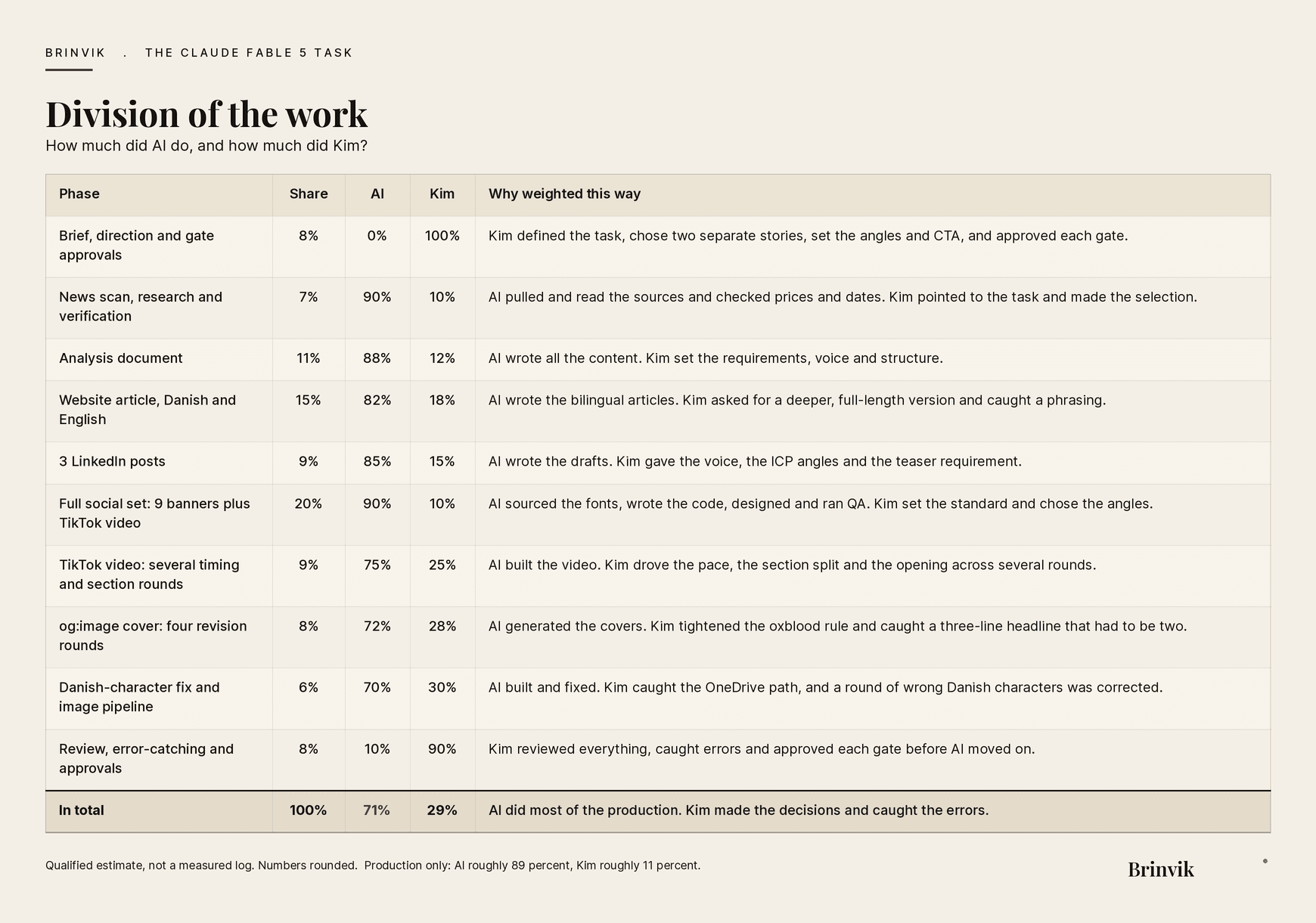
This work was produced in collaboration with AI. Overall: AI roughly 71 percent, Kim roughly 29 percent. Production only: AI roughly 89 percent, Kim roughly 11 percent. The human sets the direction, AI produces the volume. A qualified estimate, not a measured log.
FAQ
Frequently asked questions
Yes. From 1 July 2026 Fable 5 is back worldwide on the Claude Platform, Claude.ai, Claude Code and Cowork. For Pro, Max, Team and select Enterprise it is included for up to half of weekly usage through 7 July, then via usage credits. Access on AWS, Google Cloud and Microsoft Foundry reopens gradually.
That access to a model can vanish overnight for reasons that have nothing to do with you. Do not build a business-critical workflow on a single model alone. Map which processes depend on which models, and keep an alternative ready so a shutdown does not stop the business.
Because the US government imposed export controls after a report that Fable 5 safeguards could be bypassed. Anthropic could not verify users nationality in real time and so shut it off for everyone. Their own testing showed weaker models could do the same, and after an updated safeguard, access reopened on 30 June.
A jailbreak is a technique that bypasses an AI model built-in safeguards so it does something it was set up to refuse. Anthropic, together with several large vendors, proposes a shared framework for scoring how severe a given jailbreak is, so developers and governments can respond consistently.