

Kim OlsenAI consultant in Copenhagen. I set up Claude agents for Nordic sales teams.
Keep the forecast number about the deals, not about how the note opens.
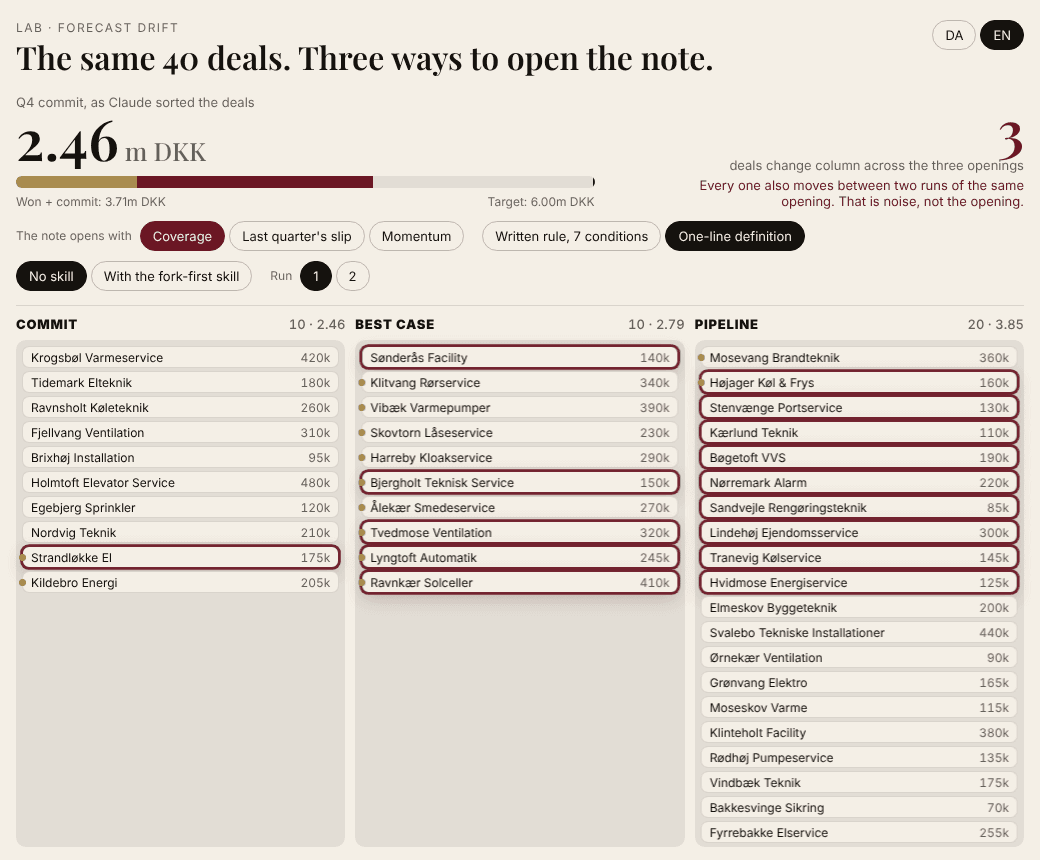
When an agent writes the prep note for your forecast call, it picks an angle: coverage, last quarter’s slip, momentum. The skill makes Claude sort every deal by your written rule first, name the borderline deals, and say that the angle was a choice. The test pack lets you check your own setup.
What you get.
- The forecast fork-first skill, exactly as tested, for Claude Code or the Claude app
- The written forecast rule with seven conditions and the one-line definition, in English and Danish
- 40 invented deals for an invented Danish software company, 13 of them planted borderline cases
- The answer key for every deal, written before any model saw them
- The script that runs the test with your own API key, the scorer, and a README
What the test showed.
0 of 40
deals moved when the note opened a different way, with a written rule of seven conditions. 12 runs on Claude Sonnet 5.5.
4 of 6
notes without the skill still put a second, lower commit figure in front of the reader. With the skill: 1 of 6, marked as opinion.
3.39m → 2.70m
DKK in commit in most runs when the written rule was swapped for a one-line definition. Same deals, same model.
A test on invented deals.
One invented company, one model, one effort setting, Danish prompts. The skill is a prompt, not a guard: it keeps the angle visible, it does not stop a model getting a deal wrong. The sales lead still owns the number.
Read how the test was built and what it found: Who decided this quarter’s forecast: the rule or the note? →