There is a machine on a Danish factory floor right now whose most important document is a ring binder sitting next to it. The weight of the robot arm is in that binder. So is the limit on how fast it may swing with a full tray. The rest is known by the technician who has looked after it for six years, and it has never been written down anywhere.
On 27 August, Anthropic published a standard about exactly that ring binder.
It is called the Model Hardware Standard, MHS for short. If you know MCP from 2024, this is the same move one floor further down. MCP made it cheap to connect an AI agent to software. MHS makes it cheap to connect one to things that can break.
The coverage has been fairly uniform: AI can run the lab now. I have read Anthropic's own page, the five partner accounts underneath it, and the QuEra and Tetsuwan blog posts on top of that. They tell a different story from the headlines, and it is a more useful one.
What MHS actually is
The Model Hardware Standard is a driver, the piece of software that sits between an operating system and a physical device and translates between them. Three things make it different.
It cuts everything down to two kinds of command. A read, "what is the temperature", and a write, "set the temperature". Any device with a programmable interface can answer that, however old or strange its own interface happens to be.
It makes the device discoverable on the network in a fixed format, so devices and agents can find each other and talk without a bespoke translator program in between.
Then there are the tags. The driver carries fields where you write the machine's characteristics in plain language. The weight of the robot arm. What it can measure. What can be adjusted. Which safety limits are enforced. You can write them yourself, or let an agent interview you about your setup. From that, the driver automatically produces a reference file containing everything an agent needs in order to operate the machine.
That is the ring binder. Written down, in one place, in text a machine can read.
Control then runs three ways: through MCP, through a command line, or through code files. When an agent has to run something long, or something faster than it can reason in real time, it chains driver commands together in a code file. The machines then execute on their own, without the agent thinking at every step.
Safety limits are enforced on the device itself, independent of the model. That detail is easy to read past. The limit lives in the hardware interface rather than in the agent's judgement.
The number everyone is quoting
Weeks or months become hours or minutes. That is the sentence that has travelled everywhere, and it comes from the partners' own accounts of their own labs.
Carnegie Mellon built drivers for a liquid handler, a plate reader, a robotic arm and monitoring cameras spread across three computers with mutually incompatible interfaces. The first is driven by dropping job files into a directory. The second through an ancient Windows COM script. The third has no programmable interface at all, only a screen, so MHS operates the graphical interface the way a person would. From raw, un-automated hardware to a finished dose-response curve, including one autonomous rerun along the way: eight hours. A vendor-delivered setup typically takes several weeks.
University of Washington. Zihao Song, a PhD student in the Baker and Pinglay labs, connected six instruments in under a week, including the time he spent writing the drivers for them.
HHMI Janelia. Virginie Ruetten describes a microscopy rig that fills an entire room and required seven programs launched in a fixed order. The detectors ran in MATLAB, the cameras in Python, the electrophysiology in C#. After MHS it took her a few minutes to add a new camera and feed its output back to the mirrors steering the laser beam.
QuEra, which builds quantum computers on neutral atoms, has the most dramatic number. A team of four had spent months on a script to recover the laser's lock. It worked about 58 percent of the time and took roughly 150 seconds per attempt. They gave Claude access through MHS and let it run overnight in a loop with four roles: one proposed a hypothesis, one wrote the change into the script, one ran it against the live laser and logged every step, one read the logbook and decided what to try next. By morning a recovery took about six seconds and succeeded 96 percent of the time. In a later blind test across 700 trials the script found the correct lock 695 times. 99.3 percent. A human at the bench takes five to ten minutes.
Every figure here is the partners' own accounting of their own work.
What every pilot ran into
Here is the part the headlines left out.
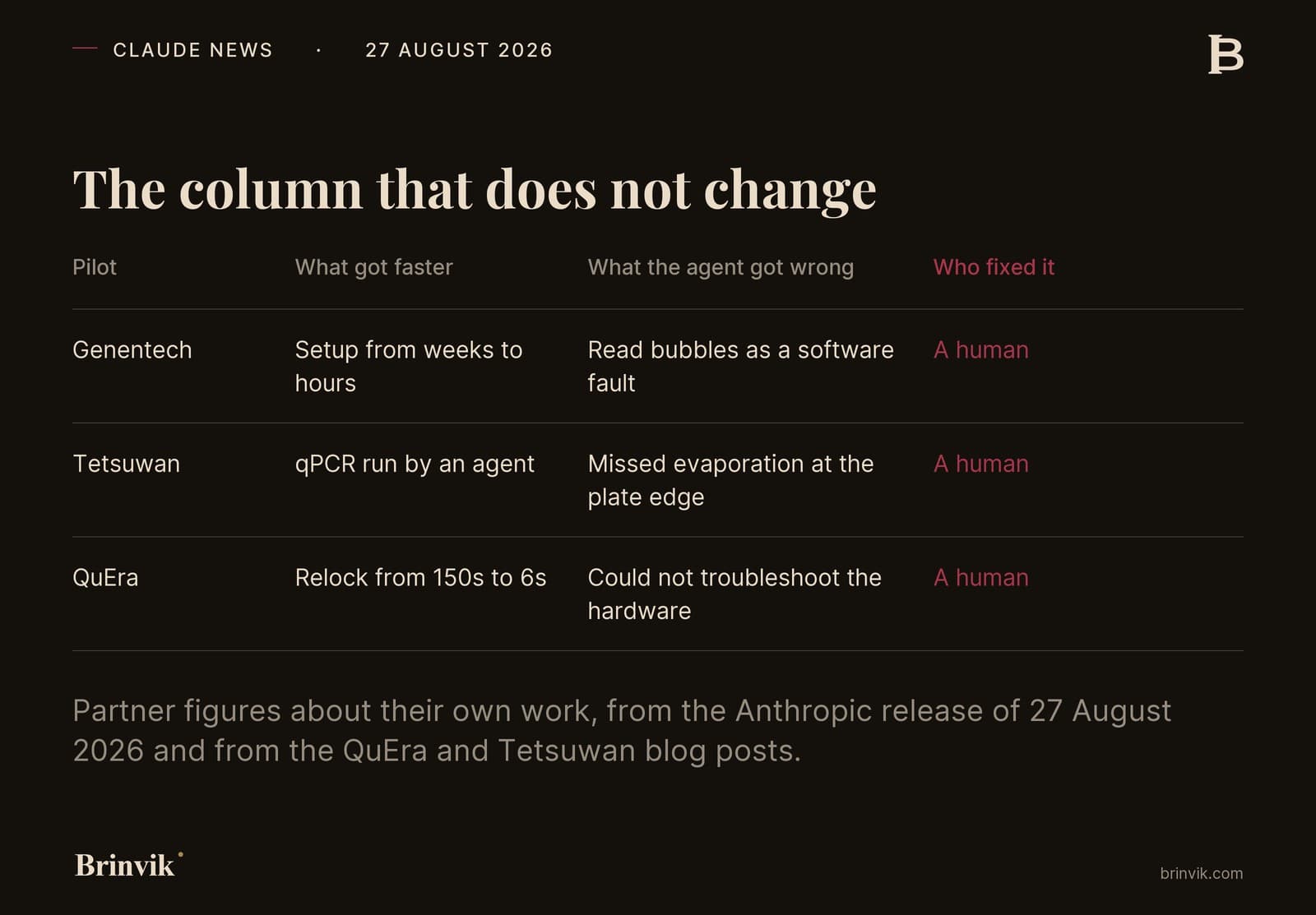
Genentech automated a BCA assay, which measures protein concentration and requires a liquid handler, a robotic arm and a plate reader working together. Claude executed the protocol, but picked the same flow rate for water and for a viscous protein solution. That produced bubbles, and bubbles wreck the measurement from three directions at once: air takes up room in the pipette tip so less liquid transfers than the protocol specifies, the liquid sensors fail when the tip meets foam instead of liquid, and the bubbles distort the optical reading that is the whole point of the experiment.
When Claude got the error code, it retried in the same well with different parameters. That agitated the liquid further and made more bubbles.
Genentech's own explanation: Claude did not understand the physics behind the failure. They had to tell it that the error code came from physical bubbles, and that it needed to move to a clean well and cut the number of mixing cycles. After that it held on to the knowledge for the rest of the run, and they wrote the lesson into reusable skills so it would pick sensible starting parameters for liquids with different physical properties.
Tetsuwan Scientific, which is building an automated biology lab, describes the same thing from another angle. Their agent struggled to reason about physical effects such as evaporation and needed a fair amount of prodding and correction. When they worked through their measurements, about a third of the variation they had attributed to pipetting turned out to be evaporation from the edge of the plate.
QuEra, which has the prettiest number in the entire release, puts it most directly. Claude did not know how to troubleshoot when something went wrong with the physical hardware, because its understanding of the rig was programmatic rather than physical. It often stopped and waited for human approval before doing anything it judged even slightly risky, so experiments could sit idle overnight while it waited. On their own blog they write that the human role of setting the scope, reviewing every step and deciding what counts as proof became more important, not less. They name their technical lead, Evgeny Ostroumov, who repeatedly caught the agent before it spent effort on something that looked right and was not.
Anthropic says it themselves, in the section on joining the preview: Claude learns about the physical world through text and images, so its spatial and physical reasoning has limitations that still require expert oversight.
Four independent teams. The same finding. Integration was the visible cost, and it fell by two orders of magnitude. Judgement about the physical world was the real cost, and it did not move an inch.
Universal Robots is on the list
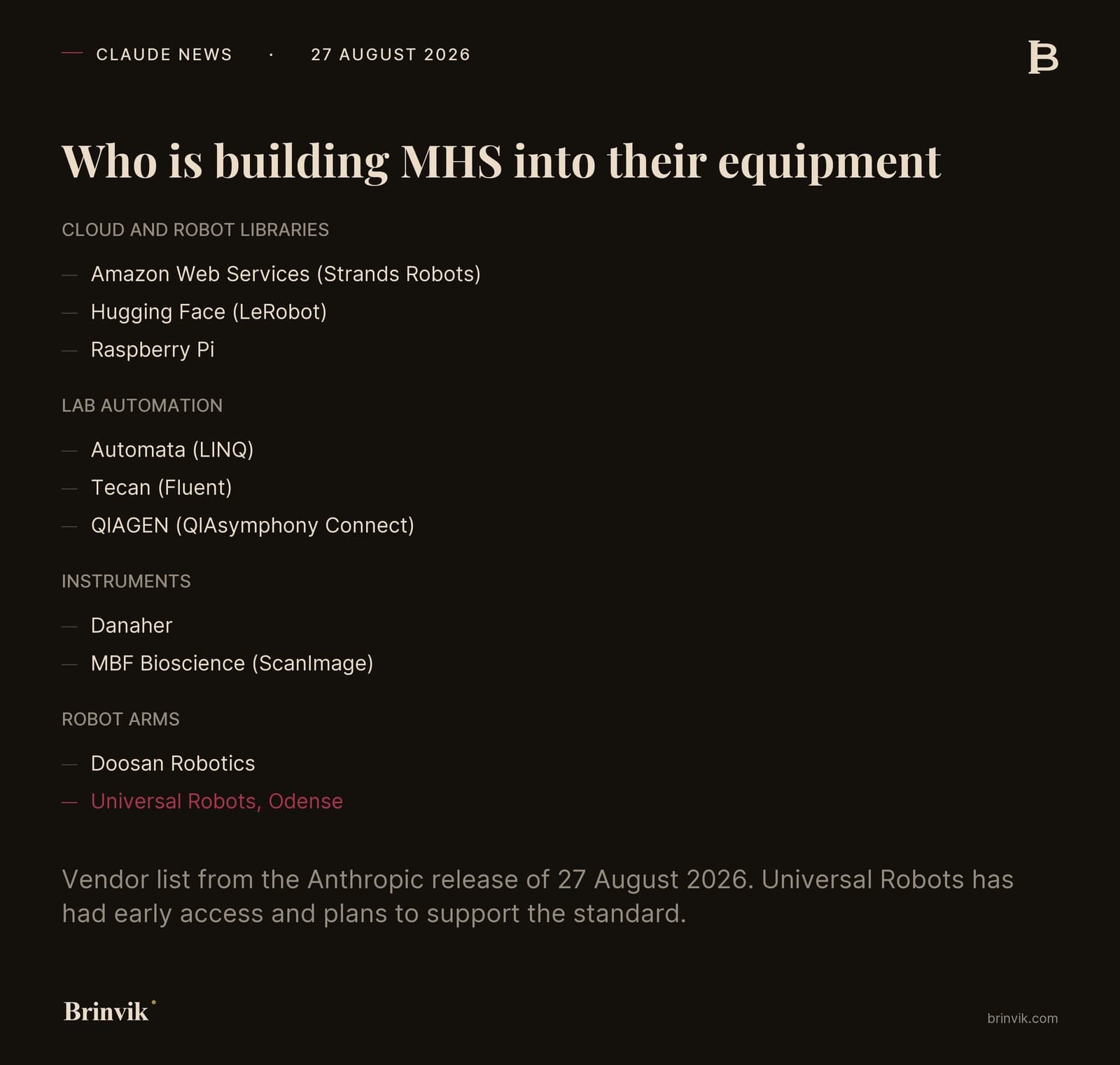
Among the vendors building MHS support into their equipment sits Universal Robots. The cobot company from Odense, owned by American Teradyne since 2015. It has had early access to the standard and plans to support it on its robotics platform.
The rest of the list: Amazon Web Services through Strands Robots, Automata in their lab automation platform LINQ, Danaher, South Korean Doosan Robotics, MBF Bioscience in ScanImage (the software running laser-scanning microscopes in hundreds of neuroscience labs worldwide), QIAGEN on their QIAsymphony Connect, and Tecan on their Fluent platform. Hugging Face is adding MHS to their robotics library LeRobot, and Raspberry Pi is working across several products after a successful test of their camera driver.
That is the Danish hook in this story, and it is more concrete than it looks. A Danish manufacturer cannot go out and buy MHS today. It is a preview with a waiting list. But the interface between physical machines and AI agents is being defined right now, by a group you have to apply to join, and the vendor standing in a great many Danish production halls has a seat at that table.
A standard nobody can read is still a product
The word standard is doing heavy lifting in this release, and I think it is worth watching.
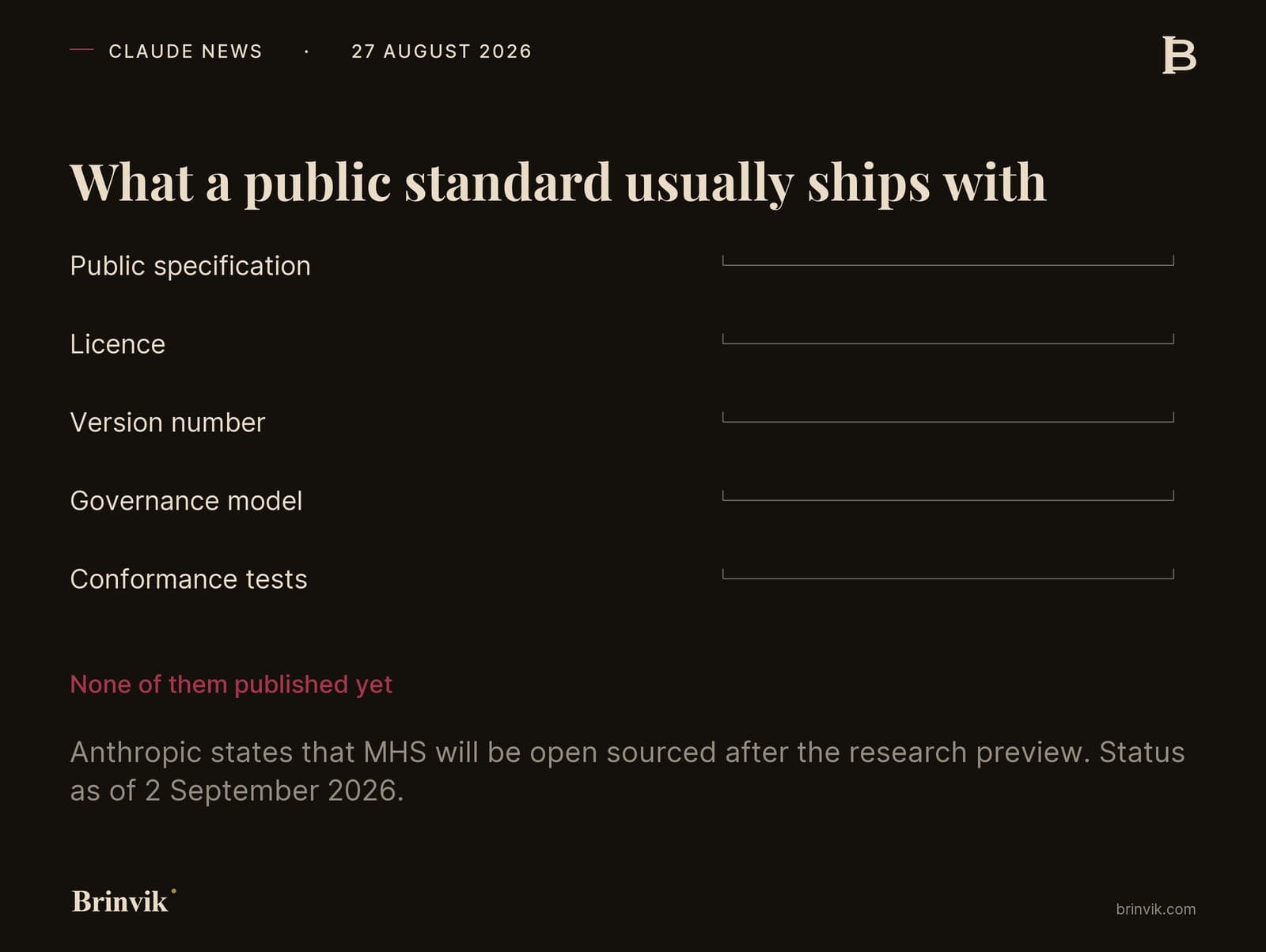
There is no public specification. No schema, no licence, no version number, no governance model, no conformance test, no reference implementation you can read. Anthropic says they will open source it once they are finished, and that they are using the preview to build safety evaluations together with the partners first. That is a sensible order of operations. It just does not make MHS a standard yet. It makes it a product with a statement of intent.
Model independence is a claim about design rather than something demonstrated. Anthropic writes that any agent harness can access MHS through standard protocols. Every single detailed pilot in the release ran on Claude.
Then there are the standards that already exist. The lab world has SiLA 2. Industry has OPC UA. Robotics has ROS 2. Anthropic does not describe how MHS relates to any of them. There is a real difference that works in MHS's favour: the existing standards were built for machines talking to machines, deterministically, with schemas defined ahead of time. Writing down in plain language how heavy a robot arm is and which actions are dangerous, so a model can read it, is not something they do. But in April 2026 the OPC Foundation announced it is preparing over 430 of its companion specifications for RAG and MCP. They are moving toward the same junction from the other side, carrying twenty years of conformance work.
If I got to pick what I saw next, it would not be more partner results. It would be one of these pilots reproduced by somebody outside the list, on a different model.
What becomes scarce when connecting things is free
This is the second time in under two years that Anthropic has standardised the connective tissue and given it away. MCP did it for software. The Model Hardware Standard does it for physical things. The pattern says something about where the value moves.
When a cost falls by two orders of magnitude, the work does not disappear. It moves to whatever did not fall. Across all five partner accounts it points at the same place: the person who can explain why the machine failed.
That mechanic holds even if you never go near a liquid handler. It is the same for an order flow, an invoice check or an onboarding process. Once integration gets cheap enough that you automate something you had not automated before, the question stops being whether it is technically possible.
Try this against your own list. Write down the processes you plan to hand to an agent. Put a name next to each one: who in the building could explain why it went wrong, if it went wrong at three in the morning. Not who owns the process, and not who wrote it down. Who understands why.
The lines with no name against them are the ones to deal with first. Not because the automation will necessarily fail, but because nobody will see it when it does.
It is the same boundary I wrote about yesterday in connection with auto mode in Claude Code, moved out into the physical world. There it was about what an agent may do in your systems without asking. Here it is about something that can tip over a tray.
It is also exactly the kind of work I do as an external AI lead on retainer: working out where the line sits, writing it down, and making sure there is a name against every row.
If one sentence from this whole release belonged on a slide, it would be this. Make integration free, and the bottleneck moves to whoever knows why the machine failed.
Sources
Anthropic: Previewing the Model Hardware Standard (27 August 2026) →
modelhardwarestandard.com: apply for research preview access →
QuEra: Holding the light, teaching an AI to lock and tune our quantum computers lasers →
Tetsuwan Scientific: MHS and ResearchOS →
Anthropic: Model Context Protocol (MCP) →
Fortune: Anthropic makes first move into physical AI →
CNBC: Anthropic pushes into physical world with new standard →
Universal Robots: about the company in Odense →
FAQ
Frequently asked questions
A shared specification from Anthropic that lets AI agents operate physical equipment such as microscopes, liquid handlers and robotic arms. It works through a standardised driver that reduces every device to read and write commands, makes it discoverable on the network, and lets the user describe the machine's characteristics and safety limits in plain language. It was published on 27 August 2026 as a research preview for a first group of research labs and advanced manufacturers.
MCP connects an AI agent to software and data. MHS connects it to physical devices. MHS can be reached through MCP, so the two work together rather than competing. Anthropic's Alek Kemeny has described MCP as something like a USB port for the connection between AI and software, and MHS is the same idea applied to hardware.
Not freely. It is a research preview with a waiting list, and you apply for access through modelhardwarestandard.com. Anthropic has opened it to a first group of scientific labs and advanced manufacturers, and is working with hardware vendors to build support into their equipment.
Not yet. Anthropic says it will be open sourced, but that they will first use the research preview to build safety evaluations and best practices together with the partners. There is currently no public specification, licence, governance model or conformance test.
Anthropic describes the standard as model-agnostic and writes that any agent harness can access it through standard protocols. That is a claim about design, though: every single detailed pilot in the release was run with Claude, and no results from another model have been published.
Anthropic does not describe how MHS relates to them. The real difference is that the existing standards were built for deterministic machine-to-machine communication with schemas defined ahead of time, while MHS lets the user describe physical characteristics and hazard limits in plain language so a model can read them. In April 2026 the OPC Foundation announced it is preparing over 430 companion specifications for RAG and MCP, approaching the same junction from the other side.
Anthropic names Amazon Web Services (through Strands Robots), Automata, Danaher, Doosan Robotics, MBF Bioscience, QIAGEN, Tecan and Universal Robots. Hugging Face is adding support in the robotics library LeRobot, and Raspberry Pi is working across several products after testing their camera driver.
Two things at once. Integration time fell dramatically: Carnegie Mellon went from raw hardware to a finished dose-response curve in eight hours against a typical several weeks, and QuEra took laser recovery from 58 percent at 150 seconds to 99.3 percent in seconds. At the same time every team hit the same limit, which is the model's grasp of physics. Genentech had to explain to Claude that bubbles were a physical problem rather than a software fault, Tetsuwan found that a third of their variation was evaporation, and QuEra writes that human oversight became more important rather than less.