TL;DR: Claude Haiku 5.5 arrived on 7 October at a tenth of Haiku 4.5's price per token, and on the same day Anthropic announced a monthly API credit for Max and Team plans. I had Claude Code give both Haiku models 300 invented enquiries from a Danish contact form to sort. Haiku 5.5 put 291 in the right pile, Haiku 4.5 299. The two disagreed on 10 enquiries, and every mistake was among them. Sort with two models and read only the ones they disagree on. The prompt, the test enquiries and the script are free: download the zip.
The film shows one of the ten disagreements. In the demo below you can click through all 300 enquiries with seven different sorters and see how far the monthly credit goes.
On 7 October Anthropic launched Haiku 5.5, its new small model and, at list price, its cheapest. It costs $0.10 per million input tokens and $0.50 per million output tokens, against $1 and $5 for Haiku 4.5. Anthropic recommends it for high-volume work where each task is narrow, and names classification as one example.
The same day, Anthropic announced a monthly API credit for Max and Team plans: $100 on Max 5x, $200 on Max 20x, and on Team $20 per Standard seat and $100 per Premium seat, pooled into one balance capped at $500. Free, Pro and Enterprise plans don't get it. It covers the API, the Batch API, Claude Managed Agents, the Agent SDK and the Playground, not interactive Claude Code. It expires at the end of each billing period, and what you don't use is gone.
If you have a Team plan and a contact form, sorting enquiries is an obvious first job for that credit. So I had Claude Code write 300 invented enquiries to an invented Danish firm, Vagtly ApS, which sells shift planning to cleaning and care companies. Six piles, 50 enquiries in each, and an answer key that Claude Opus 5.5, reading every enquiry blind, agreed with on all 300 before a single model was scored.

What does it cost to have Claude sort your enquiries?
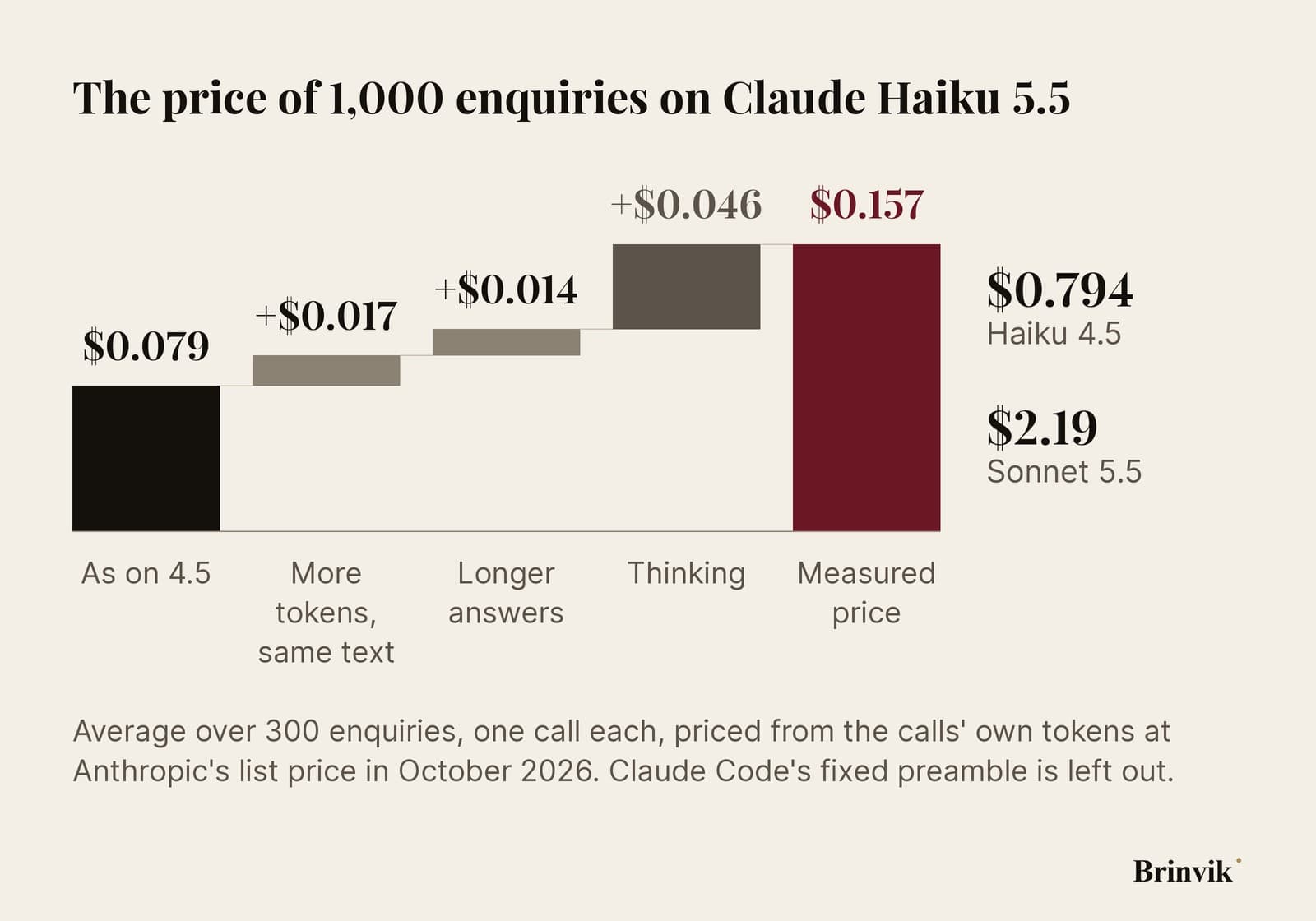
Each enquiry was sent on its own with the same prompt, and the price is worked out from each call's own tokens (the small chunks of text a model is billed by) at Anthropic's list price. Sorting 1,000 enquiries cost $0.157 with Haiku 5.5, $0.794 with Haiku 4.5 and $2.19 with Sonnet 5.5.
At list price, Haiku 5.5 is ten times cheaper than Haiku 4.5. Here it came out at about 5.1 times, for two reasons. The new tokenizer, which Anthropic flags in its migration guide, split the same text into a third more tokens in this test. And Haiku 5.5 thinks by default: of its 181 output tokens per enquiry, 93 went on thinking, while Haiku 4.5 answered in 59.
Effort, the setting for how much the model thinks before it answers, is the obvious place to save, and Anthropic itself suggests low effort for simple, high-volume requests. Here low effort saved 10 percent and put 285 in the right pile against 291. High effort got 293.
Price shouldn't decide it. A single Standard seat on Team brings $20 a month, which covers about 127,000 enquiries on Haiku 5.5. Even 5,000 enquiries a month cost under $1. Knowing which of them the model put in the wrong pile matters far more.

Haiku 5.5 and Haiku 4.5 disagreed on 10 of 300 enquiries
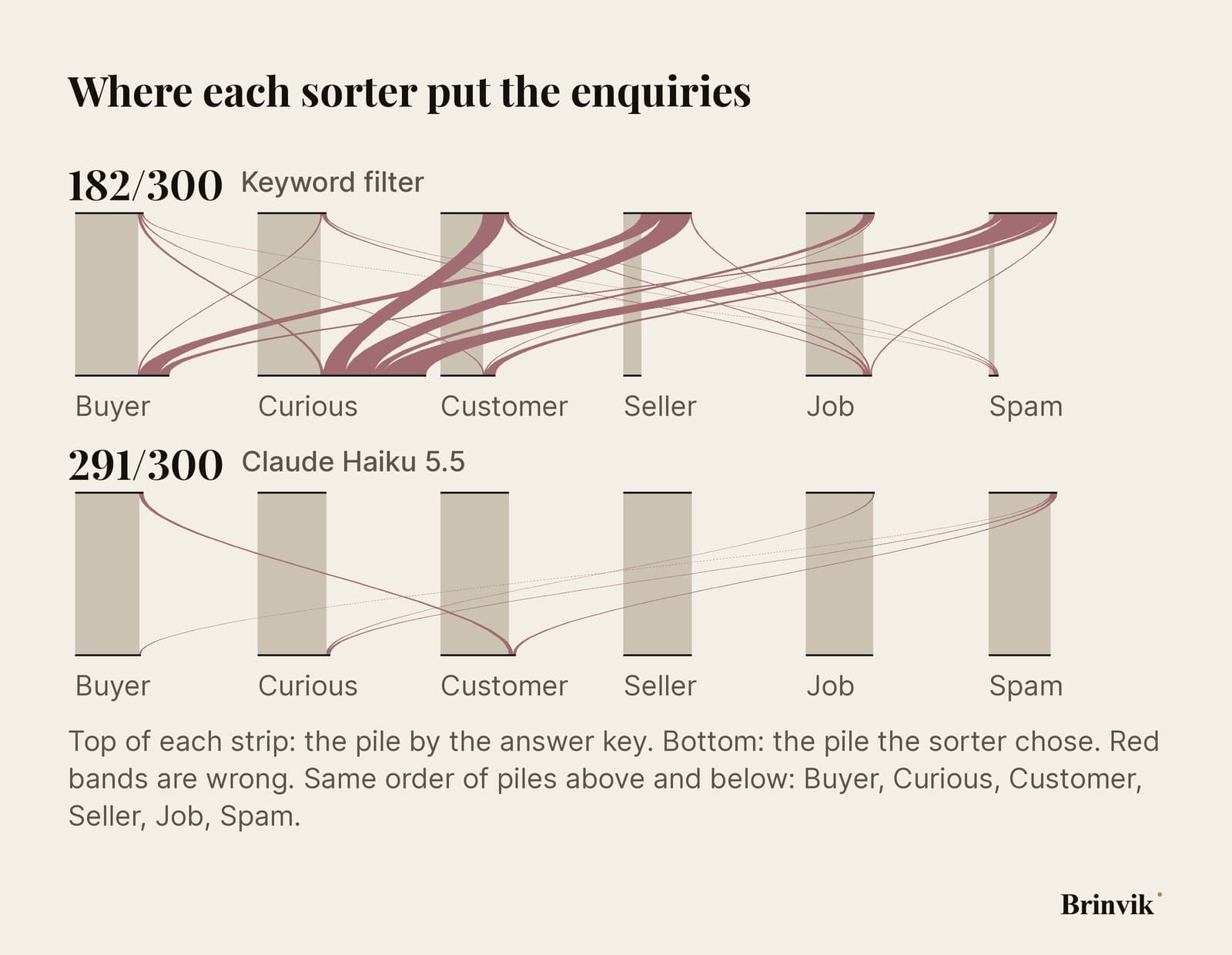
Haiku 5.5 put 291 of 300 in the right pile. Haiku 4.5, the previous Haiku model, put 299. Sonnet 5.5 got all 300. So the newest and cheapest model wasn't the most accurate on this job.

The two Haiku models disagreed on 10 enquiries, and all 9 of Haiku 5.5's mistakes, plus Haiku 4.5's one, were among those 10. There was no enquiry where both got it wrong. If you read only the enquiries the two disagree on, you read 10 of 300 and find every mistake.
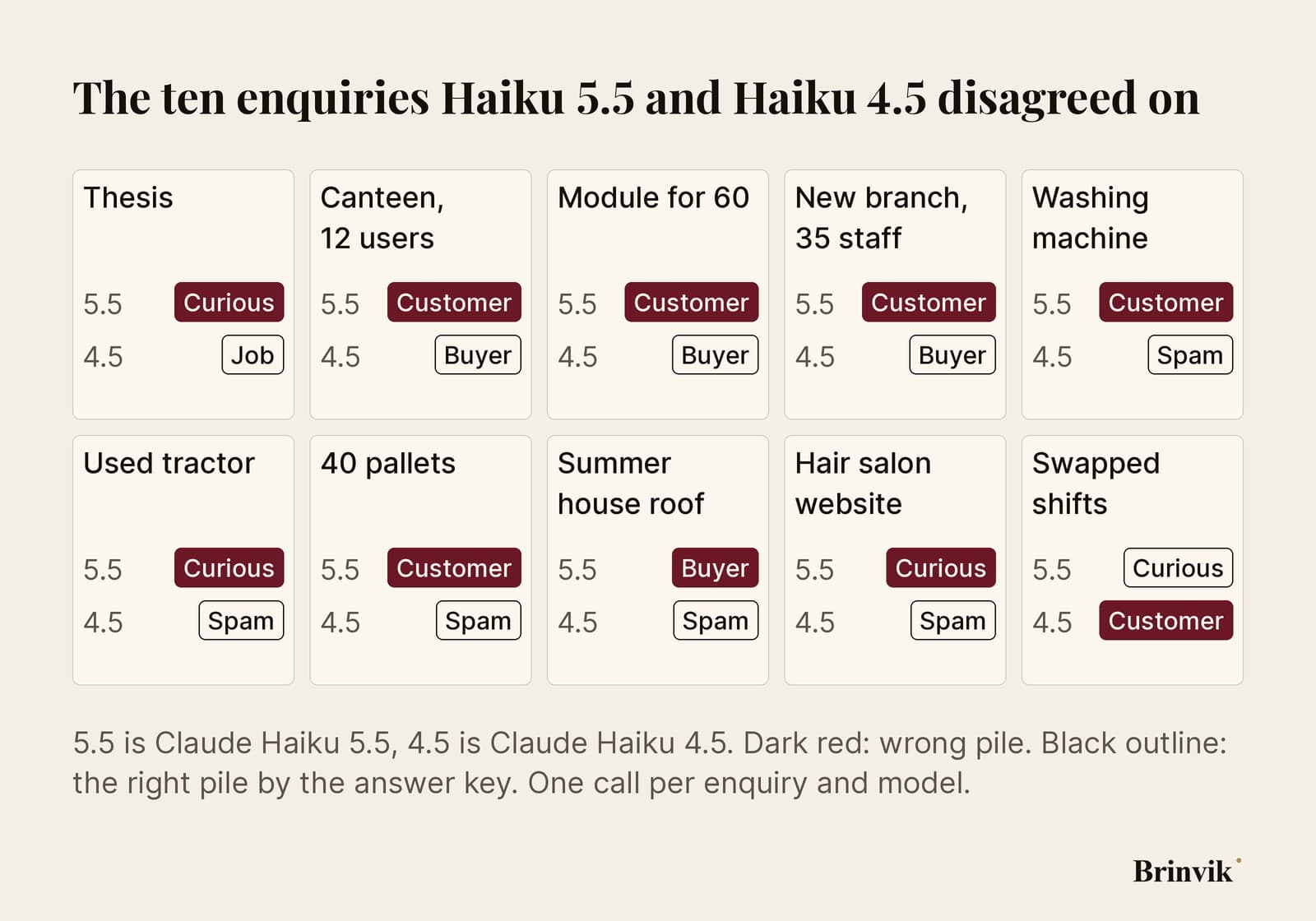
Haiku 5.5's nine mistakes came in three kinds. Five enquiries were plainly written to a different company: one wanted a washing machine repaired, one was looking for a used tractor, one confirmed a delivery of 40 pallets, one wanted a new website for a hair salon, and one wanted a new roof on a summer house. Haiku 5.5 filed them as Customer, Curious and Buyer. For the summer house, it suggested arranging an inspection of the roof.
Three were existing customers wanting to buy more: a module for 60 staff, a new department in Aarhus with 35 people, a canteen with 12 users. Haiku 5.5 put all three in Customer, which means the support queue, even though the prompt says a customer who wants to expand is a buyer. The last was a student who wanted to write a thesis, filed as Curious instead of Job.
Haiku 4.5's one mistake was an enquiry about seeing who has swapped shifts, which it filed as Customer instead of Curious.
Agreement isn't proof. Two models can make the same mistake, and then it slips through unseen. That didn't happen once in this test, but it's why the method finds mistakes rather than vouching for everything else.
To see whether the pattern held, Claude Code wrote 60 new enquiries afterwards: 20 customers wanting to buy more, 20 enquiries meant for other companies and 20 ordinary support cases. Haiku 5.5 sorted 57 right, Haiku 4.5 59. They disagreed on 4, and all 4 mistakes were among them again. This time Haiku 5.5 sorted all 20 customers who wanted to buy more correctly. The mistake with other companies' enquiries came back, though: two about a sofa and one about a pair of hiking boots ended up in Customer.
A keyword filter managed 182 of 300. It sent 15 sellers and 7 spam messages to Buyer, five of them meant for other companies, because they used words like quote and price.
Once you've seen what kind of mistake the model makes, you can write it into the prompt. Claude Code added two lines right after the pile descriptions, as checks in order: is the enquiry about this company at all, and does a customer want to buy more? With them, Haiku 5.5 put 298 of 300 in the right pile, and all 60 of the new enquiries. The lines were written after reading the mistakes, which is why they were tried on the 60 new enquiries before they went into the zip. They cost about 23 percent more per enquiry, because the prompt gets longer and the model thinks more.

How to run the test on your own inbox
The zip has the prompt with and without the two lines, the 300 test enquiries, the answer key and a small Python script, sort_inbox.py, that sends the enquiries to Claude, shows the piles and finally counts the mistakes, tokens and price. It runs on the API with a key from the Console organisation your credit lands in. Run the same job through Claude Code signed in with your plan, and it draws on the plan's limits, not on the credit.
- Rewrite the first paragraph of the prompt for your own business, and the piles for the ones your team works from.
- Export 200 real enquiries from your form or inbox.
- Run them through two models, for example Haiku 5.5 and Haiku 4.5.
- Read only the ones the two disagree on, and decide who's right. That's your answer key for the mistakes that cost something.
- Write the mistake you see most into the prompt as a check right after the piles, and run it again.
- Give the job its own workspace with a spend limit, and send the monthly run through the Batch API, which costs half.
The test doesn't show everything. The enquiries are invented, short and clear, and a real inbox is messier. Each enquiry was run once per model, so a difference of one to three mistakes could be chance. The calls went through Claude Code and are priced as API calls, not billed. And the test says nothing about speed, because the machine was under heavy load at the time.

A website AI agent that sorts your enquiries
As an AI consultant, I set up AI agents that take enquiries from the website, sort them and create them in HubSpot: an AI lead qualification agent, which is what this test stands in for. The hard part is rarely the model. It's agreeing on the piles, wiring two models into the form and the CRM, and deciding who reads the enquiries the models disagree on, and how fast.
That's AI workflow automation that ends in a HubSpot AI integration, and it's what a website AI agent does. Send me your six piles and three real enquiries with the names removed, and I'll tell you what the prompt needs to handle. If you want to see how the choice of model depends on the job, read the Sonnet 5.5 vs Opus 5.5 test.
FAQ
Frequently asked questions
Haiku 5.5 costs $0.10 per million input tokens and $0.50 per million output tokens when the prompt is under 100,000 tokens. Above that it costs $0.50 and $2.50. Through the Batch API the price is halved.
In this test, 1,000 enquiries cost about $0.16 with Haiku 5.5, $0.79 with Haiku 4.5 and $2.19 with Sonnet 5.5 at list price. Thinking and the new tokenizer make Haiku 5.5 dearer per enquiry than the list price alone suggests.
No. The Max and Team credit covers the API, the Batch API, Claude Managed Agents, the Agent SDK and the Playground. Interactive Claude Code and extra usage in the Claude apps aren't covered, and claude -p only counts with an API key from the organisation the credit is linked to.
At the end of each billing period. Unused credit doesn't roll over. On Team, each Standard seat brings $20 and each Premium seat $100, pooled into one balance capped at $500 a month.
In this test, Sonnet 5.5 sorted all 300 right, Haiku 4.5 299 and Haiku 5.5 291. The price is so low for all three that it rarely decides it. Run two models and read the ones they disagree on: in the test, every mistake was there.
On the 300 Danish test enquiries, Haiku 5.5 sorted 291 right. The mistakes weren't about language. Eight of the nine were enquiries written to a different company or from customers wanting to buy more.
If the organisation has other credits, usage carries on with those. Otherwise API calls stop until next month's credit arrives, and nothing is charged to your Claude plan.
Sources
- Anthropic: Introducing Claude Haiku 5.5 (7 October 2026)
- Claude Platform Docs: API credits for Max and Team plans
- Claude Help Center: Monthly API credits for Max and Team plans
- Claude Platform Docs: Pricing
- Claude Platform Docs: Effort
- Claude Platform Docs: Claude Haiku 5.5 migration guide
- Brinvik: lead-sorter-kit, the README for the prompt, the test enquiries and the script