Take the list of systems you actually run. In a Danish company of thirty-five people that's usually an accounting package, a payroll system, a CRM, maybe a webshop, and Microsoft 365.
Now take the list Anthropic published on 15 September: Shopify, Salesforce, TikTok, Atlassian, Zoom, Xero and Gusto (accounting and payroll), Square, Stripe and Zapier.
Put the two lists side by side before you read on. It takes thirty seconds, and it's the only exercise in this article that decides anything.
Because the number that decides anything isn't 43. It's how many of your own five systems are on the other list. Working out what the rest cost takes an hour, and that hour is written out at the bottom.

The number everyone is going to quote
Claude for Small Business isn't new. A Claude implementation that starts today starts from a product that launched on 13 May 2026 as a package of 15 ready-to-run workflows, 15 skills and seven integrations. A workflow is a finished recipe: Close the Month reads through the ledger, finds what doesn't reconcile, and writes the monthly report. The seven integrations were Intuit QuickBooks, PayPal, HubSpot, Canva, Docusign, Google Workspace and Microsoft 365.
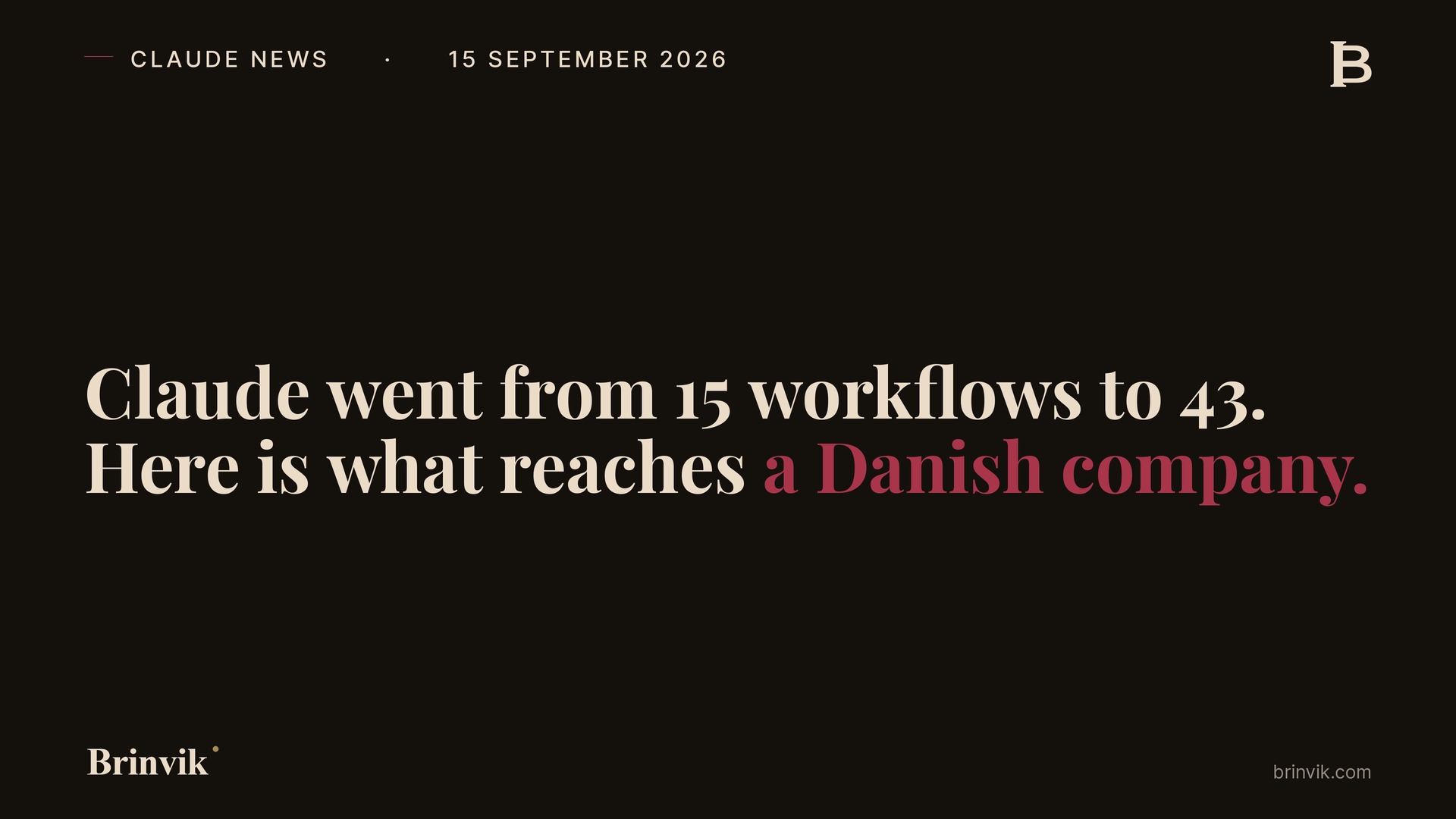
On 15 September 2026 it's 43 workflows and 27 new integrations. Anthropic adds that the package has been installed more than 900,000 times since May. That's Anthropic's own figure about Anthropic's own product.
It runs on every paid Claude plan, and Anthropic recommends Team for businesses with more than one person. The prices are on their own pricing page: Pro is $17 a month billed annually and $20 billed monthly, a Team seat $20 and $25.
There's something in that jump the counts don't show. Two of May's seven already touched money: Intuit QuickBooks and PayPal. The other five were documents, files and a CRM. Then look at what arrived in September: Shopify, Xero, Gusto, Square, Stripe. Orders, books, payroll and payments.
The product went from seeing an invoice to seeing the whole chain. That's a bigger change than 15 to 43, and it's what turns the integration question into something other than a technical detail.
900,000 is a healthy number, and what it counts is installations, not workflows that are running.

The number in the other post
Five days before the launch, Anthropic published something else. It's written by their US SMB team under Lina Ochman, with Tenex as build partner, and it does something vendors rarely do: it measures how it went when they did the teaching themselves.
They ran workshops in ten US cities in May and June. More than 1,000 owners and operators came through. Eighty percent of registrants run companies with 5 to 50 employees, and the industries skewed toward the physical economy: construction, manufacturing, logistics, trades, and the professional services firms that serve them. That's why the numbers carry across to Denmark at all. These aren't US enterprises, they're companies the size of yours.
Before the launch they'd surveyed 503 small business decision-makers, and 81 percent said they were open to new AI tools. Keep that one, because it closes off the easy explanation. What's missing isn't willingness.
Two questions in three were about running the business. The third was about growing it. Reporting was the single most common use case, outside of marketing work.
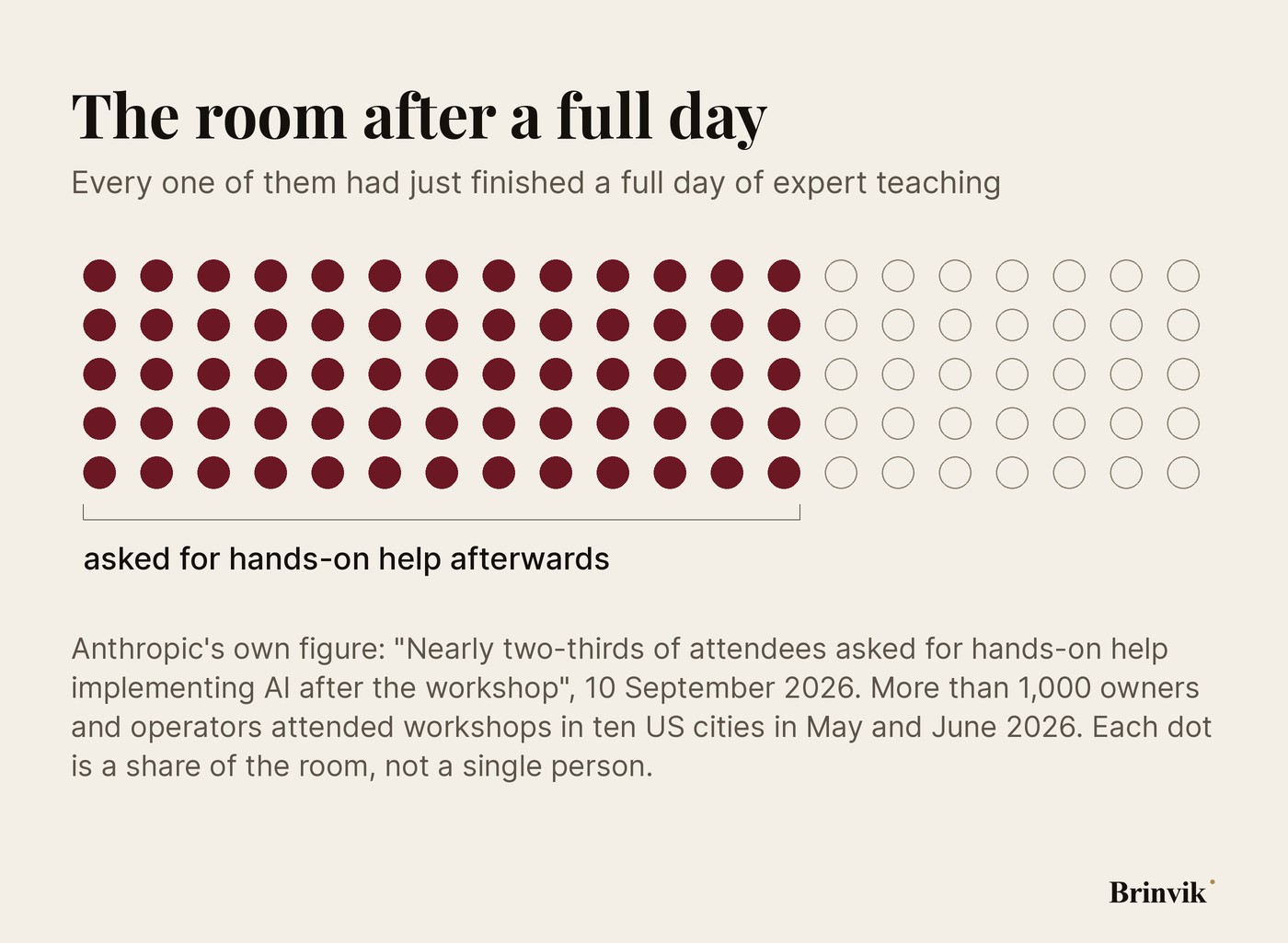
Then there's the sentence. Anthropic writes that nearly two-thirds of attendees asked for hands-on help implementing AI after the workshop. Across 635 exit surveys, the most-cited highlight was the guided build session, and the most common request was more of it.
Read those together. These people had just spent a full day with an expert. They had the explanation. What they wanted more of was the part where they sat with their own systems.
The research is American end to end. That limits how far the number carries.
But what it points at isn't a knowledge problem.

Which half crosses the border
The product itself is not in doubt. Claude is supported in 195 countries and regions, and Denmark is on the list.
The teaching is a different matter. Alongside the launch, Anthropic announced free workshops in ten more US cities, from Boston to Phoenix. More than 150 organisations they've trained as Approved Claude SMB Trainers will run over 750 workshops in their own communities. Fourteen integration partners are hosting free webinars from September to November.
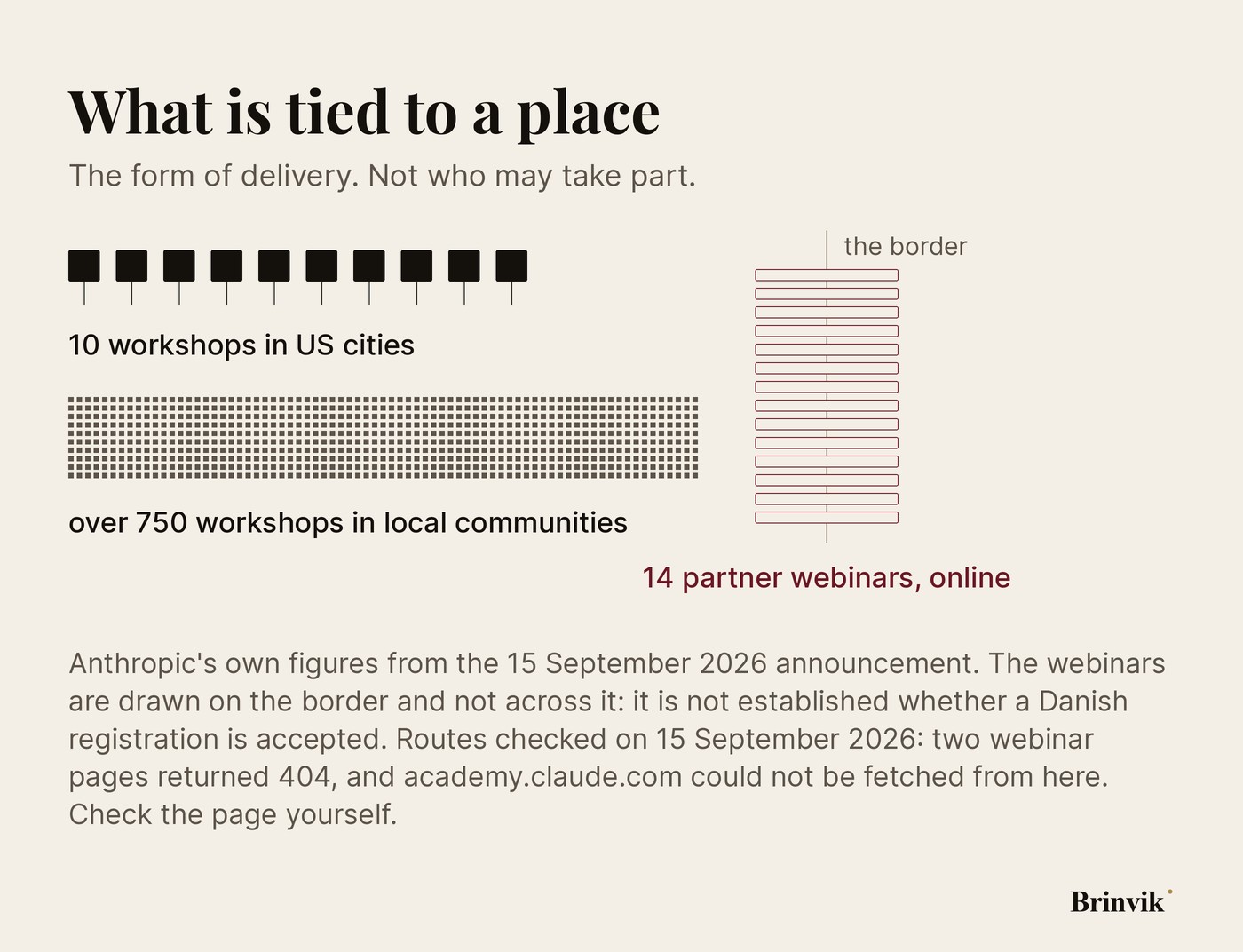
The difference is the form of delivery. A workshop in Memphis is tied to Memphis. A webinar isn't.
What I can't tell you: whether a Danish company can actually register for those fourteen webinars, what timezone they run in, or on what terms the free course is offered. I tried four routes. claude.ai/availability returns 403. Two of the webinar pages return 404. academy.claude.com is blocked from the environment I work in. So it isn't established in either direction, and I'd rather write that than guess. The pages sit under claude.com/smb-events if you want to look yourself.
Don't wait for a webinar. Nothing that follows here needs you on one.

The first hour
So what is it that a full day of teaching can't hand you?
Your own data. Your own accounts. Your own permissions.
A workshop can show you what Close the Month does. It can't log in to your accounting system. It can't answer who at your company owns that integration afterwards, or what happens the first time Claude asks permission to do something in a real system on a Friday afternoon and nobody's agreed who gets to say yes. That's approval mode, and it's on by default.
Anthropic has an example of their own that shows where the work sits. HireEffect in Dallas isolated 16 transactions behind a $13,000 discrepancy, and got monthly reporting down from two hours to 10 seconds. That's Anthropic's own customer write-up. Notice the order: somebody found those 16 transactions first, and only then did reporting get fast. The first part is what takes an hour. The second part is what looks good in a blog post.
What those two-thirds asked for wasn't an expert. They'd just had a full day with one. They asked for an hour with their own system logged in, and somebody beside them so they didn't wander off into something else.
That's an appointment, not a hire. And you can make an appointment yourself.

The flagship is the hardest one to switch on
Anthropic highlights five workflows, and tells you how many integrations each one speaks to.
Monday Brief: 37. Proposal Builder: 17. Social Content Engine: 16. Speed to Lead: 15. Close the Month: 14.
Those numbers read as power. It's the opposite. It's a precondition. A count isn't how much the workflow can do, it's how much of your company it has to be able to see before it returns anything at all.
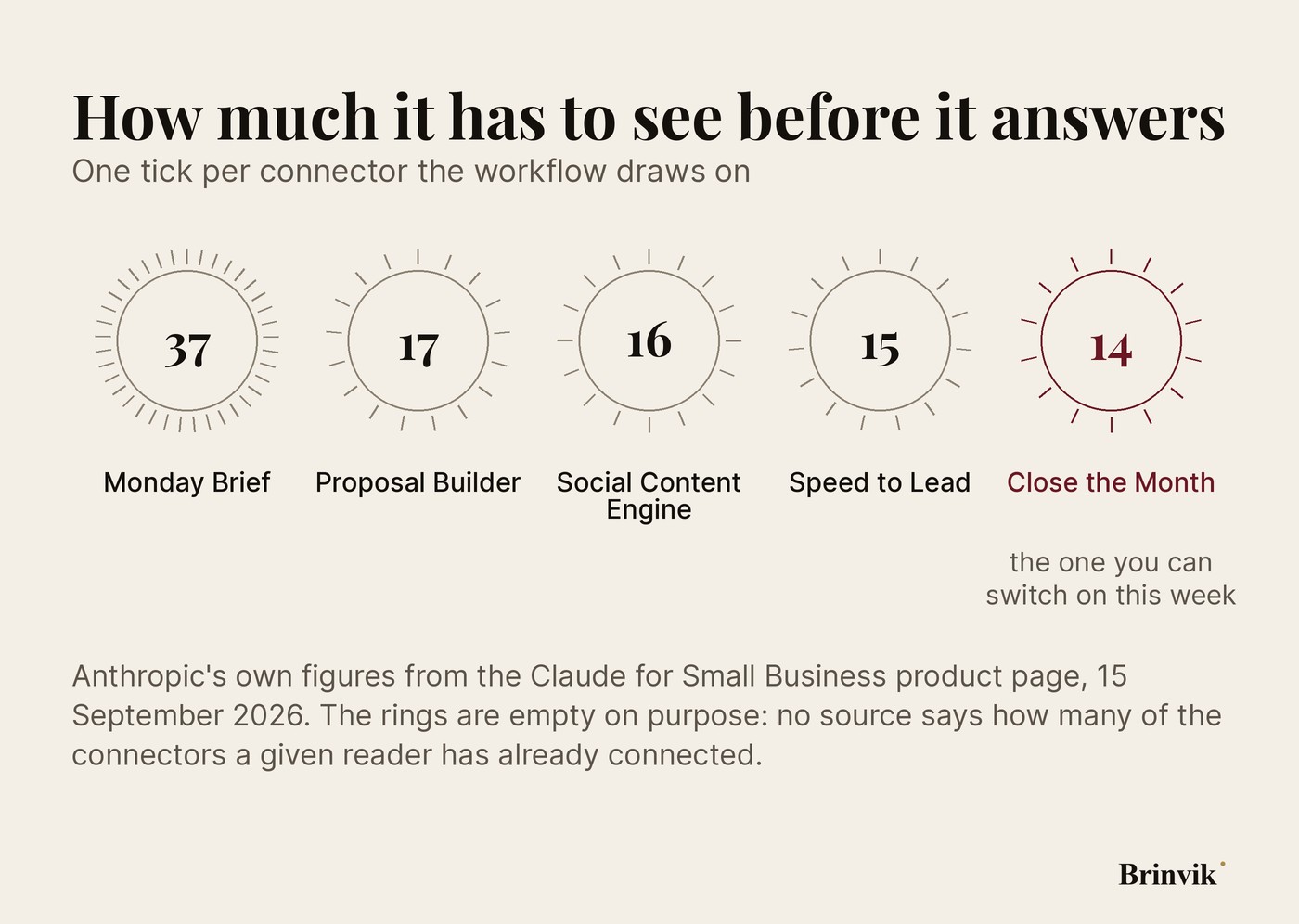
Monday Brief is the flagship and the hardest to switch on. A Monday briefing across 37 systems is worth nothing until enough of them are connected. Close the Month, at 14, is the one that company can finish this week.
That matches what their own attendees asked about, as it happens. Reporting was the most common use case, and Close the Month is the workflow that reaches reporting on the fewest preconditions. The cheapest one to switch on is also the one most people wanted.
I've written about choosing the first workflow in AI workflow automation: what to build first. This piece adds the Danish half of the arithmetic.
It also decides who needs to be in the room. Close the Month belongs to finance. Speed to Lead belongs to sales. Don't start one and summon the other.

What a Claude implementation connects to in Denmark
This is where a Claude implementation in a Danish company stands or falls, so here it is in full. Here's the list Anthropic named, sorted by what touches money: Intuit QuickBooks, Xero, Stripe, Square, Gusto and PayPal.
Not one of them is Nordic. No Danish accounting or payroll system appears on the list Anthropic published.
Be precise about what that means, because I didn't get all the way through it. claude.com/connectors reports 812 connectors in the directory. The front page showed about 23 of them and I couldn't load the rest. I looked at the directory, ran targeted searches, and opened both the Xero and Gusto pages to read what they point at. None of those routes turned up a Nordic system. But I haven't been through all 812, so I can't tell you one doesn't exist. I can tell you one isn't on the list.
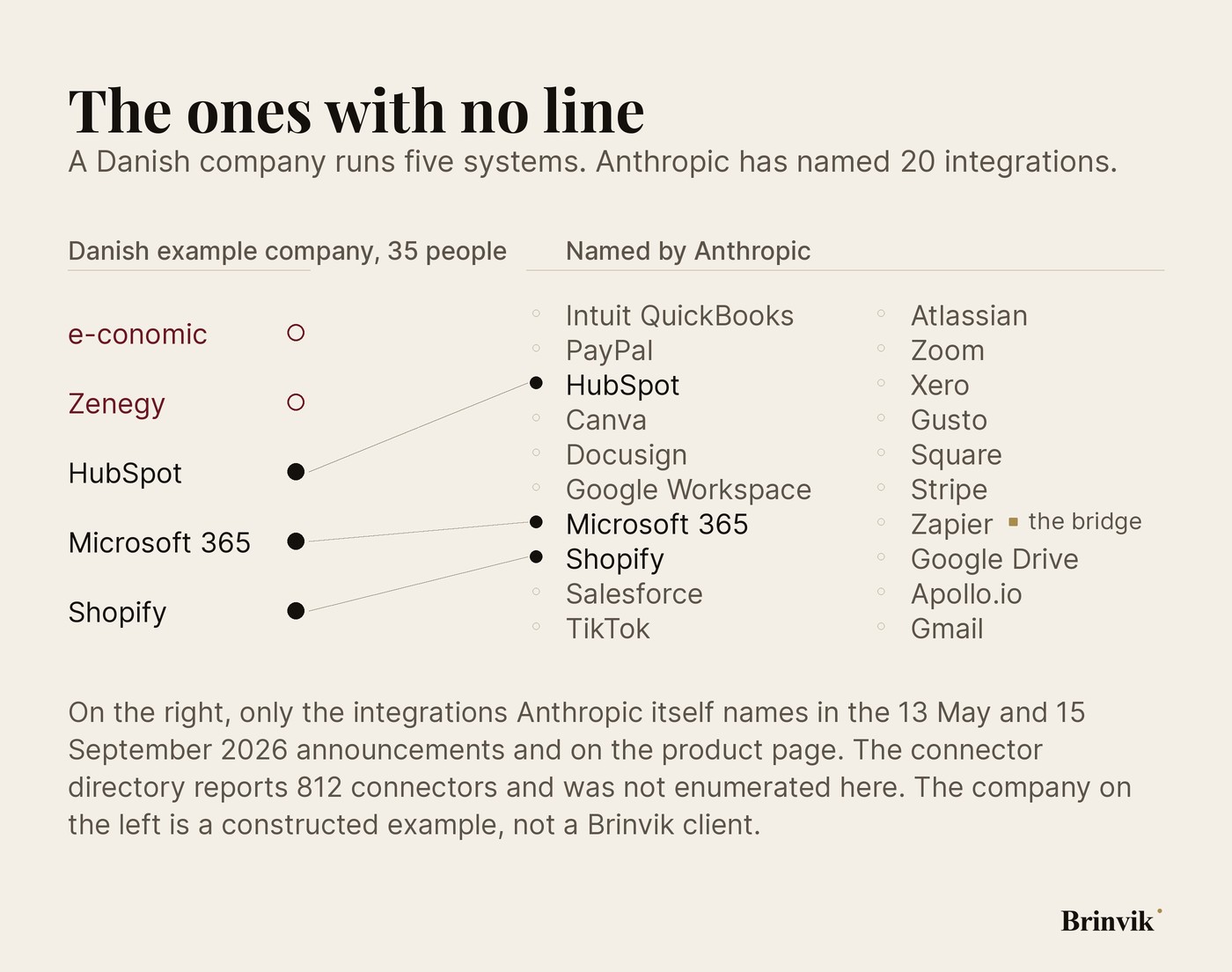
Two things keep this from being a dead end. Zapier is on Anthropic's own list, and the product page points to Zapier as the bridge to whatever isn't. And the Xero connector that is on the list is read-only: its own page describes read access to P&L, cash position, invoices and customers. Close the Month reads the ledger. It doesn't close anything in it.
So the difference between an American and a Danish company here isn't access. It's a build step.
And there's a decision to make before any of it gets connected. Anthropic writes that the package runs on every paid plan. In the same post, they write that by default they don't train on your business data on Team and Enterprise. Those two sentences don't cover the same set of plans. Nothing is said about Pro, and I'm not going to tell you what applies to Pro, because the source doesn't either.
What I do about it: I don't connect the accounting system and the mailbox on a Pro seat. The step up to Team is $20 against $17 a month billed annually. It's the cheapest decision in this article.

One hour, one ledger
Here's the hour, written out. Take a constructed example: thirty-five people, e-conomic for accounting, Zenegy for payroll, HubSpot as CRM, a Shopify store and Microsoft 365. It's an example I've built to show the arithmetic, not a client.
The first ten minutes go on what's already on the list. HubSpot, Shopify and Microsoft 365 get connected. Three of five.
Minute twelve: approval mode asks for the first time. This is where people stop. Not because they don't understand the question, but because nobody has agreed who's allowed to answer it. Settle that before you start. Two minutes up front saves you half a day afterwards.
Minute twenty-five: the first run comes back and something in it is wrong. It should be. A workflow that lands perfectly on the first run is one that hasn't seen enough of your company. Look at what's missing and you can read off which integration isn't connected yet.
Minute forty: e-conomic and Zenegy are still outside the setup. Now the choice is concrete. Either you build the bridge through Zapier, or you pick a workflow that doesn't need them. Both are fine. Not choosing isn't.
That's what AI workflow automation looks like when you take it seriously: one workflow at a time, with arithmetic behind it.
Minute sixty: you have three integrations connected, one workflow running, and an exact figure for what the last two cost. That's further than most of those 900,000 installations have got, and it took you an hour.
As an AI consultant in Copenhagen I run Claude implementations for Danish companies, and that work sits under internal AI tools. I say so because it's what I do for a living, not because the hour needs me. It doesn't. There's one place I'd call someone: if the workflow that matters most to you needs a system that isn't on the list, and nobody at your company has built a Zapier bridge before. That isn't another hour. That's a small project, and you should know that before you start.
FAQ
Frequently asked questions
Buy a paid plan, install Claude for Small Business, and connect whichever of your systems appear on Anthropic's integration list. Start with the workflow that needs the fewest integrations, not the one that sounds most impressive. Budget an hour for the first one, plus a build step for every Danish system that isn't included.
Yes. Claude is supported in 195 countries and regions, and Denmark is on Anthropic's own list for both the API and Claude.ai. The package runs on every paid Claude plan.
Pro is $17 a month billed annually and $20 billed monthly. A Team seat is $20 and $25, a Team premium seat $100 and $125. Enterprise is $20 per seat plus API usage on an annual term. Anthropic recommends Team for businesses with more than one person.
Anthropic writes that the package runs on every paid plan, and in the same post, that by default they don't train on your business data on Team and Enterprise. Those two sentences don't cover the same set of plans, and the source says nothing about Pro. If the accounting system and the mailbox are going to be connected, the step up to Team is $20 against $17 a month.
Anthropic writes in the launch post: "by default, we don't train on your business data on Team and Enterprise plans". That is what the source says, and it says nothing about Pro. The detail sits in their Trust Center.
Not through the list Anthropic published. No Danish accounting or payroll system appears on it. The directory reports 812 connectors, and I looked at the directory, searched deliberately and opened the Xero and Gusto pages without finding a Nordic system, but I haven't been through all 812, so I can't tell you one doesn't exist. Zapier is on the list, and Anthropic points to Zapier as the bridge to whatever isn't.
It isn't established. Fourteen integration partners are hosting free webinars from September to November, and a webinar is online. I couldn't confirm the registration terms: claude.ai/availability returns 403, two of the webinar pages return 404, and academy.claude.com is blocked from the environment I work in. The pages sit under claude.com/smb-events.
Sources
- Anthropic: Claude for Small Business launches new workflows, integrations, and training programs (15 September 2026)
- Anthropic: Introducing Claude for Small Business (13 May 2026)
- Anthropic: What 1,000 small business owners taught us about AI (10 September 2026)
- Claude for Small Business, product page
- Claude pricing
- Anthropic: supported countries and regions
- Claude connectors directory
- Claude connectors: Xero