
In short: On 22 October Anthropic recommended that companies fold their subagents into one agent with skills. I wanted to see whether that held on a job a sales team knows, so I had Claude Code build the same quote desk twice on Claude Sonnet 5.5: once as a coordinator with three specialists, and once as one AI sales agent that loads the same rules as skills. Both answered the same twelve requests for a quote, three times each.
The single agent got all 36 quotes right. The four agents got 29 right, and one quote went out 28,800 kroner too high, because the coordinator trusted a specialist's arithmetic. The single agent used 2 model calls per quote against 8, finished in 7.3 seconds against 13.9, and cost under half as much. The whole test and all 72 answers are free to download: get the kit.
Below you can pick any of the twelve emails and watch both desks answer it, exactly as they did in the test. It opens on the quote that went wrong.
Anthropic's Applied AI team has published guidance on when to fold subagents into your main agent loop. A subagent is an agent with its own context, tools and instructions that a coordinator hands work to. A skill is a file of instructions the agent only reads when the task calls for it. The team writes that across several enterprise deployments, a single agent with skills often beat both one big prompt and a set of subagents, frequently at a lower cost and latency. That's Anthropic's own comparison, and the numbers behind it aren't published.
They also write that a fold can break something that used to work, and that in their own example it only showed up in one run out of two. So I had Claude Code build a quote desk both ways and run both on the same emails, more than once.

The quote that was 28,800 kroner too high
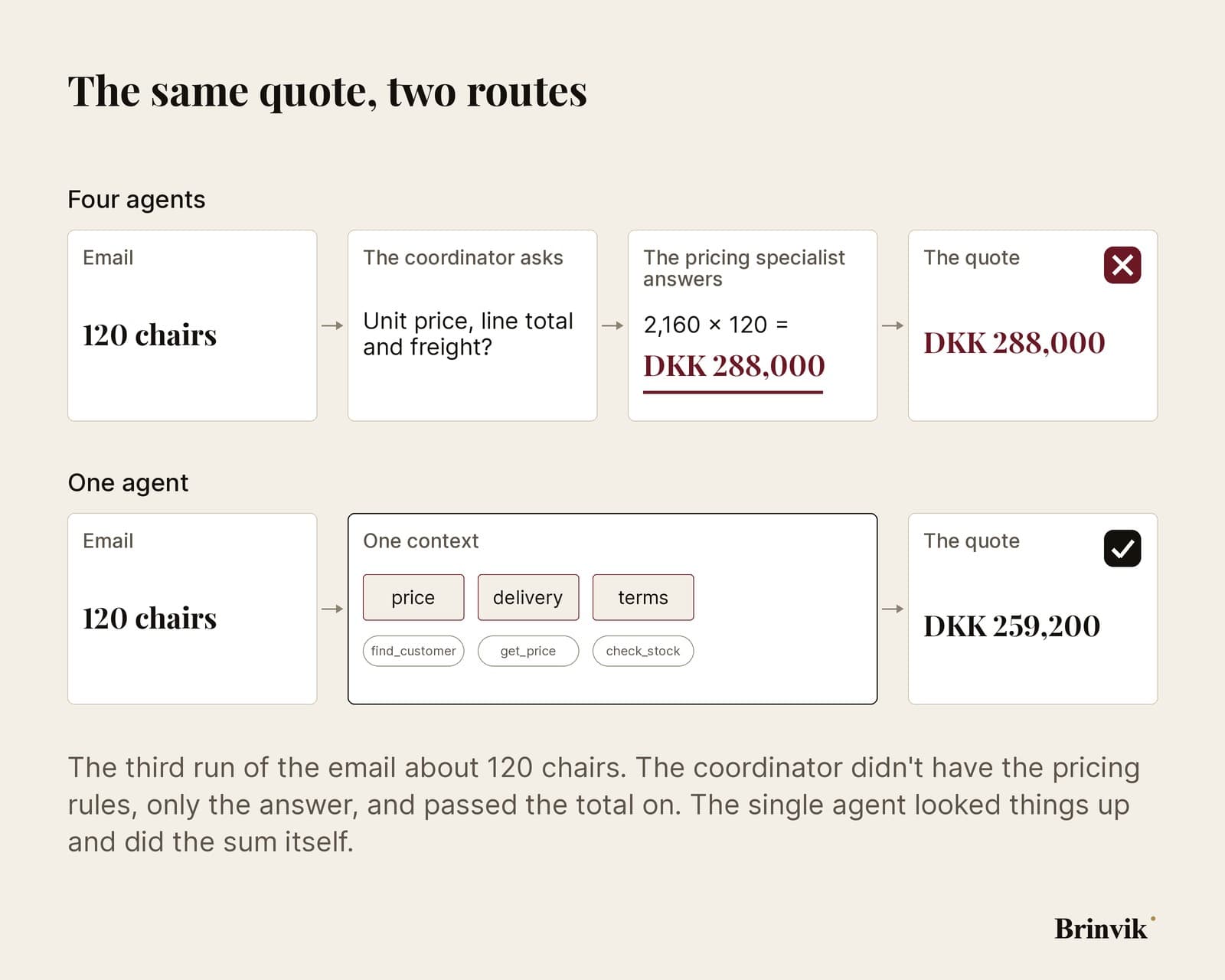
Sam, an invented customer, asks for 120 office chairs. 100 units or more earns a 10% discount, so the unit price is DKK 2,160 and the total DKK 259,200.
In the third run, the coordinator asked the pricing specialist: "What is the unit price, line total, and any freight?" The specialist looked up the list price, applied the right discount, got the right unit price, and then wrote: "Line total: 2,160 × 120 = 288,000 DKK". The unit price was right. The multiplication wasn't. The coordinator didn't have the pricing rules, only the answer, and this time it didn't redo the sum: the quote went out at DKK 288,000 with the unit price of DKK 2,160 on the same line.
The specialist made the same slip in the first run. There the coordinator redid the sum and sent DKK 259,200. The single agent got the same email, looked up the customer, the price and the stock in one go, and got the sum right in all three runs. It's one wrong quote out of 36, but it shows the weakness Anthropic describes: every handoff between agents is a summary, and whether the receiver checks it depends on the run.
The desk belongs to Nordlys Kontor ApS, an invented Danish supplier of office furniture to businesses, with four products, six customers in its CRM, and stock in Vejle and Malmö. The twelve emails, six in Danish and six in English, each carry a trap: the discount step at 100 units, a quantity written as a word, stock that runs short, a framework agreement, a request for 15% off and another for 20%, a new customer, an overdue invoice, and a delivery deadline missed by one day.
Both desks got the same written rules for pricing, delivery and payment, the same tools and the same model, Claude Sonnet 5.5 at medium effort. Every email ran three times per design: 72 quotes, 364 model calls and $2.19 at list price. A script checks eight things in each quote: the total, the order lines with product codes and freight, the delivery date, the payment terms, whether it should go to the sales manager, the language, whether the reply states the total, and whether it states the date.

Where AI sales agents lose the product code
The wrong price wasn't the only slip. In 7 of the four agents' 36 quotes, the order line said "Ergo 2" instead of the product code ERGO-2. The coordinator has no catalogue: only the specialists' tools know the codes, so the code only comes back if the coordinator asks for it. In 29 of the 36 quotes its question to the pricing specialist asked for the SKU, and all 29 got it. In the other seven it didn't ask, and it had nothing to put on the line. The single agent had looked the product up itself and put the code on every time.
The customer wouldn't notice. The system that books the order would. Count only what the customer reads and the gap is small: 35 right out of 36 against 36. All seven slips were in the three emails with the biggest discounts.
Anthropic calls it a "telephone game": every time one agent passes something on, it gets a little less precise. If you keep subagents, Anthropic advises a shared answer format and having the main agent check a subagent's conclusion against real data. Here that would mean the specialist always sends back the product code, quantity, unit price and total, and the coordinator redoes the sum. A fixed format would very likely have saved the product codes. It wouldn't have caught 2,160 × 120 = 288,000 unless the coordinator did the sum itself.

Four times the model calls for the same quote
The coordinator used 8 or 9 model calls per quote: one or two to send out the three questions, two for each specialist, which looks things up and then answers, and one to write the quote. The single agent used exactly 2 every single time. It loaded all three skills and made every lookup in one batch, and in the next call it sent the quote.
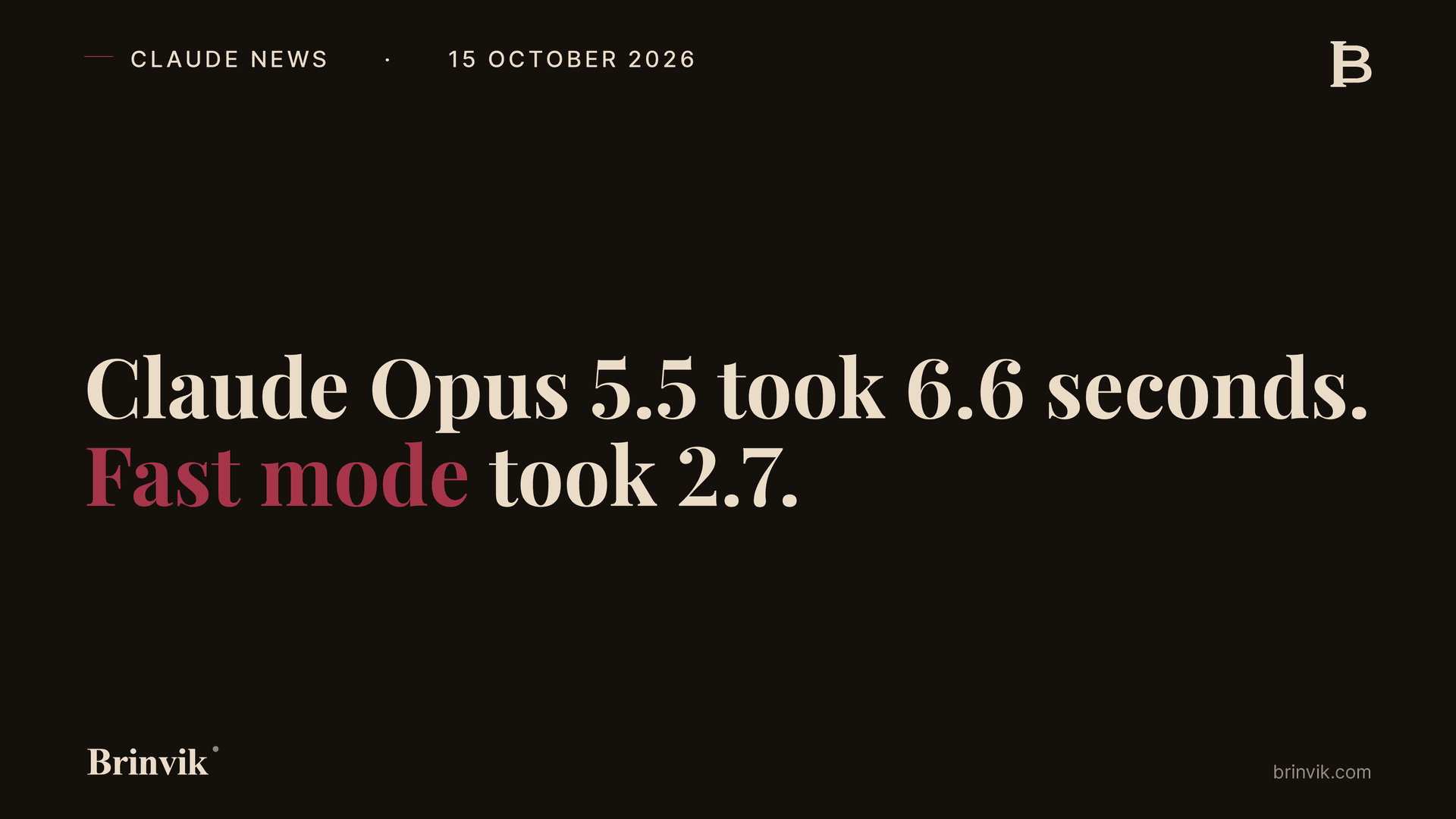
You can feel it. The median quote took 13.9 seconds with four agents and 7.3 with one, and 12,704 tokens against 6,239. At list price a quote cost 4.1 US cents against 2.0, or about $41 against $20 per 1,000 quotes.
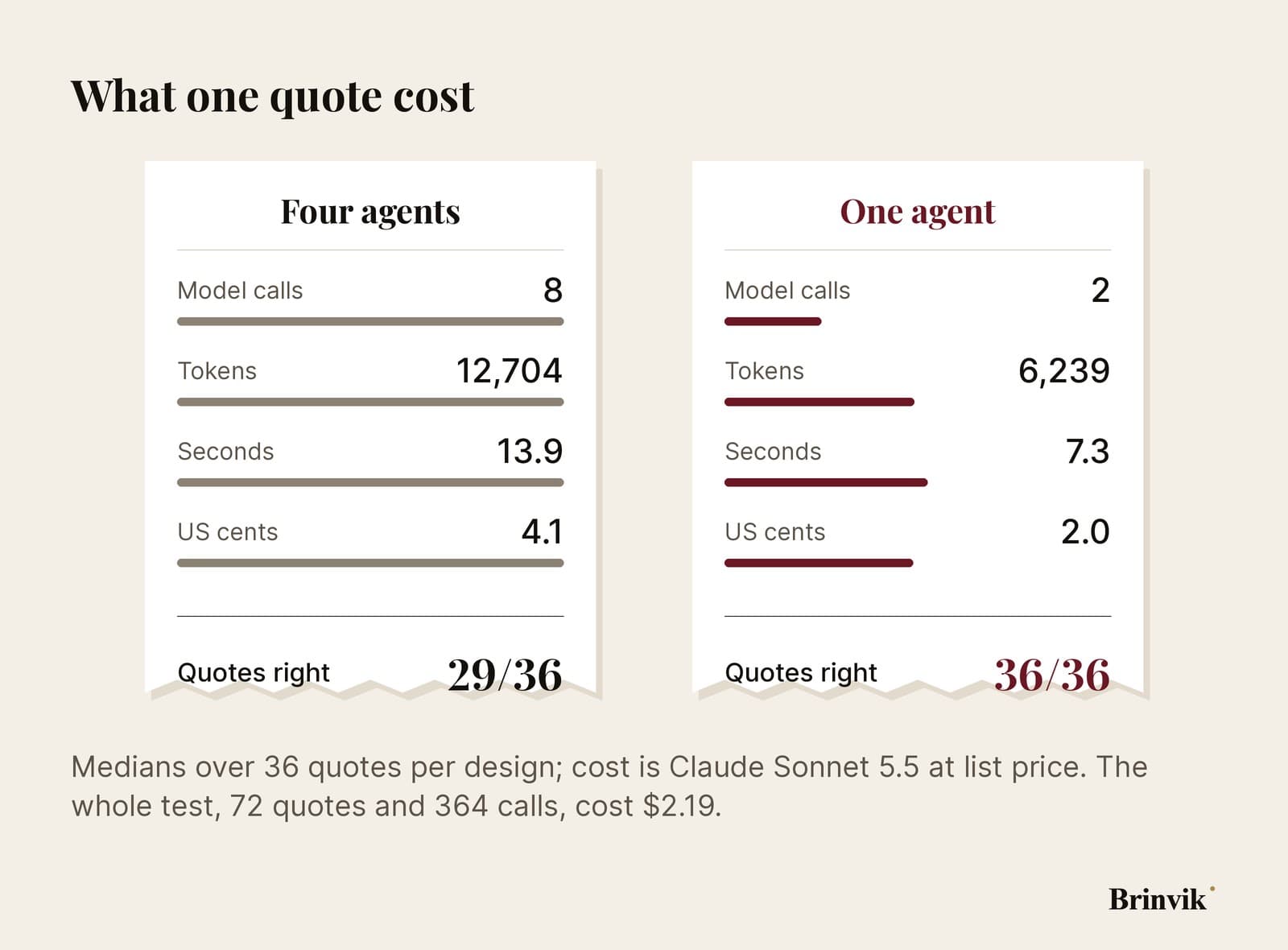
The money is small change. The time matters more if a customer is sitting in a chat waiting for an answer. The single agent loaded all three skills for every quote, so it didn't read less. It was faster because everything sat in one context: it could make every lookup at once and work out the price itself.

When a subagent is still the right call
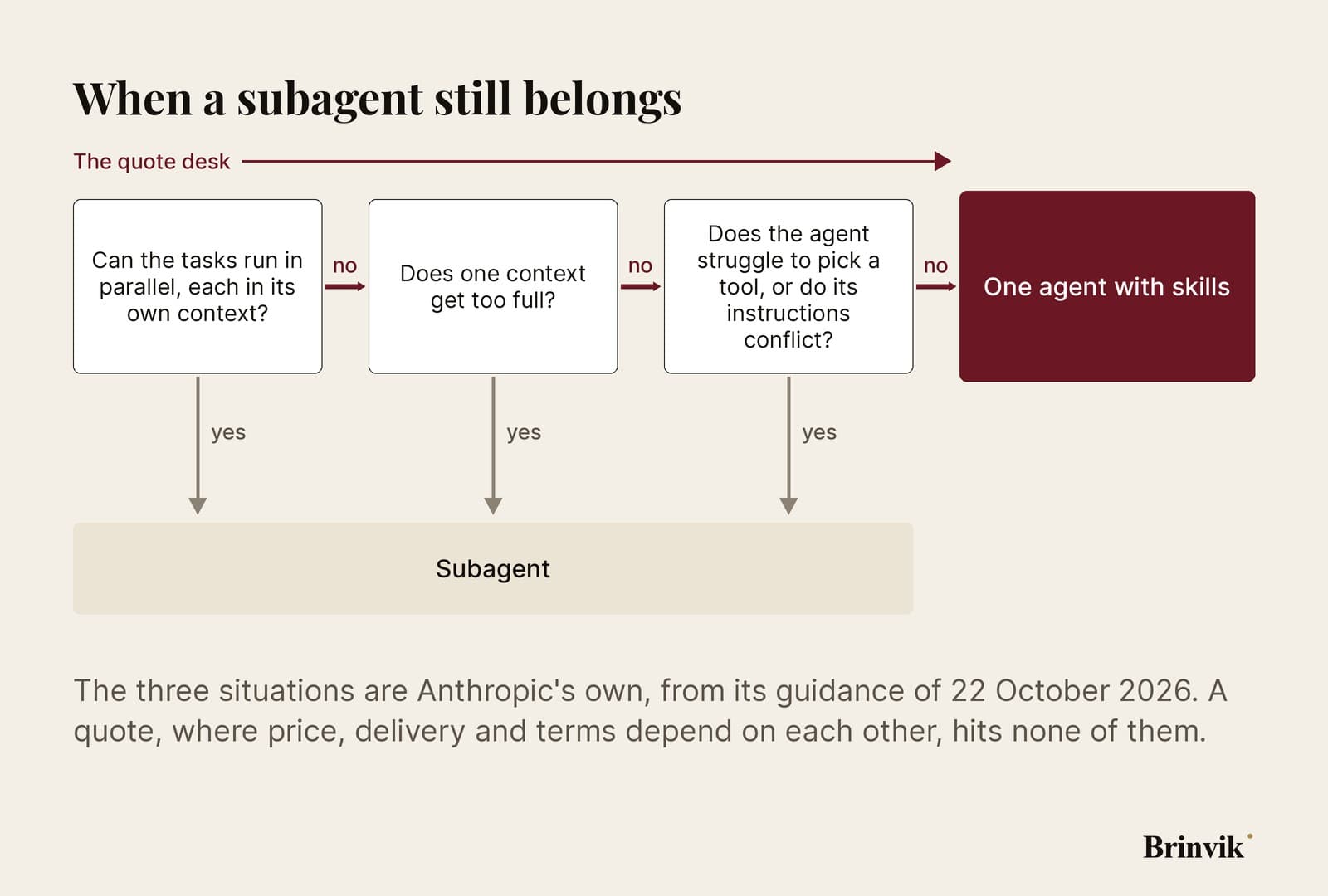
Anthropic doesn't say subagents are wrong. It names three situations where they still belong: when one agent gets measurably worse because its context is too full; when several tasks can run in parallel, each in a fresh context that's thrown away afterwards; and when one agent struggles to pick the right tool or has conflicting instructions.
In a sales team, that might be reviewing twenty accounts' latest activity before a pipeline meeting, where each account is its own piece of work. That suits subagents. A quote doesn't: price, delivery and terms depend on each other, and whoever writes the quote needs to see all three.
Anthropic writes that it too often sees companies give each team its own subagent, so the agent ends up as a copy of the org chart: one agent per team, because pricing, logistics and finance are three departments. Anthropic recommends instead that each team owns its skills and their own small evals, and one central team owns the agent's instructions and the end-to-end test.
If you already run a coordinator with specialists, start by building a small set of emails with known answers, like the twelve here. Fold one specialist into a skill at a time, run every email more than once, and look at which tasks flip from right to wrong, or the other way.

What this test can't tell you
It's one desk, one model and three runs per email on invented data, checked by a script on eight points. It says something about these two designs on this job. It can't say a single agent always wins.
The specialists were told to answer briefly with the numbers. Their instructions never mentioned the product code, so it only came back when the coordinator remembered to ask. The specialists also never saw the email, only the coordinator's question. That's exactly the design Anthropic warns about, but a set-up where every specialist gets the whole email wasn't tested.
The seconds were measured on GitHub's servers, six quotes at a time, mixed between the two designs. The job allowed at most ten calls at once, a cap the parallel specialists hit more often, so treat the seconds as approximate.

Run the test on your own quote desk
The kit holds the desk as one JSON file with products, customers, stock, rules and the twelve emails; both designs; the script that checks the quotes; and all 72 answers with every model call. Swap the products, customers and emails for your own, run it first without a model to check the plumbing, then with your own API key. 72 quotes cost $2.19 here.
The kit doesn't talk to your CRM. The tools read a file, on purpose, so the test can be run again and give the same answer key. If you want to fold a multi-agent set-up that already runs into one agent, Anthropic has published a migration kit with a guided walk-through and a worked support-desk example. Anthropic has also just handed Skills to the Agentic AI Foundation, under the Linux Foundation. Skills was already an open standard that more than 70 platforms read, so the same skill also works in agents other than Claude (Anthropic, 22 October).

When I build AI agents for a sales team
As an AI consultant and Claude specialist, I build these agents for Nordic sales teams: an AI sales agent that answers quote requests, leads or customer email, with your rules as skills and your systems as tools. The agent is the easy part. The work is writing the rules so they can be tested, and building the ten emails with known answers that tell you whether a change made the agent better or worse.
If that's where you are, read more about internal AI tools or send me three typical requests your team answers. I'll tell you whether they suit one agent or several, and what it takes to test them. To see what happens when several agents share one memory, read about three agents with one shared memory, or start with what AI agents are.
FAQ
Frequently asked questions
A subagent is an AI agent with its own context, tools and instructions that a coordinator hands a task to. It sends back a summary, and the coordinator only sees that summary, not the work behind it.
A skill is a file of instructions the same agent reads when the task calls for it, so everything stays in one context. A subagent is a separate agent with its own context that only hands back an answer. In this test, one agent with skills got every quote right, with fewer calls and no handoffs where anything could get lost.
No. Anthropic still recommends subagents when tasks can run in parallel, when one context gets too full, or when one agent struggles to pick a tool. A quote, where price, delivery and terms depend on each other, suits one agent best.
The specialist found the right unit price, DKK 2,160, but multiplied it by 120 wrongly and wrote DKK 288,000, in two of three runs. Once the coordinator redid the sum; once it passed the total to the customer. With one agent there was no handoff to trust.
72 quotes and 364 calls to Claude Sonnet 5.5 cost $2.19 at list price. With four agents a quote cost 4.1 US cents, with one agent 2.0.
Yes. The kit has the desk as one JSON file, both designs, the script that checks the answers and all 72 answers. Swap the products, customers and emails for your own and run it with your own API key.
Build ten emails or tasks with known answers, fold one subagent into a skill at a time, and run every task more than once. Look at which tasks flip from right to wrong, not just the overall score.
Sources
- Building agents: When to fold subagents into your main agent loop, Anthropic, 22 October 2026
- single-agent-loop-kit, Anthropic's migration kit on GitHub
- Donating Agent Skills to the Agentic AI Foundation, Anthropic, 22 October 2026
- The test kit: the desk, both designs, the grader and all 72 answers, Brinvik Lab