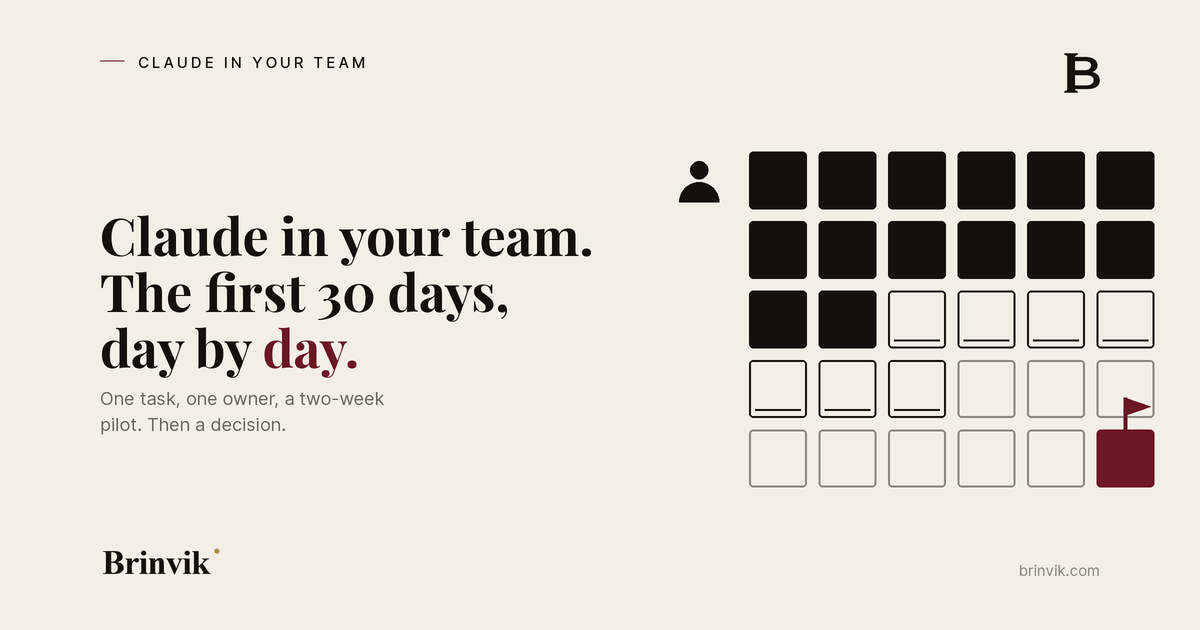

TL;DR: Most teams start with Claude by buying seats and hoping. Three weeks later two people use it for emails. Start with a calendar instead. Day 0: pick one task that eats hours and one person who owns it. Days 1 to 14: a pilot in one shared project with three to six people. Days 15 to 21: write the data rules and the shared knowledge down before the first customer email goes in. Day 30: three numbers and one decision. That is the whole plan for Claude for business in a team of 5 to 80, and it costs less than the seats you would otherwise have bought.
Anthropic has made the licence part easy. Claude Team costs 25 USD per seat a month, 20 billed annually, Claude Code is included in every seat, and your data is not used for training by default. That is the list price, read on 21 October 2026. The part Anthropic cannot do for you is keeping a team on it three months in. That is what the next 30 days are for.
Anthropic, updates to Claude Team, 28 January 2026 (primary source) →

Day 0: pick one task before you buy a single seat
The first decision in any Claude for business rollout is the one that usually gets skipped. Which task should Claude solve first? The answer has to fit on one line, and the task has to pass three tests. Someone does it every week. It takes time that person would rather spend on something else. And a human can check the result in a minute.
Quotes written from the same price list. Replies to the same ten questions in the inbox. Meeting notes that have to become tasks in a system. All three pass. "We want to use AI more" passes none of them, and it is the sentence most pilots are built on.
Once the task is chosen, the next two decisions follow on their own. The pilot is the three to six people who do the task today, not the people most curious about AI. The owner is one named person with an hour a week for 30 days. Without that person the next 29 days go the way they always do.
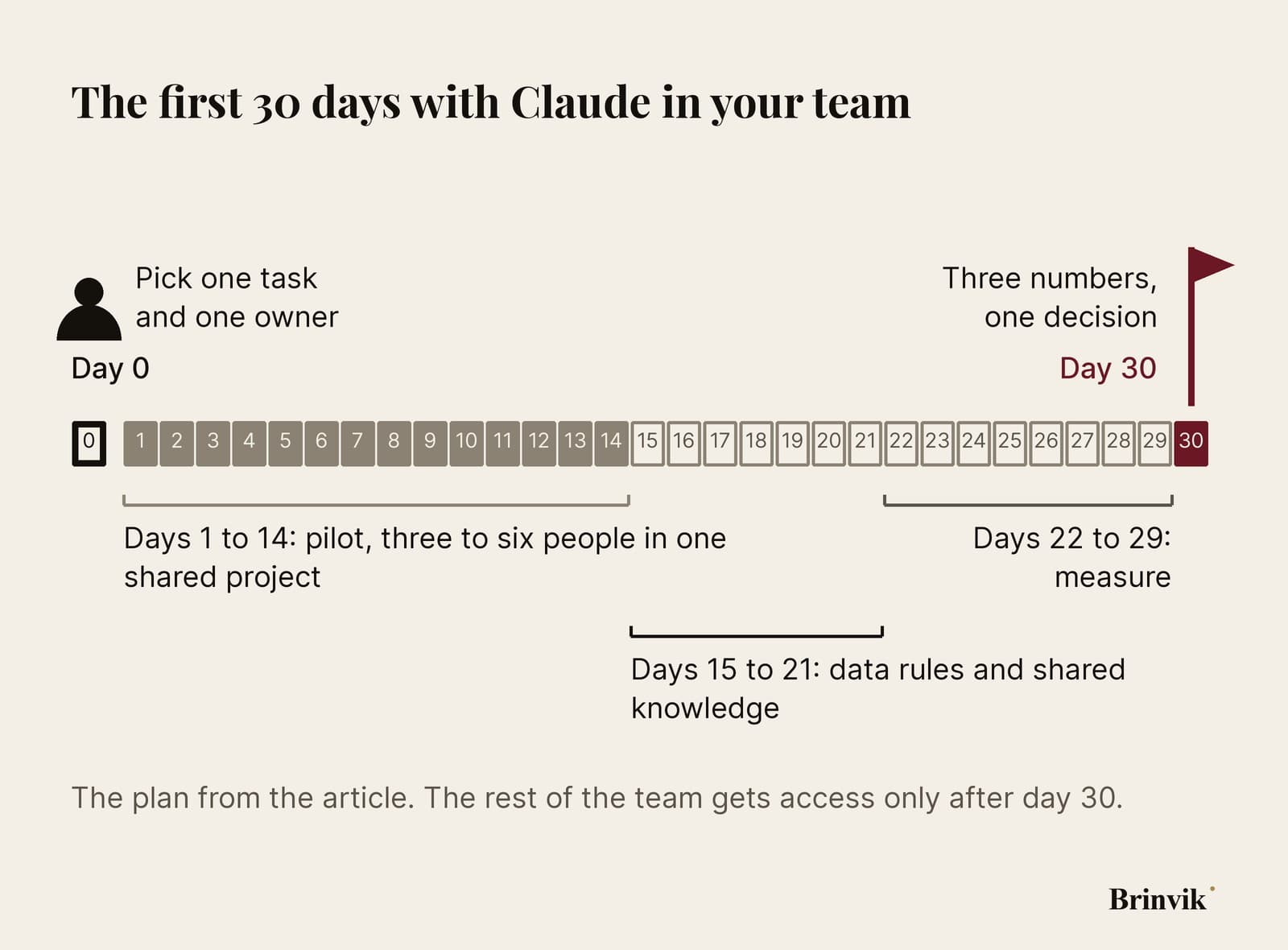
Notice what is not on the strip. It does not say "buy seats for everyone". The pilot has three to six seats, and the rest of the team gets access only after day 30 is over and the decision is made. That keeps the pilot cheap, and it keeps it honest: nobody can say it worked because everyone had it.

Weeks 1 and 2: a pilot in one shared project, not on six separate accounts
The pilot runs in one project. A project in Claude is a space with its own instructions, its own knowledge and its own conversations, and on the Team plan it can be shared, so everyone in the pilot works from the same setup. Anthropic describes projects as self-contained workspaces with their own chat histories and knowledge bases, and sharing can be set to "can view" or "can edit" per person.
The shared project is the pilot's most important decision, and it is the one most teams get wrong. The temptation is to let each participant try on their own Pro account, because it is faster to start. Then you get six different setups, six different results and no shared knowledge of what worked.
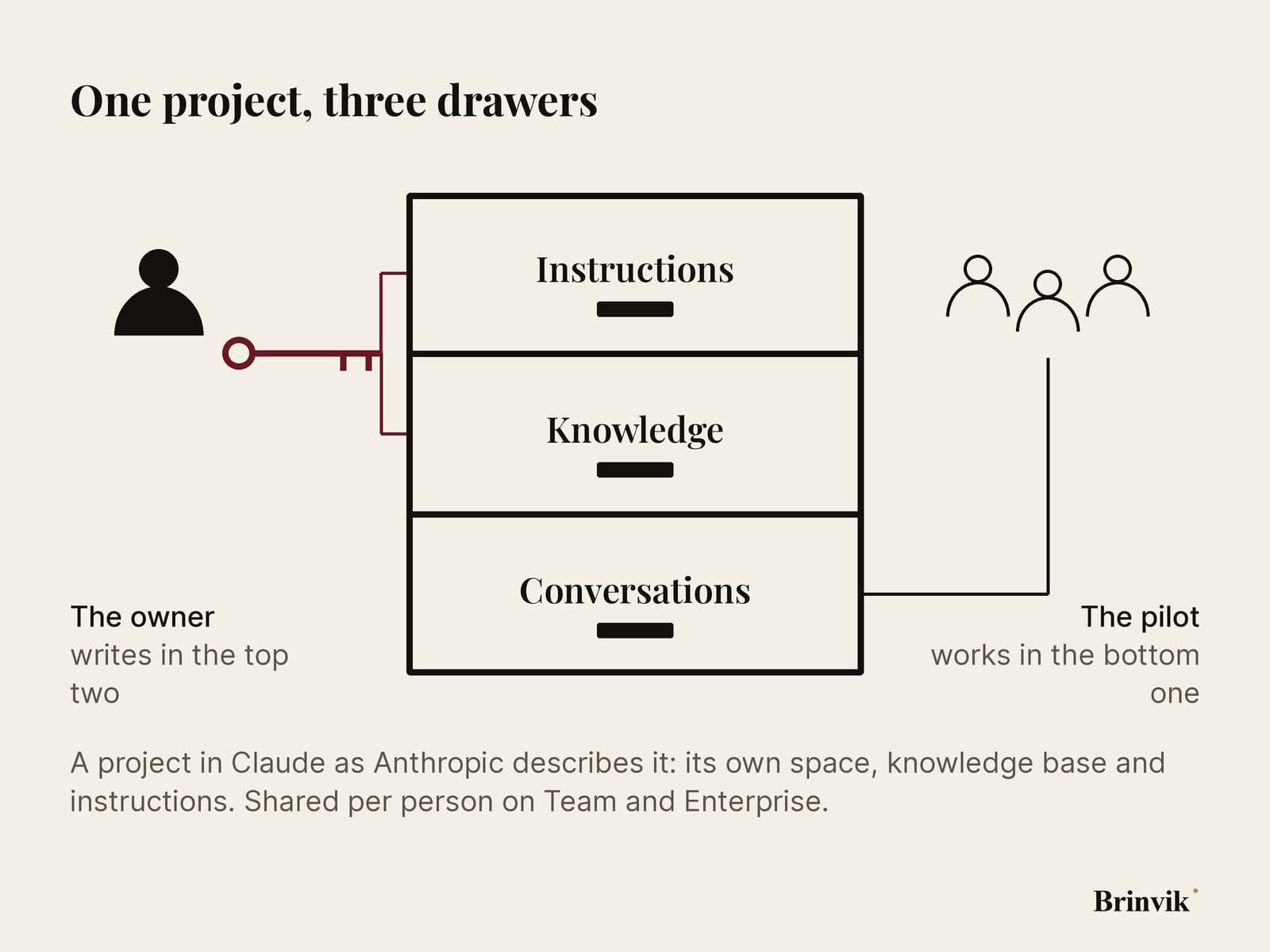
The owner writes the project instructions on day 1: what the task is, what a good result looks like, and what Claude must never do. The owner adds the documents the task uses, say the price list, the ten standard replies or the template for the notes. The participants solve the task inside the project every day, and every day one of them writes three lines in a shared document: what got solved, what went wrong, and what was missing from the instructions.
The owner edits the instructions once a week, based on those notes. Not more often, or nobody knows which version produced which result. And the notes are not optional. They are the only thing you have to decide from on day 30.

The pilot has to be allowed to fail, and to fail fast
Most pilots are built to succeed. The task is chosen because it is easy, the participants are chosen because they are positive, and the result is presented to management with the best examples. That's a demo, not a pilot.
A pilot is a test of whether the team still uses it on day 30 without being pushed. So pick a task that is slightly too hard, and bring the sceptical colleague along. If the setup holds up for him, it holds up for everyone. And if it fails on day 9, you have saved 21 days and every seat you did not buy.
I sell Claude training and Claude setups, so I have an interest in people getting started. I don't lower the bar for my own clients: a pilot that is not allowed to fail is one I do not set up.

Days 15 to 21: three piles, before the first customer email goes in
For the first two weeks the pilot has run on price lists, templates and standard replies. That is deliberate. Day 15 is the first time someone will want to put a real customer email in, and it is the day the data rules have to be written. Three piles that anyone in the pilot can sort a file into in five seconds are enough. An eight-page policy does not get read.
Pile 1, fine. Anything already public or internal with no personal data: price lists, product descriptions, templates, process descriptions, your own tone of voice.
Pile 2, only in the Team project. Customer emails, quotes with names, CRM exports, meeting notes. That is personal data, so it belongs in a setup with a data processing agreement, where your data is not used for training by default. On Team and Enterprise that is the case from the start, according to Anthropic itself. On Free, Pro and Max each user controls it in their own privacy settings, which is exactly why the pilot does not run on private accounts.
Pile 3, never. National ID numbers, health information, salaries, passwords, anything from an ongoing dispute. The tool can handle it. The reason is that nobody in the pilot should make that call alone.
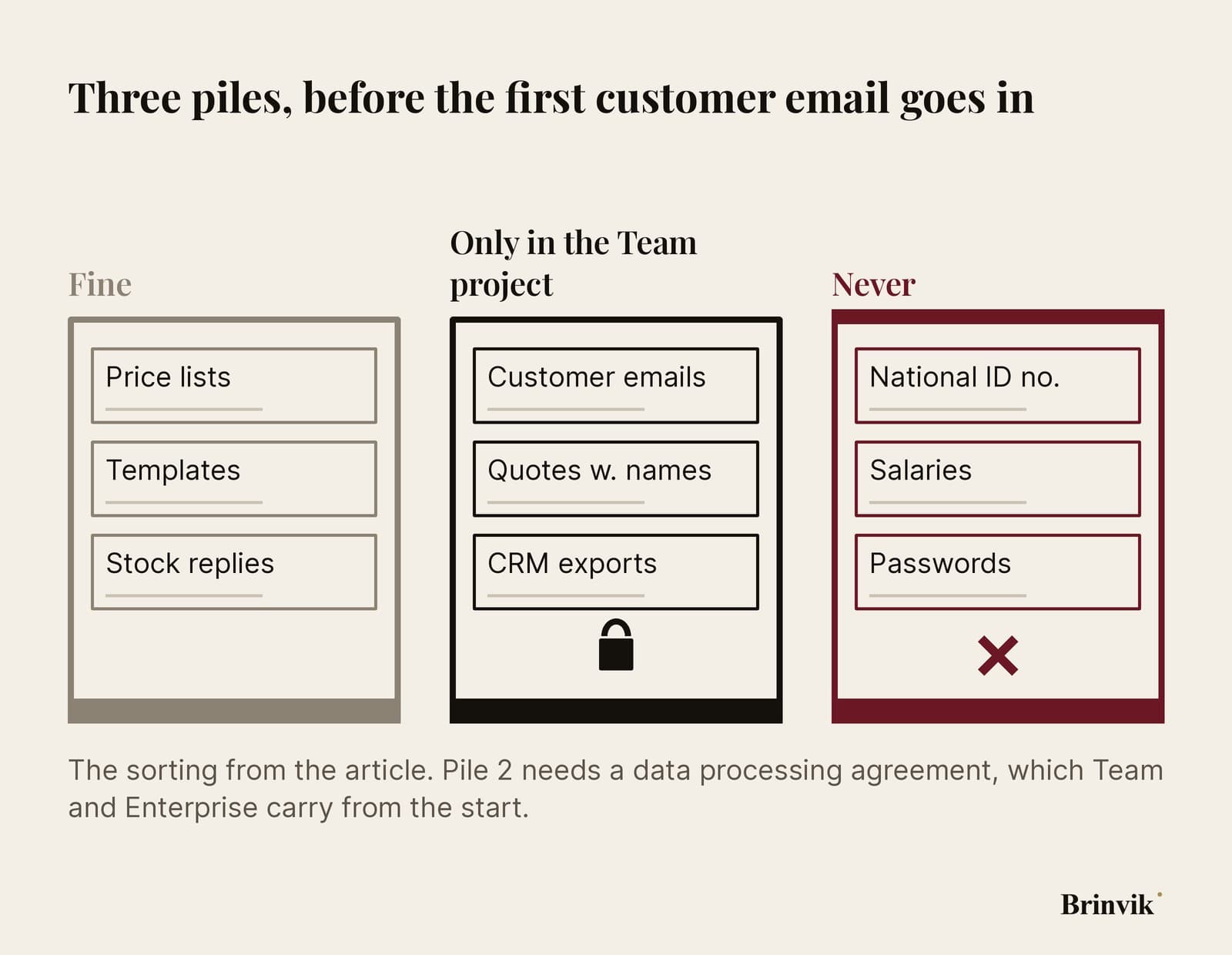
The rules go into the project instructions, so Claude itself objects if someone puts something from pile 3 in. And they go on the wall of the room the pilot team works in. A rule that only exists in a document is not followed on a busy Thursday.
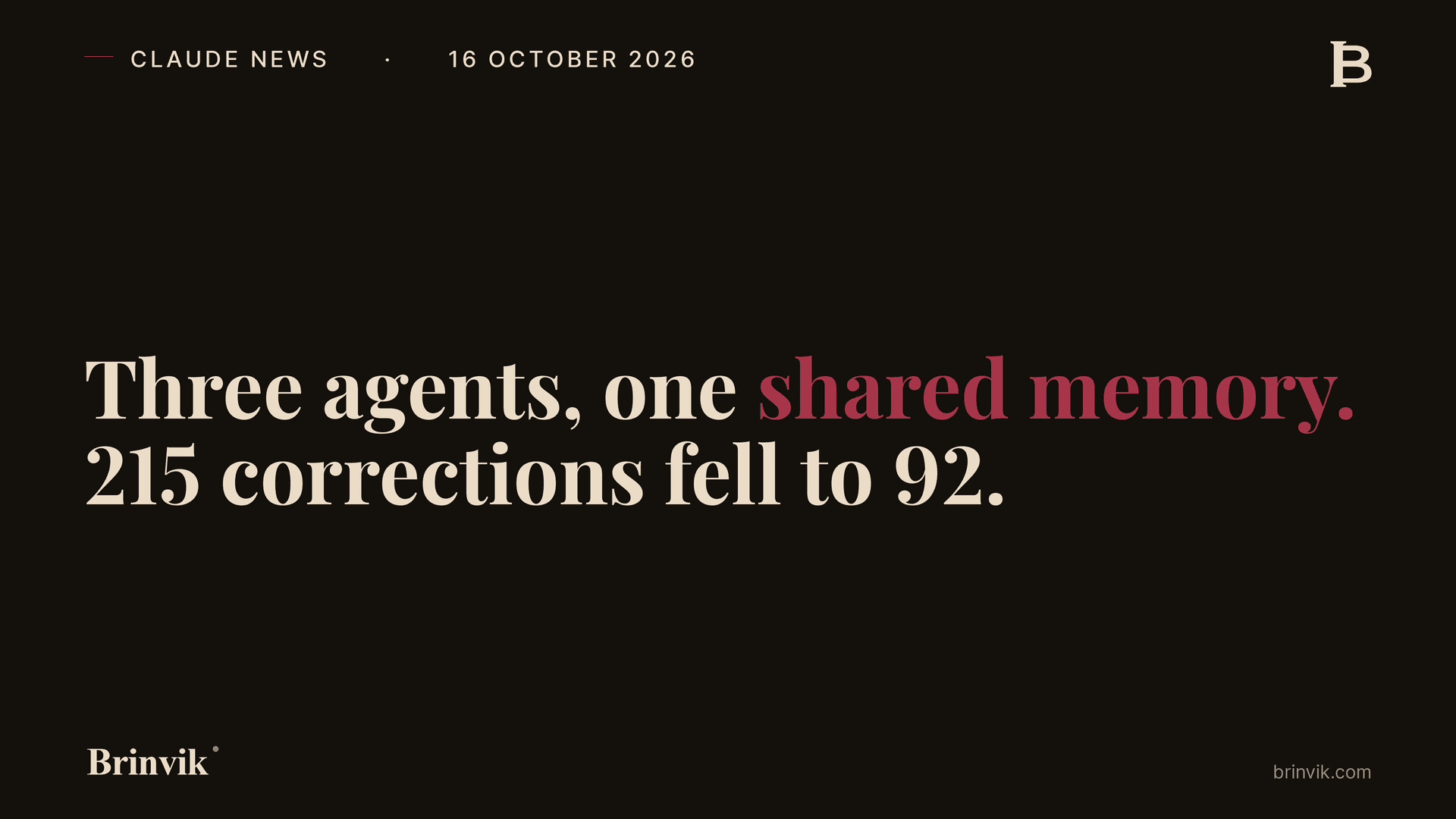
It is also the week the shared knowledge takes shape. Everything the notes from weeks 1 and 2 showed was missing now goes into the project as documents and examples, and the owner writes down who is allowed to edit them. I tested earlier what happens when several agents share one memory and one person corrects it: the agents learned the reason behind the correction, not only the word. The same holds for a project that people share. An instruction with an example and a reason sticks. A list of banned words does not.

Day 30: three numbers and one decision
On day 30 the owner sits down with the notes and three numbers. No more than three, or the meeting becomes a discussion about the method instead of the task.
- How many of the participants used it in the last week? Count days, not feelings. Four of six who used it three days out of five is a good number. Six of six who tried it once is a bad one.
- How long did the task take before and now? The participants estimate it themselves, and you write the estimate down with a name on it. It is not precise, and it does not have to be. It only has to be large enough to see with the naked eye.
- How many mistakes did a human catch before they reached a customer? That number has to exist. Zero mistakes usually means nobody looked.
From those three numbers you make one of three decisions. Continue with the same task and the same six people for 30 more days, because the numbers point the right way but are not large enough yet. Scale to the rest of the team and the next task, because the numbers are clear and the notes say what the instructions should contain. Or stop, because the task was wrong, and all you have lost is six seats for a month.
The training belongs here, on day 31. A course for the whole team before anyone knows which task it is for turns into a morning about prompts. A course on day 31, with the pilot's own task and the pilot's own notes as the material, turns into the way the team works. Anthropic has built a free AI fluency course for small businesses around four skills: delegation, description, discernment and diligence. It is the framework I teach from, and I hold Anthropic's certifications in it myself.

An AI consultant sets up the first 30 days so there is a day 31
As an AI consultant in Copenhagen I set Claude up in teams of 5 to 80 people, and I build the setup myself. The part that is hardest to do alone lies between day 0 and day 1: choosing the task that is both large enough to measure and small enough to solve in two weeks, and writing the first instructions so the pilot does not spend its first week finding out what Claude needs to know. That is where most pilots lose their 30 days, and it is the part I take care of.
If you want the whole team in from day 31, the AI workshop is one day with your own task as the material. If you want Claude for business set up so the project, the connectors and the data rules hold, that is internal AI tools. Both start with a 30-minute conversation where I say whether you need me, or whether you can run the 30 days yourself. If you're still unsure what Claude is and what the plans cost, start there.
FAQ
Frequently asked questions
Start with one task that repeats every week and the three to six people who do it today. Set it up in one shared project on the Team plan with instructions and the documents the task uses, and run it for two weeks with three lines of notes a day. Only when you have numbers from day 30 do you give the rest of the team access.
For a pilot with several people you need Team. Projects can be shared, so everyone works from the same instructions, and your data is not used for training by default. Pro is for one person. Team costs 25 USD per seat a month, 20 USD billed annually, excluding VAT, according to Anthropic's list price read on 21 October 2026.
After the pilot. On day 31 the team has its own task, its own notes and a project that already works, and a course built on those sticks. A course on day 1 has nothing to teach from except prompts. Anthropic has a free AI fluency course built around four skills, and it is a good place to send the people who want to prepare.
Sort into three piles. Price lists, templates and anything without personal data are fine. Customer emails, quotes with names and CRM exports belong only in a Team or Enterprise project with a data processing agreement. National ID numbers, health, salaries and passwords never go in, on any plan.
Count on 30 days from the task being chosen to a decision you can make on numbers. Two weeks for the pilot, one week for data rules and shared knowledge, and one week to measure. Setting up the project itself takes a day if the instructions are written. The instructions are what take the time.
Buy seats for the pilot, three to six, and not for the whole team. Give the rest access on day 31, when the decision is made and the instructions are written from the pilot's notes. They then walk into a project that already works, instead of an empty chat window.
Sources
Primary source
- Anthropic, updates to Claude Team, 28 January 2026. The seat prices, Claude Code in every seat, the shared workspace and the sentence that your data is not used for training by default.
Anthropic's own documentation
- Anthropic, what are projects. Self-contained workspaces with their own knowledge base and instructions, sharing as "can view" and "can edit" on Team and Enterprise, and the five-project limit on the free plan.
- Anthropic Academy, AI Fluency for Small Businesses. The free course and the four skills: delegation, description, discernment, diligence.
- Anthropic, pricing. The list prices for Free, Pro, Max, Team and Enterprise, read on 21 October 2026.