
In short: Three AI agents drafted a week of email for Mette, an invented salesperson, and a script playing Mette corrected every mistake against eight house rules. In the English runs, when each agent kept separate notes, she made 37 to 41 corrections a week. With shared memory, 13 to 20. With shared memory the Inbox agent's first two drafts on Monday needed no correction at all; without it they needed correcting every time.
The notes also taught the agents more than the rule. The agents followed the reason a note gave rather than the word it banned, and they copied its example: "Tuesday at 10:00", the example in one note, turned up in 155 of the 306 drafts that saw it. The test, a ready-made skill and all 360 drafts are free to download: get the zip file.
In the demo below you can play the week in both set-ups at once and read the drafts Claude wrote for the same task, side by side.
Anthropic has published how one of its own sales reps in Japan works with five scheduled agents and a coordinator on Claude Managed Agents. They route leads, reply to new enquiries, answer email and follow up after meetings, and they share one memory. He writes that he fixes a phrasing once in one agent's drafts and the others stop making the same mistake. He also writes that it took a few hundred cheap rounds of drafting, fixing and saving before the drafts sounded like him.
I wanted to see whether that held. So I had Claude Code build a small version of the set-up, give the agents rules they didn't know, and count how many times a salesperson has to correct the same thing.

The same email to a trial customer, written twice
Here's the same Monday email, written twice by the Inbox agent. A trial customer can't work out how to move a job to another technician and would like the trial extended. The first time, the agents keep separate notes, and Inbox's are still empty:
Hi Torben,
Thanks for getting in touch. Moving a job between technicians should be quick once you've seen it, so I'd rather show you than try to explain it in writing. Do you have 10 minutes today or tomorrow for a short call? Tell me a time that suits you and I'll walk you through it, and we can sort out anything else that's unclear at the same time.
As for the trial, you're on day 9 of 30, so you still have 21 days left. Since it's been a busy stretch, I suggest we get you set up properly this week so the remaining time counts. If you get to the end and feel you haven't had a fair chance to try it, let me know and we'll talk about it then.
Best regards, Mette Kvist ApS
Five corrections: it thanks him for getting in touch, runs long, offers no specific time, signs off wrong and says "we". And here's the same task with shared memory, after Mette had already corrected First touch that morning:
Hi Torben,
Moving a job to another technician is easy to show and slow to explain in writing. Could I call you Tuesday at 10:00 and walk you through it?
Yes, I'll extend your trial, since the busy days shouldn't eat into it. I'll confirm the new end date on the call.
Best, Mette
No corrections, and nobody had corrected anything for Inbox. It had simply read what Mette had corrected in First touch's drafts a few hours earlier.
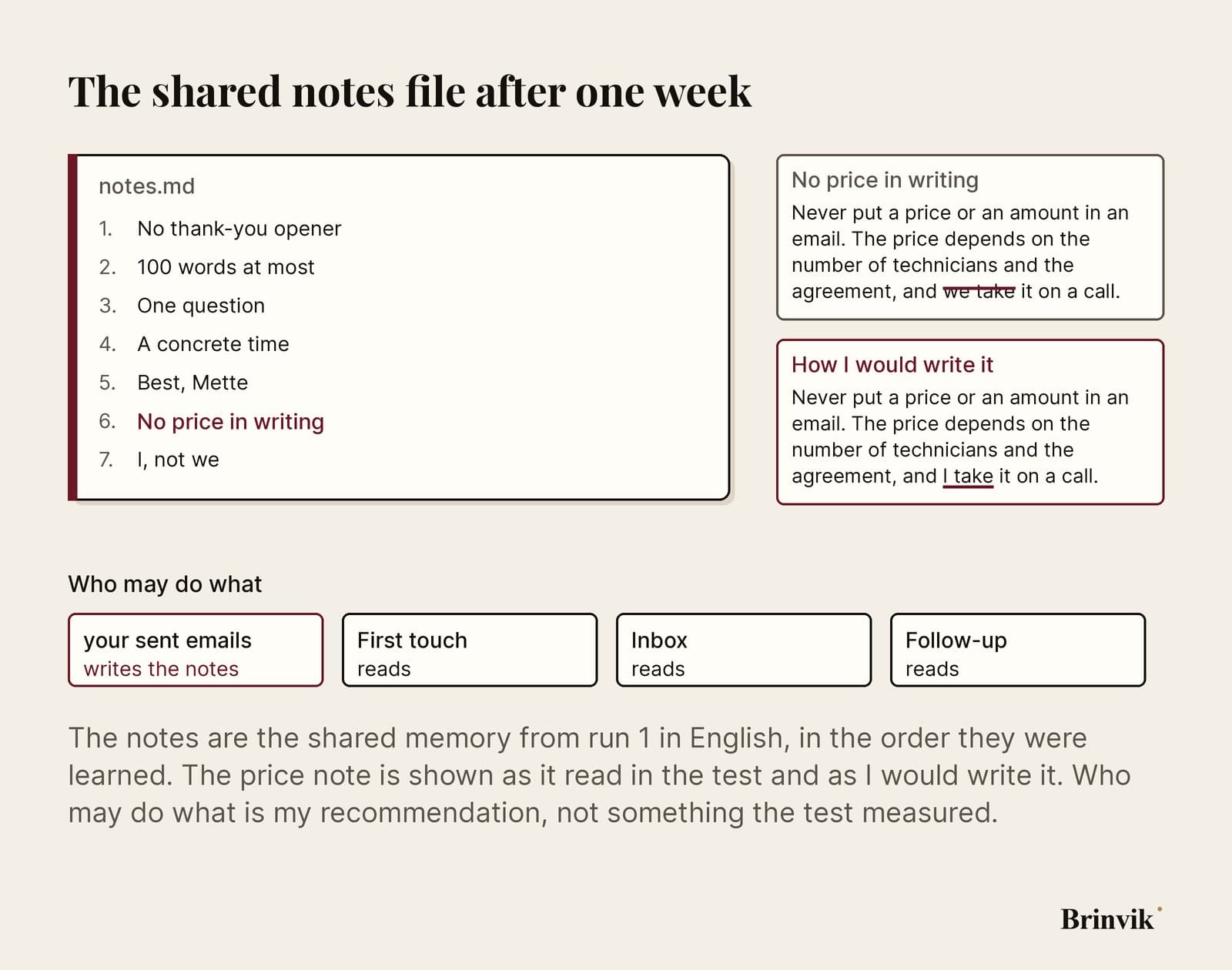
The scenario: Mette sells scheduling software for a fictional Danish company with 40 staff. She has three agents: First touch for new leads, Inbox for customer email, and Follow-up for the email after a meeting. She has eight house rules the agents are never told: no thank-you opener, 100 words at most, one question, a concrete time, no exclamation marks, "Best, Mette", no price in writing, and "I" rather than "we". When a draft breaks a rule she corrects it, and the correction is saved as a note in her words.
Two set-ups, the same 30 tasks in the same order. In one, the agents keep separate notes. In the other, they share one memory. The week ran three times in each set-up, in Danish and again in English, twelve runs in all, with Claude Sonnet 5.5: 360 drafts for $3.17 at list price. The Danish runs were there to see whether the effect held across languages. A script that checks the eight rules plays Mette, so every number can be checked.
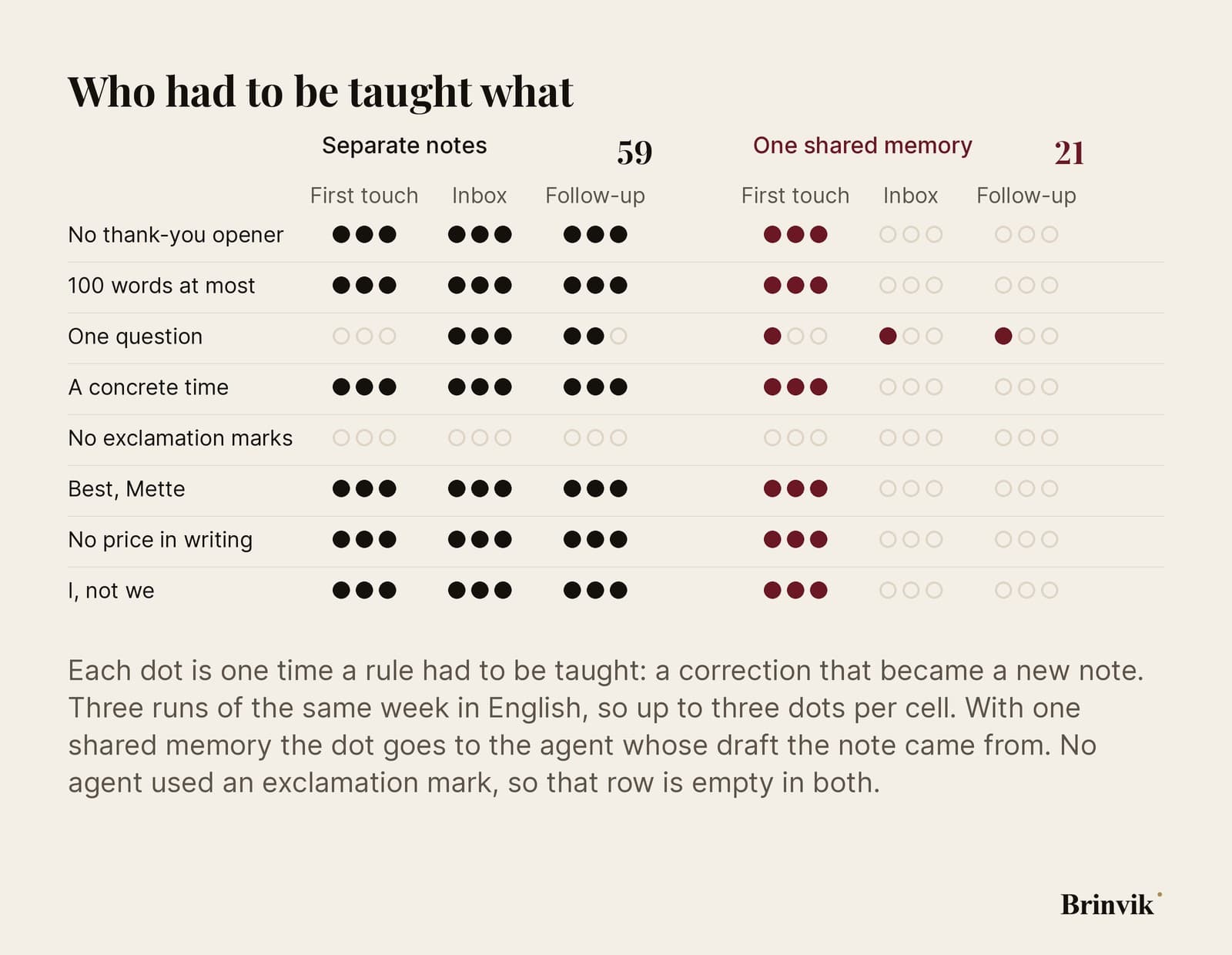
With separate notes, Mette had to teach 19 or 20 rule lessons per run, one rule to one agent each time. With shared memory, 7. A lesson is the first correction of a rule; corrections count every time a rule is broken, so there are more of them. No agent ever used an exclamation mark, so that rule never needed teaching.
Over a week that came to 37 to 41 corrections in the English runs with separate notes and 13 to 20 with shared memory. In Danish, 33 to 34 versus 13 to 16. Across all twelve runs: 215 versus 92, and shared memory came out lower in every run.
Almost all of it happened on Monday. The rest of the week, both set-ups were close to zero.
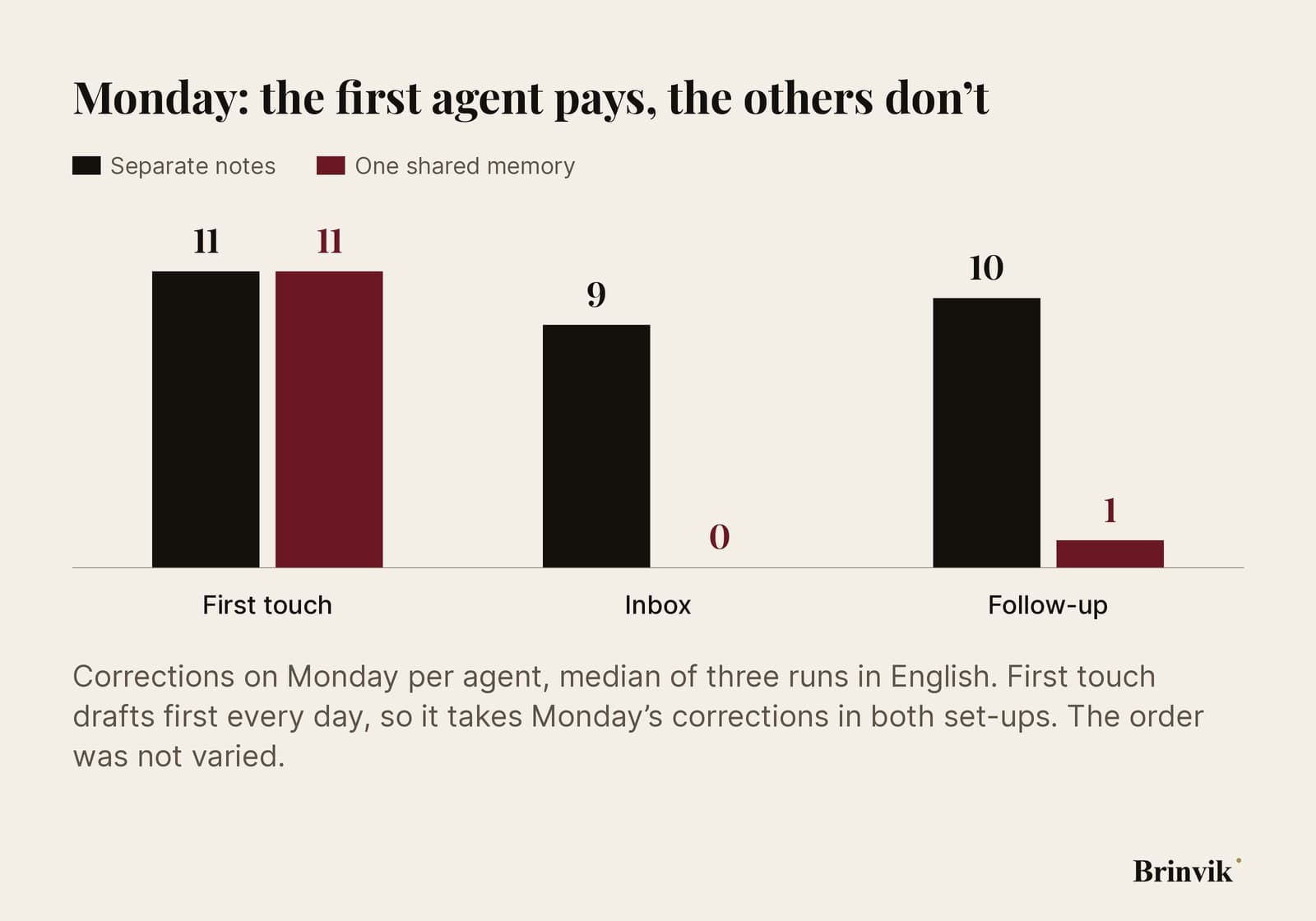
First touch drafts first every morning and took 11 corrections on Monday in both set-ups. With shared memory, the agents after it got off lightly: the second and third paid almost nothing. I didn't try more agents, but the arithmetic holds: a rule is taught once instead of once per agent, so the more agents you run, the more you save.
That only works if an agent follows a note it didn't earn itself. They did. A note that came from another agent's draft was followed 801 of the 814 times it sat in front of a draft, and a note from the agent's own drafts 1,183 of 1,202 times. The agents followed each other's notes as well as their own.

A note teaches your agents more than it says
One rule didn't seem to stick. The script counted "I, not we" as broken 31 times even though the agent had the note in front of it. That's 31 of the 32 times in the whole test that Mette had to say the same thing twice.
In 28 of those 31 it's the "we" that means you and me: "Could we talk Tuesday at 10:00?" Mette's note says: "Write 'I', not 'we', 'us' or 'our'. The customer is talking to me, not to a company." The agents followed the reason. A "we" that means the customer and Mette together isn't a company, and they left it in.
Only 3 times did they write the "we" the note was aimed at: "our minimum", "our setup", and one Danish draft that took its "we" straight from another note. Mette's price note ended "we take it on a call", and a Danish agent wrote the same words back. It picked up the wording too.
The meeting note said: propose a specific weekday and a time, "for example Tuesday at 10:00". Of the 306 drafts that saw that note, 155 proposed exactly Tuesday at 10:00. Of the 54 written before the note existed, none did. About half of the customers whose email was drafted with that note in front of it would have been offered the same slot. That was counted after the run; it wasn't part of the test from the start.

How to write a correction your AI sales agent learns from
- Write the note the way you want the draft to sound. The agent reuses your words, including the ones you didn't think about.
- Give the reason. The agents followed the reason for a rule, not just the word in it.
- Leave out any example you don't want repeated. "Propose two specific times next week" would likely spread Mette's calendar better than "for example Tuesday at 10:00".
You can do this today without building anything: put your corrections and the reasons for them in one shared instruction file that all your assistants read, such as a project in the Claude app.
There are two things the test can't tell you. The notes were fixed sentences, written before the test. In Anthropic's example the agents write the note themselves from the difference between the draft and the email that went out, and whether they write good notes wasn't measured. And the script only checks the eight rules.

Who gets to write to the shared memory
A draft can follow every rule and still promise something Mette hasn't decided. The clean Inbox draft above says "Yes, I'll extend your trial". No rule covers that, and nobody corrected it. That's why the agents draft and you send.
A shared memory spreads a bad note as fast as a good one. Anthropic says so itself in the documentation for memory in Managed Agents: a memory store, the place the agents' shared notes live, attaches with read and write access by default. If the agent reads something from outside, such as a customer's email, a well-crafted email can get it to write a note that every later session trusts. Anthropic recommends read-only access wherever the agent doesn't need to write.
In the sales team it's Inbox that reads customer email. So I recommend that the agents that read anything from outside only get to read the notes. Only two things write them: the emails you actually sent, and a coordinator that only takes corrections from you. The Anthropic rep set his up the same way. Only he can ask for changes to the agents' instructions.
For anyone already building agents, the kit includes a ready-made skill, shared notes. A skill is an instruction file Claude reads when the task fits. This one makes an agent read the notes before it drafts, turn your edits into notes in your words, update an existing note instead of adding a new one, and never write a note from a customer's email. It works in a shared folder your skills read from in the Claude app, and in a memory store in Claude Managed Agents.

When I set up AI agents for a sales team
As an AI consultant and Claude specialist I can set up agents like these for sales teams: an AI sales agent that replies to new leads, one that answers the inbox and one that follows up after meetings, with one shared memory. Building the agents is quick. What takes judgement is deciding which corrections become rules and who may write the notes, before one bad note has taught three agents something wrong for a week.
If that's where you are, read more about internal AI tools, or send me the three kinds of email your team writes most. I'll suggest which agent should draft first and which of your corrections should become notes. And if you run an agent on a schedule already, read what happened to the agent that wrote the morning brief.
FAQ
Frequently asked questions
Yes. In Claude Managed Agents several agents can read and write the same memory store, and every change is saved as a version, so you can see which agent wrote what. In the Claude app you can get the same effect with a shared folder that all your skills read from.
Yes. Anthropic's rep in Japan built the whole thing in Claude first, with a skill per agent, a scheduled task per skill and a shared folder as the shared memory. The skill in the kit works in both places.
Every agent reads it afterwards as if it were right. That's why Anthropic recommends read-only access wherever the agent doesn't need to write. Let the agents that read customer email only read the notes, and let only your own sent emails or a coordinator write them.
In the test the agents learned seven rules on a single Monday, and there was almost nothing to correct for the rest of the week. Anthropic's rep writes that it took a few hundred cheap rounds before the drafts sounded like him. It depends on how many of your habits can be written down as rules.
Yes. The prompt describes the agent's job, and the notes describe how you want things done. In the test each agent had its own role and the same shared memory.
All 360 drafts in the test cost $3.17 at list price with Claude Sonnet 5.5, under a cent per draft. The price depends on the model and on how long your emails and notes are.
In the test the agents only drafted, and Mette corrected them. That's how I'd start too: the agents draft, you send. A draft can follow every rule and still promise something you haven't decided.
Sources
- Claude: How an Anthropic BDR in Japan runs his day with Claude Managed Agents, 16 October 2026
- Claude Platform Docs: Using agent memory (memory stores and read-only access)
- Claude: Built-in memory for Claude Managed Agents, 23 April 2026
- Brinvik: fix-it-once kit, the guide, skill, script and all 360 drafts