In short: When a sales team shares skills in Claude, Claude picks the skill for each request from its name and description, unseen. I had Claude build an invented team with seven sales skills and 40 requests written the way sellers type them. Claude loaded the expected skill in 120 of 120 runs. With twenty skills that overlap, it was 117 of 120. Then Claude rewrote the description of the one skill that missed. The miss was fixed, and two requests that were right before now went to the wrong skill in every run.
Further down there is an interactive demo where you watch every request land in the skill Claude picked and open any of them to see all three runs.

Why should a sales lead care which skill Claude loads?
A skill is the team's own recipe: how we prep a first meeting, how we write a proposal, how we answer an objection. It only works if Claude loads it. When a seller types "they said we already use a competitor and are happy, how do I respond", Claude should find your objection skill, not answer in its own words.
If Claude loads the wrong skill, the seller gets a proposal written like a price sum, or a follow-up without your template. If it loads none, the seller gets a generic answer. No error appears. The seller assumes the team's recipe was used, and the sales lead assumes the rollout works.

How do I use Claude in my business with skills the whole team shares?
Write one skill per task the team repeats, and give it a description that says when to use it, with examples in the words your sellers actually type. At the same time, write a list of 30 to 50 real requests, each labelled with the skill that should load. Run the list before you roll skills out, and again every time a description changes.

Seven skills fired right. Twenty started to overlap
The first result surprised me. Seven skills with one plain sentence each, the 40 requests short and messy, Danish and English, and Claude was right in 120 of 120 runs. A small library of skills that do clearly different jobs works fine with a first draft.
Then the library grew to twenty skills, and several of the new ones sat right next to the old: a follow-up email skill beside the call recap, a pricing skill beside the proposal skill. The labels were set before the run started, and four requests accept either of two skills where a sales lead would take both. One of those, a request for a quote document, went to the pricing skill every time and counts as right.
The result was 117 of 120. The only miss was a quick discount sum, "what's 15% off 48,000 kr" (asked in Danish), which loaded the pricing skill where the label said no skill. That label was set before the pricing skill existed, and you can argue the pricing skill should take it.
Claude was shown only that one miss and rewrote the description of the pricing skill alone. The new description says a quick standalone sum does not belong there, and the sum now went to no skill in all three runs. But the new description also calls a quote "an offer (tilbud)" and gives a Danish example that asks for a tilbud for 20 licences.
Two requests had loaded the proposal skill in all three runs: "they want a tilbud by Friday, can you start on it? notes attached" and "build a tilbud for Sund Klinik from the notes, price 95,000 kr", both asked in Danish and shown here in English. After the fix they went to the pricing skill in all three. Most likely because tilbud in Danish means both a proposal and a quote. That is one rewrite, not proof of the cause.
For the team, two things follow. The risk arrives when the library grows and new skills settle next to old ones. And fixing one description can pull requests away from its neighbour without anyone noticing. Whoever owns the team's skills needs a fixed list of requests and has to run the whole list after every change. On the sixteen requests Claude had never seen, the result went from 45 to 42 of 48 after the fix. A Nordic team also has to watch for words that mean two things in Danish when the descriptions are written in English.

Can you trust the numbers?
The team, the skills and the requests are invented, and the labels were set by the builder. Each request went to Claude Sonnet 5.5 three times with the library as its only tool; the first skill Claude called is the pick. That is my reconstruction of how a skill is picked, not Claude Code's or claude.ai's own loader. Claude picks from the name and description, as Anthropic's documentation on skills describes. Every number was worked out again from the saved runs. Three runs per request is a small sample, so "3 of 3" means consistent in three tries. A separate review hunted for claims that did not hold; its caveats are in the text above.
Try it: let the demo play through, then tap any request to see which skill Claude picked in each of the three runs. "Run 1, 2, 3" switches between them.

Run the test on your own skills
The test runner is free by email: the script, the twenty sales skills, the 56 labelled requests, my scored runs and a README in English and Danish. Get the skill test runner.
To use it: write 30 to 50 requests your sellers actually type, with no customer names, and label each with the skill that should load. Point the runner at your skills folder and run the list with your own API key. You get a scorecard and every miss with its three picks. Fix the description, then run the whole list again, not only the request you fixed.
What it will not do. It reproduces how a skill is picked, but it is not one specific app's own loader, so a result says whether a description steers Claude well. The labels are yours, and if a label is arguable, so is the score. A reply with no skill call counts as no skill, even when Claude asked a question instead; the reply is saved so you can see it. And the requests go to the Claude API, so use examples with no customer data in them.

Internal AI tools your sellers can trust to fire
I am an AI consultant in Copenhagen, and I build internal AI tools on Claude for Nordic B2B sales teams. When I roll out skills for a team, we write the descriptions in the words your sellers use, in both languages, and we build the request list together so it runs again every time the library changes. That is the part of a Claude implementation that turns AI for revenue operations into something a sales lead can stand behind. See how I build internal AI tools.
Skills have a security side too. Read what Anthropic's skill scanning covers, and what it does not.
FAQ
Frequently asked questions
A folder with a SKILL.md file that has a name, a description and a procedure. Claude reads the name and description and loads the rest only when it picks the skill.
From the name and the description. That makes the description the thing you steer with: it should say when to use the skill, ideally with examples in your sellers' own words.
The test showed no limit at seven, but overlap started to cost once the library grew to twenty. It is less about the count and more about how close the skills sit to each other.
Write them in the language you work in, and include examples in both if your sellers type both. Watch for words that mean two things, like tilbud.
No. The team and the requests are invented, and the labels were set by the builder. Run the test on your own requests to get your own numbers.
One Claude API call per request per run. 56 requests at three runs is 168 calls on your own API key.
Yes. I write the descriptions with your team and build the request list so it runs every time a skill changes.
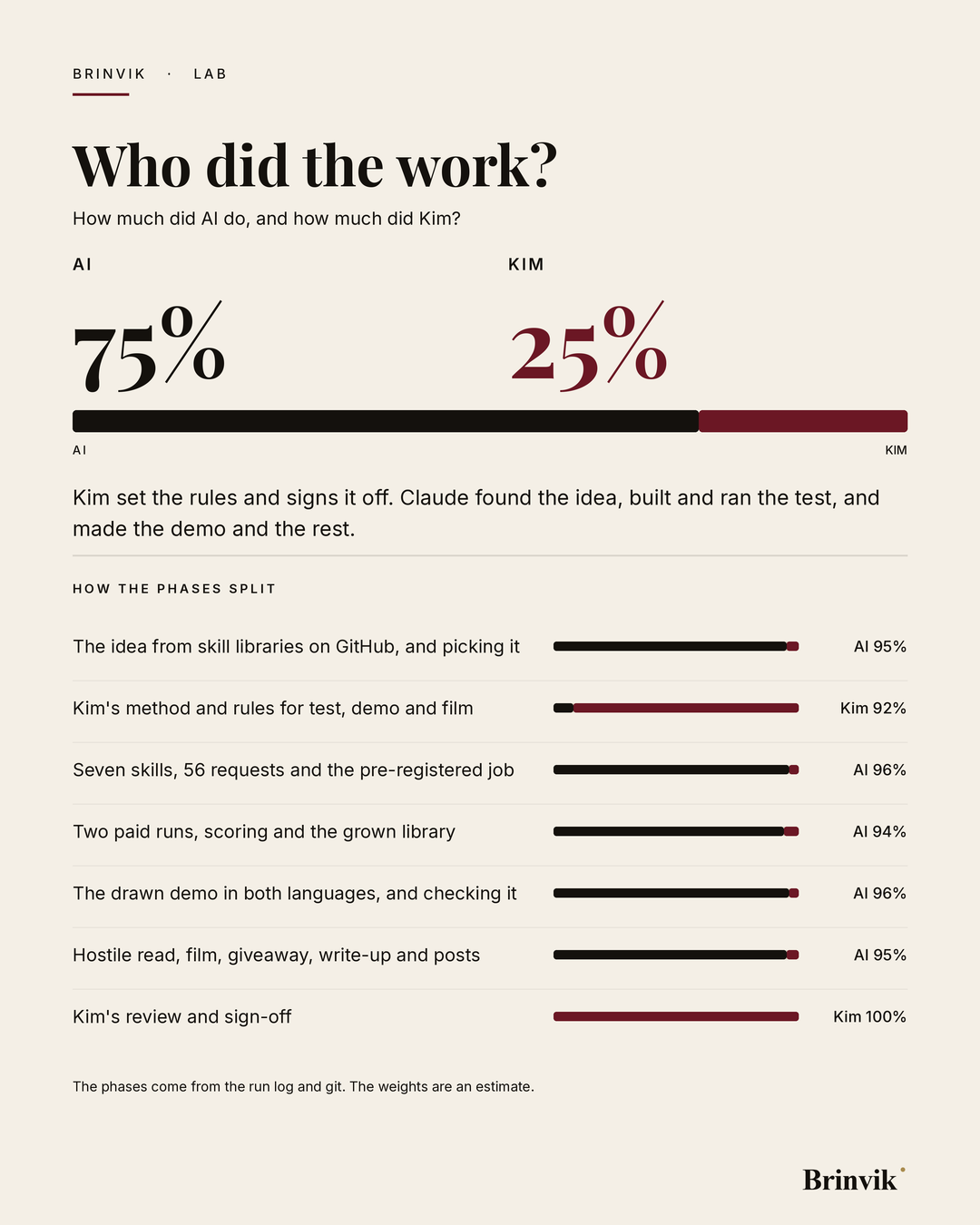
Who did the work: AI 75%, Kim 25%. Kim set the method and the rules for how a test becomes a resource, and signs it all off before it goes out. Claude Code found the idea among skill libraries on GitHub, wrote the skills and the requests, ran the test through the Claude API, built the demo in both languages and made the film and the write-up. The phases come from the run log and git; the weights are an estimate.