TL;DR: The Hard Buyer is a sales call you can play in your browser. You have booked ten minutes with Henrik, head of finance at an invented 45-person freight company, and each turn you pick one of three replies. Ask about his numbers and his process and he opens up. Pitch him and his patience drops. The eight letters of MEDDPICC light up as he gives away what a seller needs to know before a meeting is worth having. Turn the sound on and Henrik says his lines out loud, in English or Danish. Claude built it, and the game, the dialogue tree and the prompt behind it are free.
The game runs entirely in your browser. It fetches nothing, stores nothing and does not call Claude while you play, so Henrik only says what is in the dialogue tree. Claude wrote that tree, the engine, the drawing of Henrik and the tests that had to show every one of the 42 points in the conversation can be reached before the game was allowed out.

What Henrik rewards
MEDDPICC is a method for qualifying a B2B deal, and it does its work inside the conversation. The letters stand for Metrics, Economic buyer, Decision criteria, Decision process, Paper process, Identify pain, Champion and Competition. Used on a call, it steers you to what matters to this particular buyer. With the answers, you have a map of what has to happen before the deal can close and how long that will realistically take, even before you and the buyer have talked about timing. That map is what a better forecast is built on.
A letter lights only when Henrik himself says something that belongs to it. If he dodges, it stays dark, however good your question was. Ask how many invoices you are talking about, and he answers: about 1,400 a month, three percent wrong, and 212,000 kroner found last year that they should never have paid. That lights M.
Above the letters sits a patience bar. A good question earns a little back, a pitch costs a lot, and when the bar reaches zero he hangs up. Pick the top reply every time and the call is over in four turns.

The shortest road to a meeting starts with a mistake
You can book the meeting in ten turns, and the shortest way there opens with the worst reply in the first turn: "We help companies like yours save 40% of their time with AI automation." Henrik says "Everybody says that", and his patience drops by 25 points. A bad opening is survivable if you correct course straight away and ask whether he has the problem at all.
All eight letters take eleven turns, and there is one more trap on the way. Henrik explains that anything touching their data has to go past their IT partner and needs a data processing agreement, and that it took six weeks last time. The tempting reply is "We will handle that. It is just a formality." That costs 10 points, and he asks what you actually want out of the call.
The last two letters arrive on the same line. Ask Henrik who he thinks should be in the meeting, and he names Maja, who will use the tool, and Lise, who pays.
Put his answers together and you have the timeline. The proposal has to be with Lise before 15 November or it waits until March, and the IT partner and the data processing agreement took six weeks last time. That date can go in your forecast, because it rests on his answers rather than a guess.

Take the dialogue tree
All of it is free to copy and adapt:
- The whole game as a zip file, with an index.html that opens in a browser with no internet
- The dialogue tree as JSON: 42 points in the conversation, 117 replies and three endings, in Danish and English
- The prompt to give Claude for a buyer from your own market, in the same format
The prompt asks for a buyer, a product and one fact for each of the eight letters, and it has Claude check that every point in the conversation can be reached before it hands over the tree. Drop the new JSON into index.html in place of Henrik's tree and you are playing your own buyer. Or print the tree and read it aloud with a colleague playing the buyer, which needs no code at all.
The game does not listen. It cannot hear tone, silence or timing, and Henrik can only say what the tree gives him, so practise the voice in a role play afterwards. There is room to explore, though: 7,799 distinct states are reachable once you count where you are in the call, how patient Henrik is and which letters are lit.

What went wrong on the way
Claude built the game in one session on the evening of 28 September. Twenty minutes passed between the first and the last saved version of the code, and the work before the first one is not counted. In the night to 1 October, Henrik got a voice in English and Danish and an office in 3D, built with three.js. It all sits in one file, because the frame on this page is not allowed to load anything from outside.
Claude tested it in a headless browser, both on its own and inside the frame you see here, under the same security rules as brinvik.com. The test played the shortest road to the end in Danish and English, on a desktop screen and on a phone 375 pixels wide. It found two bugs. When a call ended, the end screen covered the top of the screen, so you could not switch language. And on the phone, Henrik's longest lines covered his face. They now sit under the picture, like subtitles.
The frame cannot tell whether the page around it is Danish or English either, so the game exists in two copies, one that opens in Danish and one that opens in English. Henrik's voice was made in advance with speech synthesis that runs without the internet, and it sits inside the file. Sound is off when you start, and the speaker button at the top turns it on.
The test also found a bug in the voice. On a slow computer your replies never appeared, because the text and the sound were waiting for each other. Now they appear when Henrik stops talking, even if the browser forgets to say so. After that the voice played inside the frame in both Danish and English, but nobody has listened to it on every phone. On a computer without a graphics card, the 3D office draws fewer frames per second.

An AI workshop where the buyer is your own
Henrik is invented, and so are his invoices. Your hard buyers live in your CRM and in the calls that went nowhere. Claude will happily write a dialogue tree. The work is pulling the right objections out of your own data without the customers' names coming along with them.
As an AI consultant in Copenhagen, I can build this for your sales team: a buyer written from your own lost deals, for new sellers to practise on before they call a real customer. It can be an AI workshop where the team builds and plays its own buyer in a day, or one of the internal AI tools a new seller finds ready on their first day. See how an AI workshop with me works.
If you would rather see Claude on real sales numbers than on an invented call, I tested two Claude models on the same sales forecast.
FAQ
Frequently asked questions
A method for qualifying a B2B deal on eight points: Metrics, Economic buyer, Decision criteria, Decision process, Paper process, Identify pain, Champion and Competition. Asked in the conversation, the questions show you what has to happen before the deal can close and how long that will realistically take, which is what a forecast has to rest on.
Yes. The game is free and runs in the browser with no sign-in. It trains what you ask, not how you sound, so it works best as the warm-up to a conversation or a role play afterwards.
Yes. Press the speaker button at the top of the game and he says his lines out loud, in English or Danish, depending on the language you picked. The voice is speech synthesis and runs without the internet.
No. Claude wrote the dialogue tree and the code in advance. While you play, the page fetches nothing and stores nothing, and Henrik only says what is in the tree.
Fill in the brackets in the prompt and give it to Claude. You get a JSON file in the same format as Henrik's tree, which you can drop into the game's index.html or read aloud with a colleague.
No. The company, Henrik, Maja, Lise and every number in the call are invented. Before the game went out, Claude searched for the name online and found no company by that name.
Yes. In one day of AI training for teams, the group can write a buyer from its own lost deals and play it the same day. You need some real objections and someone who knows the sales process, and the customers' names come out before anything goes into Claude.
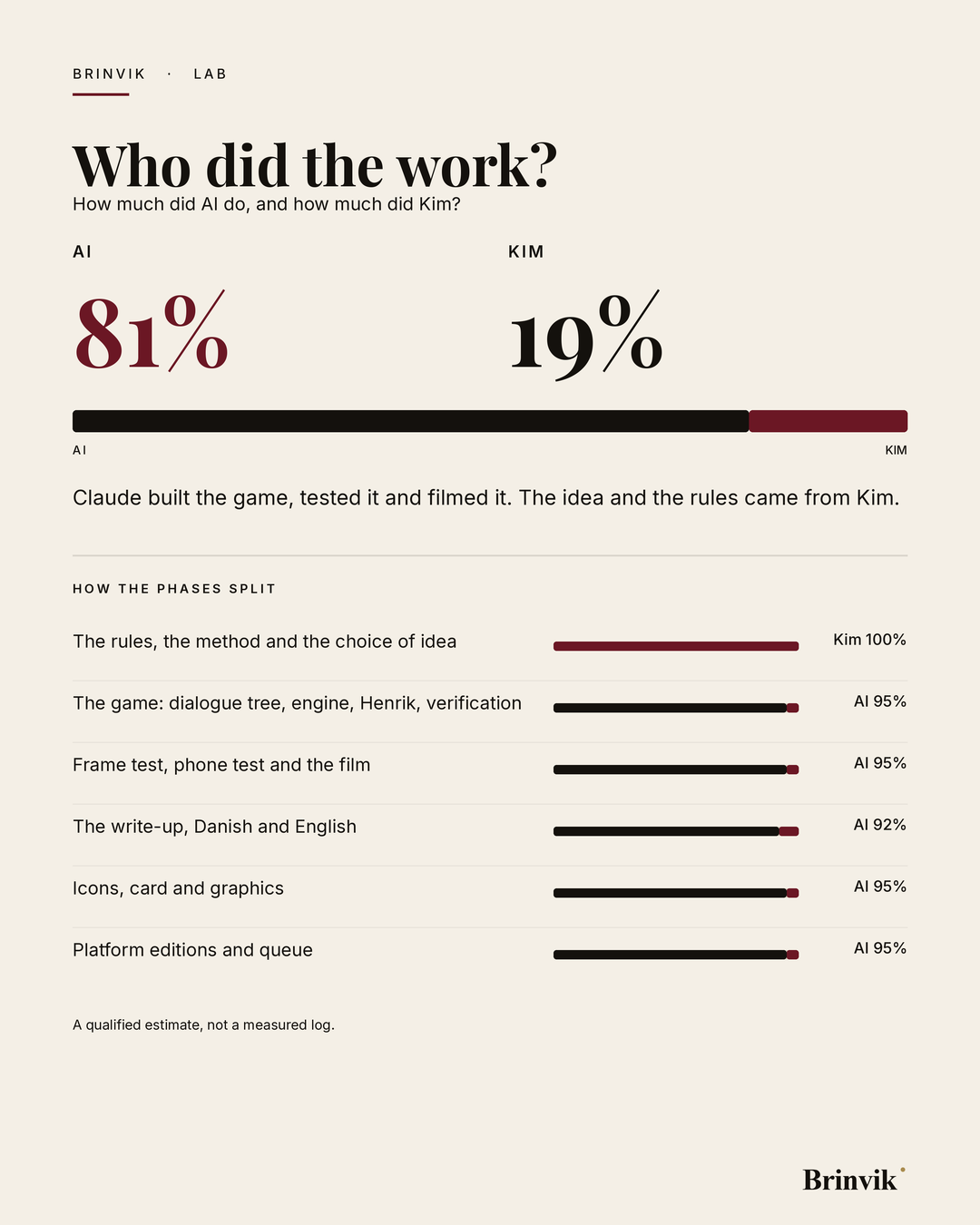
How this page was made. This work was produced together with AI. Overall: AI about 81 percent, Kim about 19 percent. Counting production alone, AI did about 94 percent. Claude wrote the dialogue tree, built the game, drew Henrik, tested it in a browser and on a phone and filmed it before a word of this page was written. Kim chose the idea and wrote the rules, the voice and the method in advance. The numbers are a qualified estimate, not a measured log.