The assistant that used to answer in headings and bullets now writes long paragraphs. In the middle of a longer task it sits silent for minutes.
Nobody touched it. Nobody deployed anything. No message arrived from your vendor, and nothing in your own setup changed. The model underneath is a different one from last week.
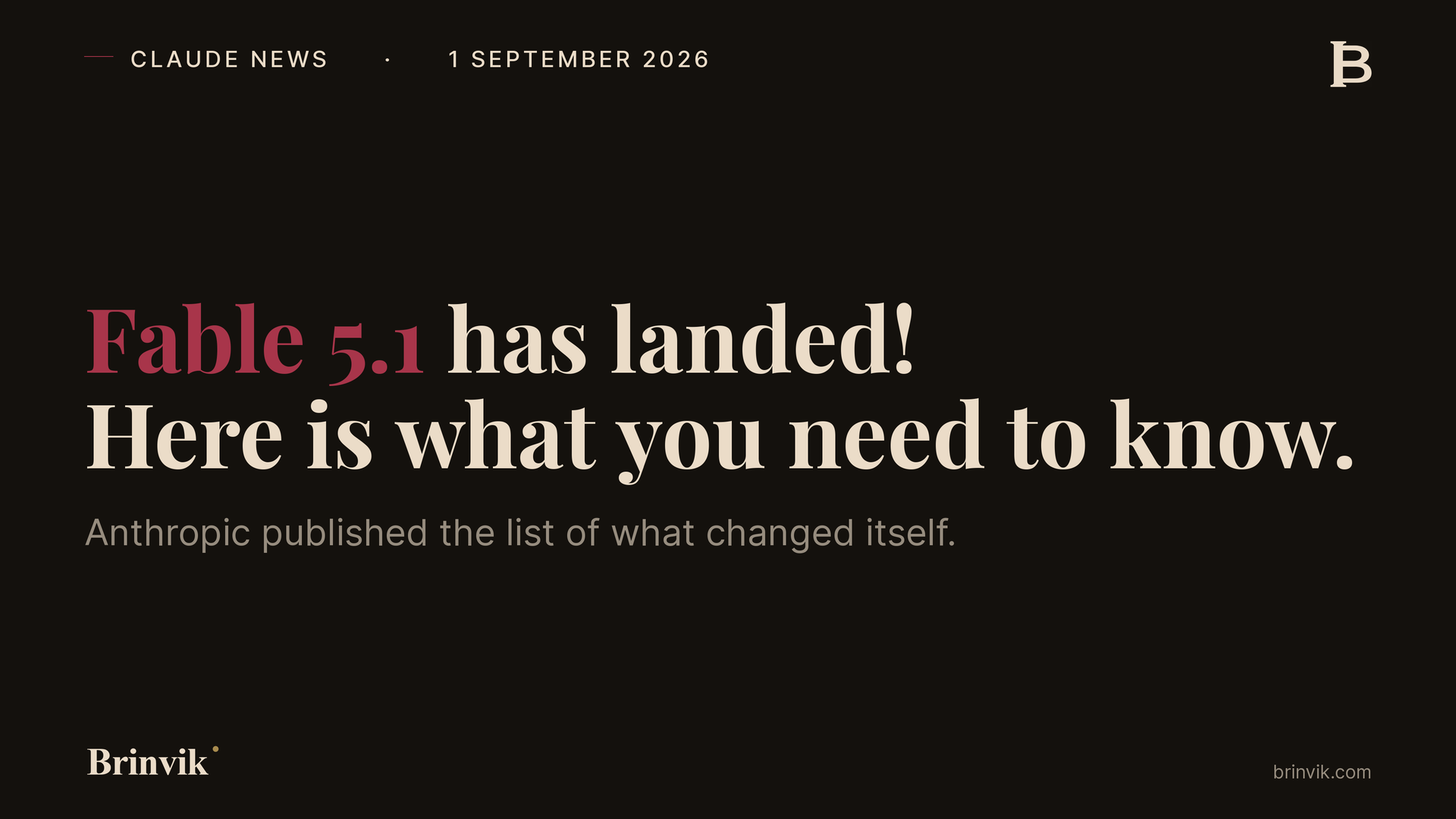
Anthropic released Claude Fable 5.1 on 1 September 2026. It is the third time this year that a change at Anthropic has landed on a Claude implementation the company running it does not control. The first two were about the model disappearing, and then coming back. This time nothing disappears. On its own migration page there are seven differences about how it behaves differently from the model it replaces. That is an unusual list to publish on launch day. Most vendors publish what got better.
A customer sees three of them. Two nobody sees until they bite. Two show up only on the bill. All seven arrive with no code change.
A vendor can swap the model underneath you without asking. Those seven differences are what you would have been told, if anyone had given you notice.
Anthropic: Introducing Claude Fable 5.1 and Claude Mythos 5.1 (1 September 2026) →
Claude Fable 5.1 differs from Claude Fable 5 in several ways that show up without any code change.
Anthropic changed the model. Your vendor does not have to ask you first.
Input and output prices are unchanged. 10 dollars per million input tokens and 50 per million output tokens, exactly as on Fable 5. The model runs on five platforms: the Claude API, Amazon Bedrock, Claude Platform on AWS, Google Cloud Vertex AI and Microsoft Azure Foundry. Anthropic's own documentation still recommends starting with Claude Opus 5 for most workloads. Claude Mythos 5.1 is limited to Project Glasswing participants, so almost nobody can reach it at all.
Commercially, then, nothing happened. That is the reason the swap is invisible. There is no new contract, no new price and no new vendor to approve, so there is no point in the process where anyone would naturally have stopped and told you.
Treat the rest of this article as the notice you are not getting.
First a question that decides how you read the rest: do you set the model yourself, or does a vendor? If your own team writes the model id into an API call, the sections on the money and on the breaking changes are yours. If Claude arrives through a CRM, a support tool or a platform you buy finished, those two sections are context, and the sections on questions and on the clause are the ones that matter to you.
Who notices what
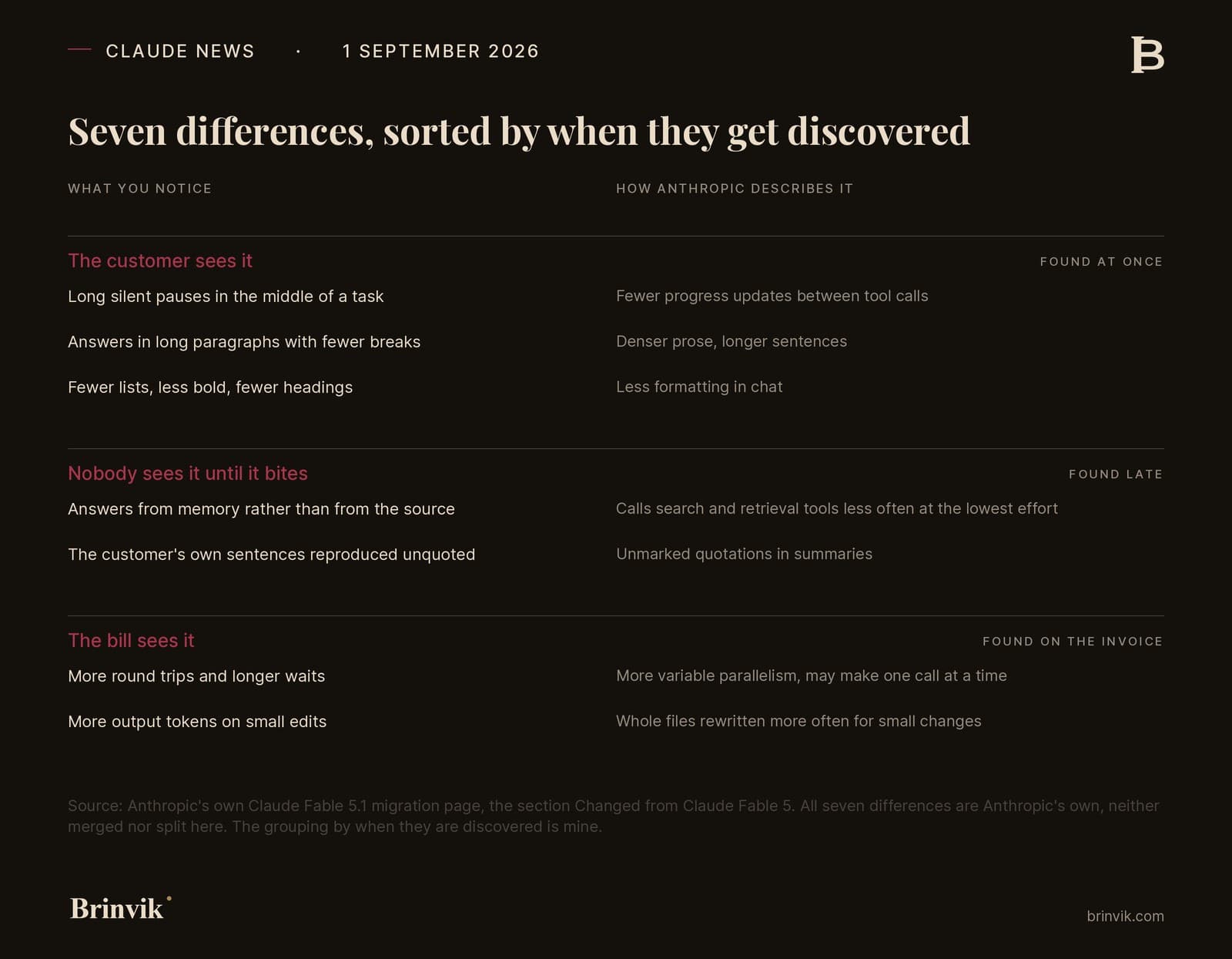
Anthropic lists seven differences. The count is theirs, and I have neither merged nor split any of them. The grouping below is mine, and it follows who notices each one.
What the customer sees
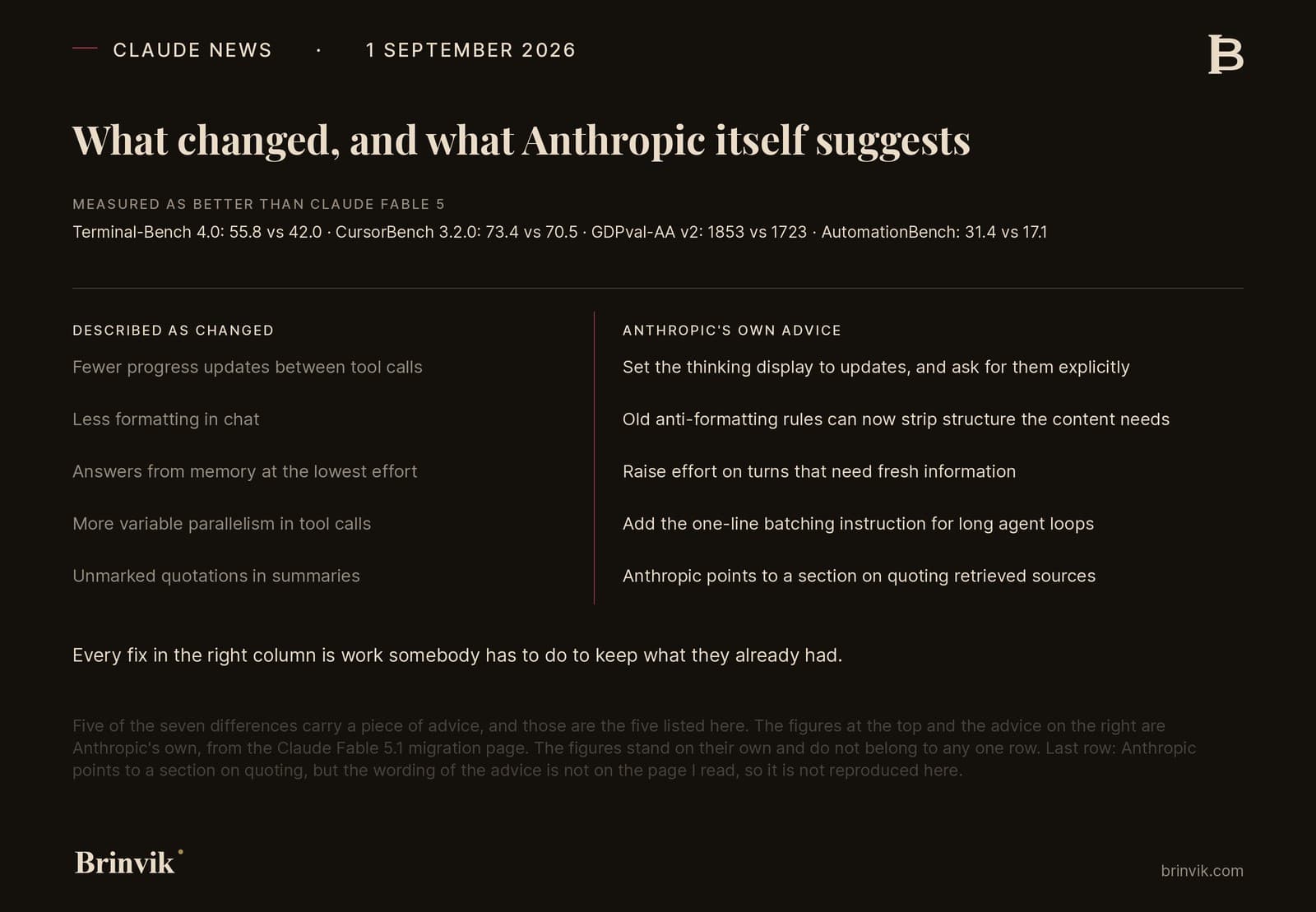
Fewer progress updates during long runs. The model writes less text between its tool calls, especially when it works thoroughly. A long task can look completely silent to whoever is waiting. Anthropic's advice is to switch the thinking display to updates and explicitly ask for an opening line, running updates and a close.
Denser prose. Longer sentences and fewer paragraph breaks than before.
Less formatting in chat. Bold, headings and lists are used less than in earlier Claude models. Anthropic points out something easy to miss: if somebody once wrote a rule against too much formatting, because an older model overdid it, that rule now strips out structure the text needs.
What nobody sees until it bites
Answers from memory rather than from the source. At the lowest effort level the model calls a search or retrieval tool less often. Anthropic's advice is to raise effort on turns that need fresh information. The trouble is the shape of it: an answer taken from memory looks exactly like an answer taken from the source. There is no error message and no empty field.
Unmarked quotations in summaries. When the model summarises a document, it more often reproduces passages from the source without marking them as quotations.
The two combine in a way that lands on a sales or RevOps team directly. Picture an assistant that writes up customer meetings and pulls answers from your CRM. After the swap the write-up reproduces the customer's own phrasing as though it were the assistant's, and on a question about that customer's contract it answers from what it remembers about contracts of that kind rather than looking up the specific one. Both read perfectly normally. The first surfaces the day a customer recognises their own sentence. The second surfaces the day an answer is wrong enough that somebody checks.
What the bill sees
One tool call at a time. Where Fable 5 batched several calls into one turn, Fable 5.1 more often makes them one by one. That costs tokens, round trips and waiting time. Anthropic states that it does not make the answers worse, and its advice is to ask explicitly for batched calls in long agent loops.
Whole files rewritten for small edits. When editing text files the model more often rewrites the whole file rather than fixing the one place. The result is usually the same, but it costs more output tokens and more time.
The reason to move anyway
There are good reasons to move, and they should stand clearly before I argue for doing it with notice rather than without.
Anthropic has published figures from a number of customers, which are those companies' own measurements. At Glean, judges preferred Fable 5.1's answers roughly two to one over Fable 5. Browserbase completed 82 percent of its tasks in about ten minutes each, against 74 percent for Opus 5 and 57 percent for Fable 5. Rogo matches Fable 5's accuracy on 20 percent fewer tokens. On Anthropic's own AutomationBench, which measures business workflows, it goes from 17.1 to 31.4.
For long-running agentic work every published number points the same way, and it points to Fable 5.1.
Cache reads are the number I would let settle it. They cost 0.25 dollars per million tokens, which is 0.025 times the base input price, against 0.1 times on every other Claude model. A quarter of the Fable 5 price. On exactly the kind of work this model is built for, a long session that re-reads the same prefix over and over, that is the line that moves the bill. Anthropic's own figure for the combined effect is about 25 percent lower cost in typical use and up to 45 percent for heavy agentic work.
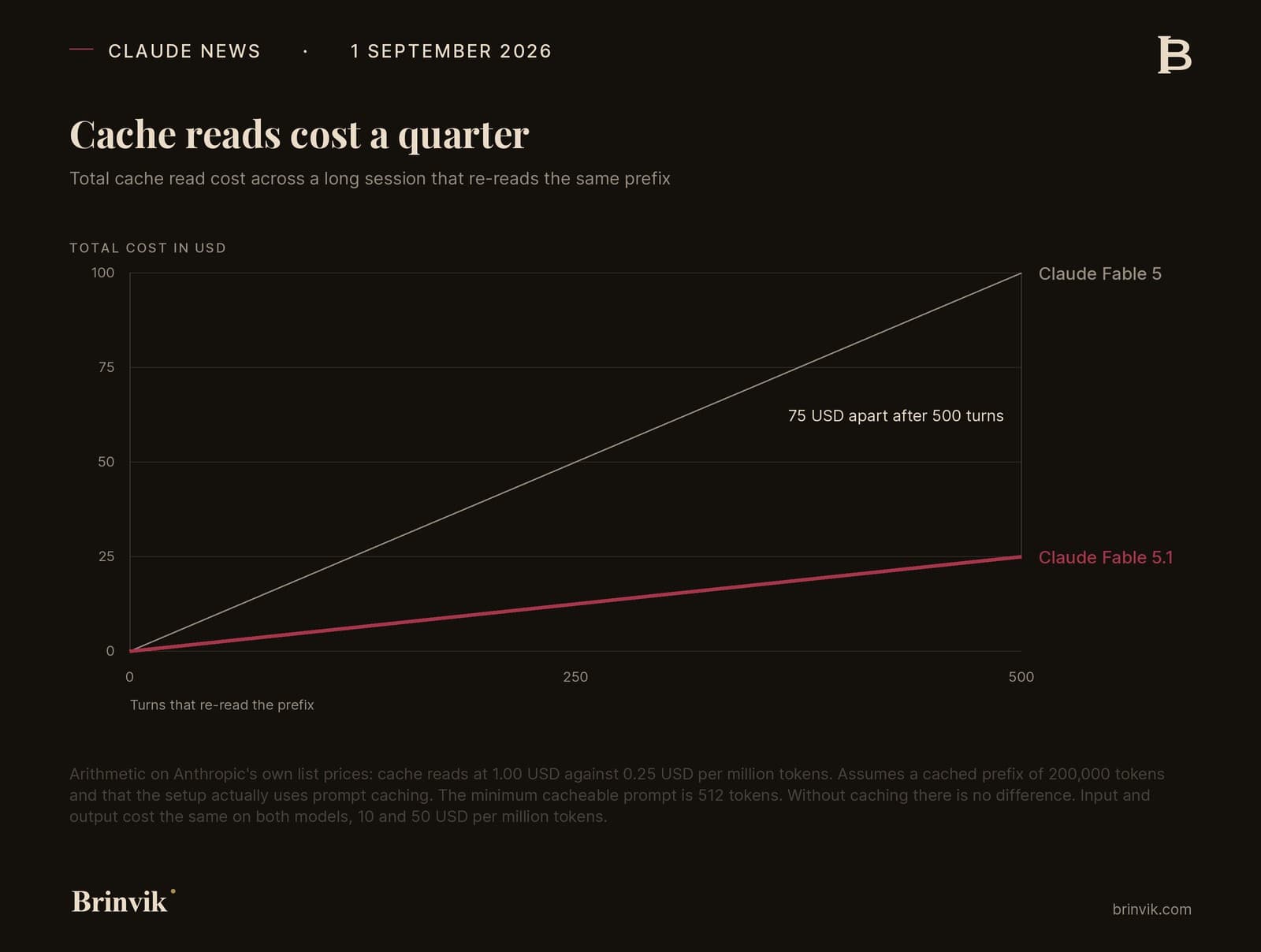
With one caveat that matters for most readers here: the discount applies to cache reads. It only triggers if the setup actually uses prompt caching, and the minimum cacheable prompt is 512 tokens. If a vendor runs the model for you, you do not decide whether anything is cached. In that case the saving is theirs rather than yours, unless you have agreed otherwise.
If somebody built on top of Fable 5
This section is for those who call the API themselves. If you do not, you can skip it.
Anthropic marks three changes as breaking.
Forced tool use no longer works. Requiring the model to call a tool returns a 400 error. Only the optional settings go through. The reason is that thinking is always on in this model, and a forced call would skip it, so the model would write its reasoning into the arguments instead. The way around it is strict schema checking on the tool, or structured outputs.
The model's thinking blocks are bound to the model that produced them. The binding runs one way only: Fable 5.1 can read older models' blocks, but no older model can read Fable 5.1's. If you have a router or a fallback that switches models mid-conversation, the blocks are dropped silently unless you turn on reporting with a beta header. Then it is disclosed in the response.
Editing earlier turns invalidates later thinking blocks. Change the system prompt, the tools list or an earlier message and the next call fails. Whether it hits you depends on when the account was created. The check is enforced for accounts created on 31 August 2026 or later on Claude Platform, Amazon Bedrock, Google Cloud Vertex AI and Microsoft Azure Foundry. Older accounts record the mismatch but act on it only if the call itself asks. Claude Code, Claude Cowork, claude.ai and third-party products are unaffected. Anthropic's stated purpose is to make distillation harder, because editing the history is a common technique in those campaigns.
The practical rule for all three: treat the conversation as something that may only grow at the end. Add new turns at the end, and leave what is already there alone.
Questions you can send your vendor today
These questions follow from the seven differences above. They are not general vendor hygiene, and they can go out in an email this afternoon. A Claude implementation you do not run yourself stands or falls on somebody being able to answer them.
Which Claude model and which version is running behind your product right now? The model id, not the product name.
What effort level are you running it at? That decides how often it looks things up rather than answering from memory.
Is anybody reading the assistant's summaries for unmarked quotations? The question sounds odd until you know Anthropic has written that it reproduces source passages more often now.
How do we find out when you change model?
There is one more area where you should know the answer before you ask: data retention. Fable 5.1 and Mythos 5.1 require 30-day data retention. Neither is available under zero data retention unless Anthropic expressly authorises it.
And then the part that did not make the headlines: Anthropic announced Enterprise Frontier Safeguards the same day, which is the answer to precisely that conflict. Activity data goes into the customer's own cloud, in Amazon S3, Azure Blob Storage or Google Cloud Storage, under the customer's own encryption keys. It rolls out in phases from autumn 2026, and until then qualifying customers get zero data retention on Fable 5 and 5.1. So zero data retention is not off the table. It is something somebody has to ask for.
A clause about model changes
If you set the model yourself, you can pin it today and decide for yourself when you move. If you do not, the work sits here, and it sits in the agreement rather than in the system.
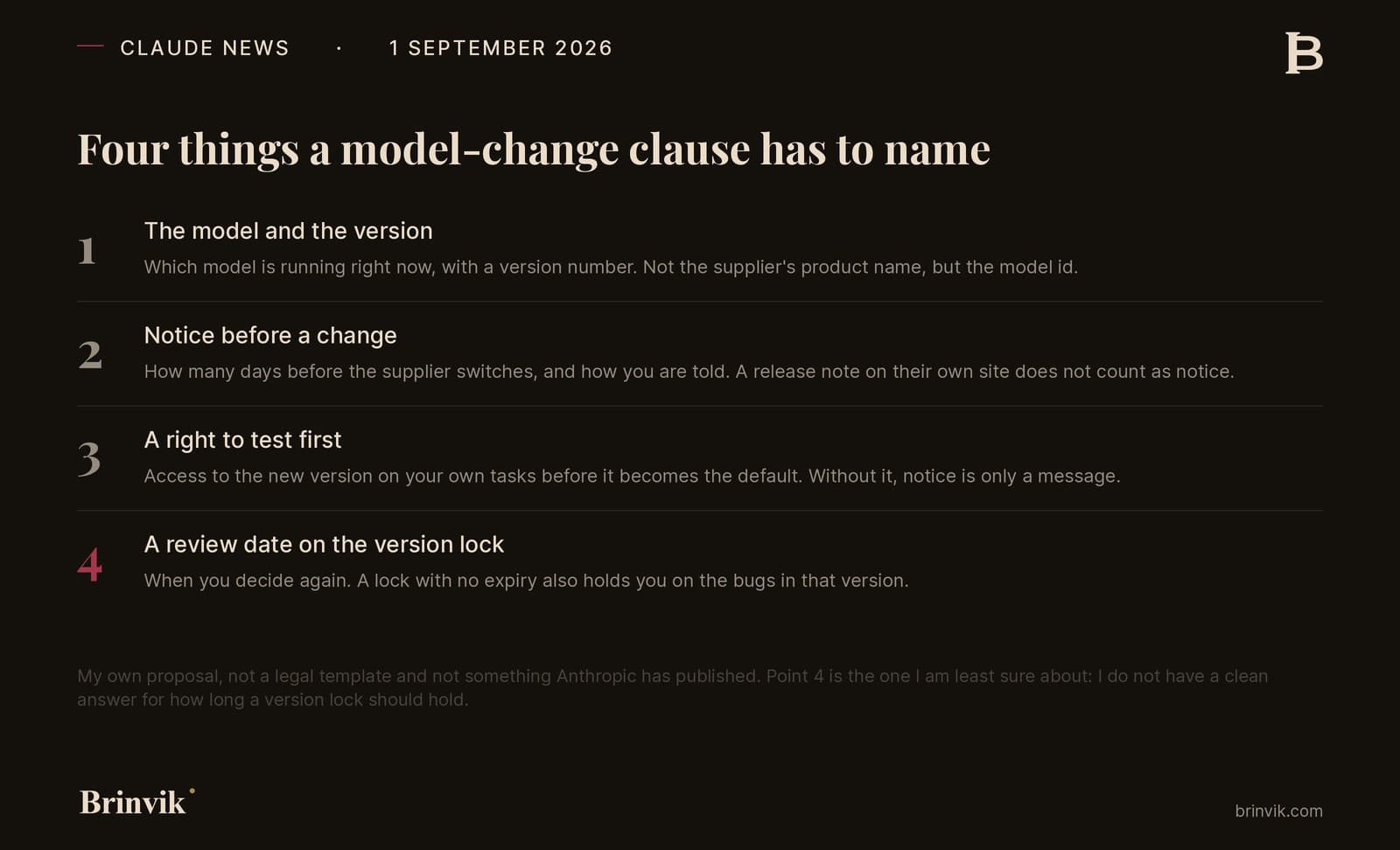
Four things a model-change clause has to name.
The model and the version. Which model is running, with a version number. The vendor's product name is not enough, because it does not change when the model underneath does.
Notice before a change. How many days, and how you are told. A release note on the vendor's own site is not notice. It is an archive.
A right to test first. Access to the new version on your own tasks before it becomes the default. Without that point, notice is only a message about something that is happening anyway.
A review date on the pin. When you decide again.
I think this kind of clause becomes ordinary in Danish vendor agreements within a year, the way uptime did. My reason for thinking so is not the mood of the market but that it has already happened once. Anthropic set a date itself, 31 August 2026, on which a behaviour change began to apply to new accounts. Nobody negotiated that date. When a vendor can set a date unilaterally, the only counterweight is that the other party has written down what happens the next time.
This is the kind of question that keeps coming back once a Claude implementation is in service and has to go on working. Send the four questions today. If you get no answer, or one you cannot judge, that is exactly what I take on: AI consultant on a standing agreement.
Then there is the objection I do not have a clean answer to. A pin also locks you to that version's bugs and to its safety profile. If a hole is closed in the newer model, you are still sitting on the old one. Point four, the review date, is my way of keeping the question open rather than a solution to it. I do not know how long a pin should hold. I do not have a number I can defend, and I would rather say so than write one that sounds right.
How the work was divided
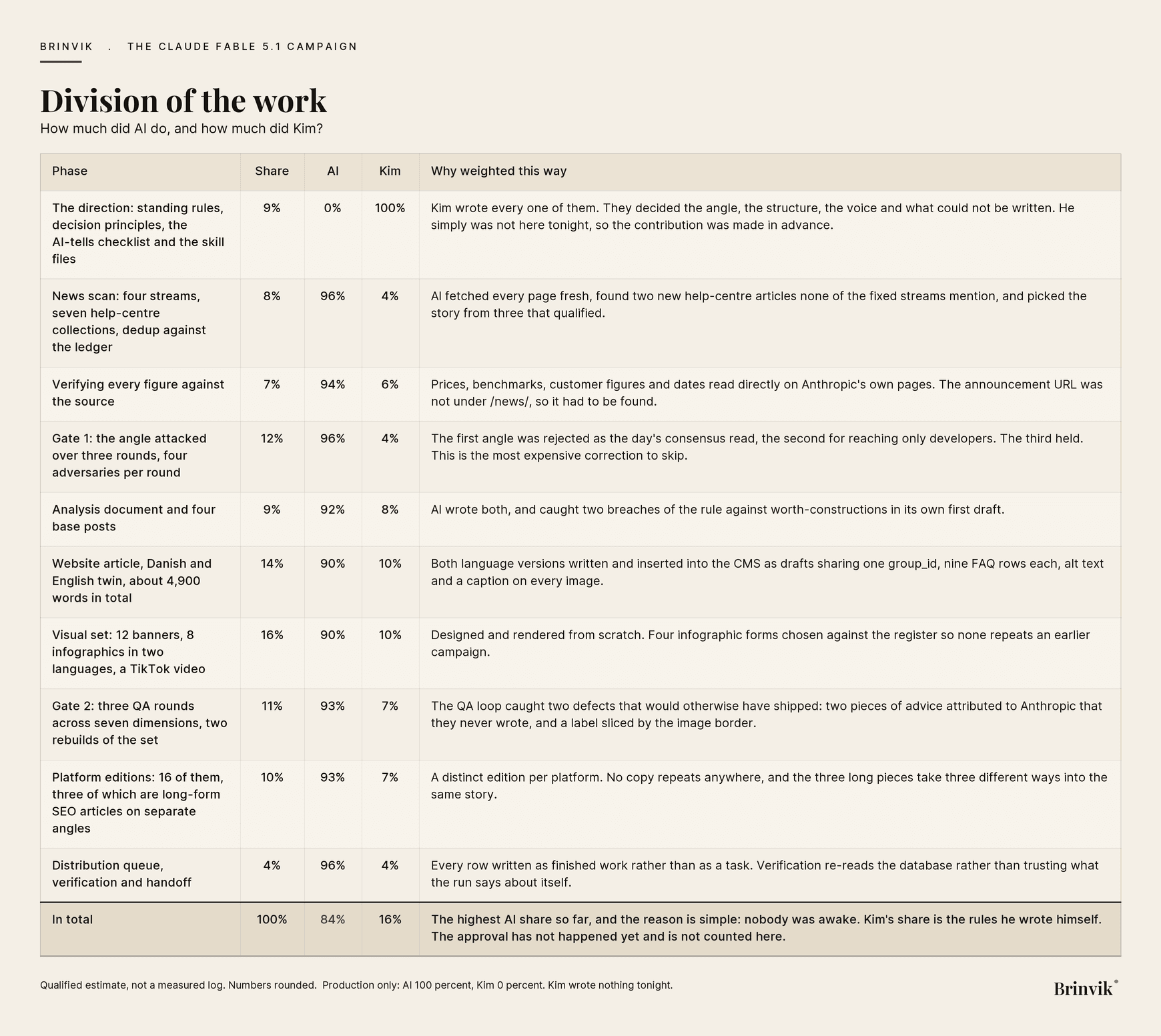
This work was produced in collaboration with AI. Overall: AI roughly 91 percent, Kim roughly 9 percent. Looking only at production, meaning who actually wrote and built the material, it is AI 100 percent and Kim 0 percent.
That is the highest AI share recorded on a Brinvik job, and the reason is simple: the whole campaign was built overnight, with nobody awake. Kim's share is the standing rules, decision principles and skill files he wrote himself, which decided the angle, the structure, the voice and what could not be written. The error catching that is usually his was done by the built-in QA rounds, which among other things caught two pieces of advice wrongly attributed to Anthropic.
The approval has not happened yet and is not counted. These numbers are an informed estimate, not a measured log.
Sources
Anthropic: What is new in Claude Fable 5.1 (capabilities, breaking changes, migration) →
Claude Platform release notes, 1 September 2026 →
Claude apps release notes, 1 September 2026 →
Anthropic: Preserved thinking and protection against distillation →
Anthropic: Developing Enterprise Frontier Safeguards with our customers (1 September 2026) →
FAQ
Frequently asked questions
That depends on your agreement. Anthropic does not require a vendor to give you notice, and because neither price, platform nor contract changes on a swap, there is no point in the process where anyone would naturally have said anything. Go and check what your own agreement says about model changes.
Four things: which model and version is running, how long before you get notice of a switch, that you may test the new version on your own tasks first, and when the pinning arrangement itself comes up for review. You can require a vendor to stay on a specific model. It is technically possible, because the model is chosen with an id in every single call, but whether they will depends on how many versions they would then have to keep running at once.
Anthropic states that Fable 5.1 uses denser prose and less formatting than earlier models. If an old instruction about not formatting too much is still in place, it can now remove structure the text needs. Take that instruction out and ask directly for headings and bullets instead.
Fable 5.1 writes fewer progress updates between its tool calls than Fable 5. It is working, it just says less about it along the way. You can get the updates back by turning on the updates display and asking for them in the prompt.
Input and output cost the same, 10 and 50 dollars per million tokens. Cache reads have dropped to 0.25 dollars per million tokens, a quarter of the previous price. Anthropic's own figure for the combined effect is about 25 percent lower cost in typical use and up to 45 percent for heavy agentic work.
Fable 5.1 and Mythos 5.1 require 30-day retention and are not available under zero data retention unless Anthropic expressly authorises it. Enterprise Frontier Safeguards, announced the same day, puts activity data in your own cloud under your own keys and rolls out in phases from autumn 2026. Until then, qualifying customers get zero data retention on Fable 5 and 5.1.
Anthropic's own documentation recommends starting with Opus 5 for most workloads and moving to Fable 5.1 for demanding reasoning and long-running agentic work, or when your own measurements on Opus 5 at higher effort still fall short. On the numbers Anthropic has published, Fable 5.1 leads Opus 5, but the price difference is real.
All text from Fable 5.1 and Mythos 5.1 carries Anthropic's statistical text watermark. Images and video Claude produces through the code execution tool carry signed C2PA Content Credentials when retrieved through the Files API. The mark does not change the meaning or readability of the text and holds no information about you.