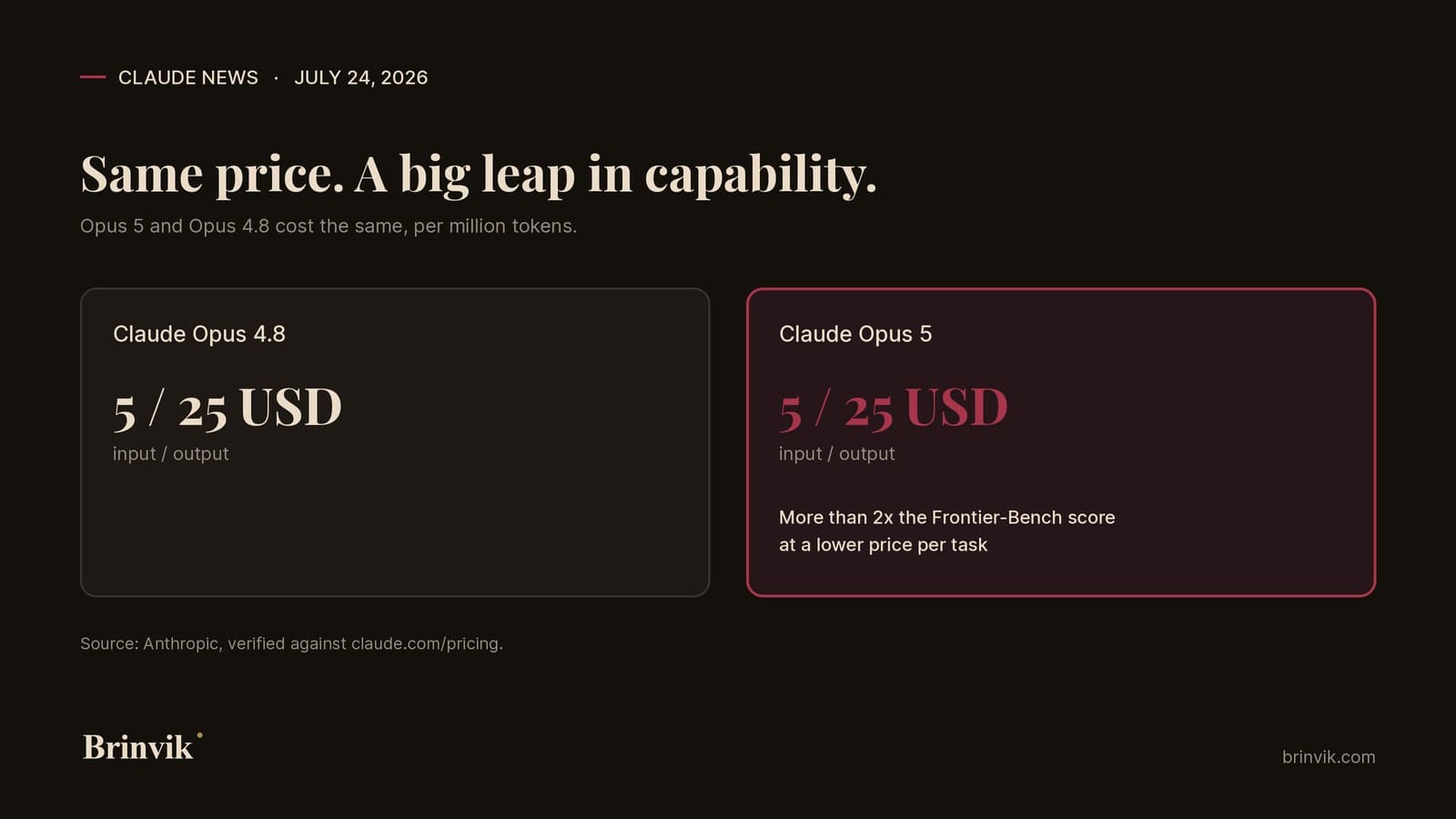
TL;DR: Anthropic launched Claude Opus 5 on July 24, 2026. It costs exactly the same as its predecessor, Opus 4.8: 5 USD per million input tokens and 25 USD per million output tokens, but takes a big leap in capability. On coding and professional knowledge work, Opus 5 now closes in on Anthropic's most expensive model, Fable 5, at half the price per task. It is the new default model on Claude Max and the strongest model Claude Pro users have access to. According to Anthropic's own safety testing, it is also their best-aligned model to date (the one least likely to act dishonestly or unpredictably), measured on their internal behavior audit, a result that has not been independently verified.
If your company already uses Claude, or is considering starting, the short answer is this: Opus 5 makes your AI investment cheaper to maintain, not more expensive. The rest of this article goes deeper on the numbers, when to choose which model, and what it actually means for your AI strategy as a Nordic company.
Anthropic: Introducing Claude Opus 5 →
Claude Opus 5 is the new default model on Claude Max and the strongest model Claude Pro users have access to, at the same price as Opus 4.8.
What Opus 5 is, and what it can actually do
Opus 5 is the new release of Anthropic's most capable model line, built for long, independent agent tasks (agentic work, where the model plans and executes several steps on its own without asking along the way) and for hard coding work. It does not introduce a brand new feature on top of the Opus line, it raises the ceiling on what an Opus model can deliver, at the same price as the previous generation.
The model has effort levels (a setting that lets you choose between a faster, cheaper answer or a more thorough, more expensive one for the same task), and a Fast mode that runs about 2.5 times faster at double the price. By default, Anthropic does not retain customer data for training on standard use, the same practice as previous Opus models, which is a requirement for most Nordic companies already working with Claude today.
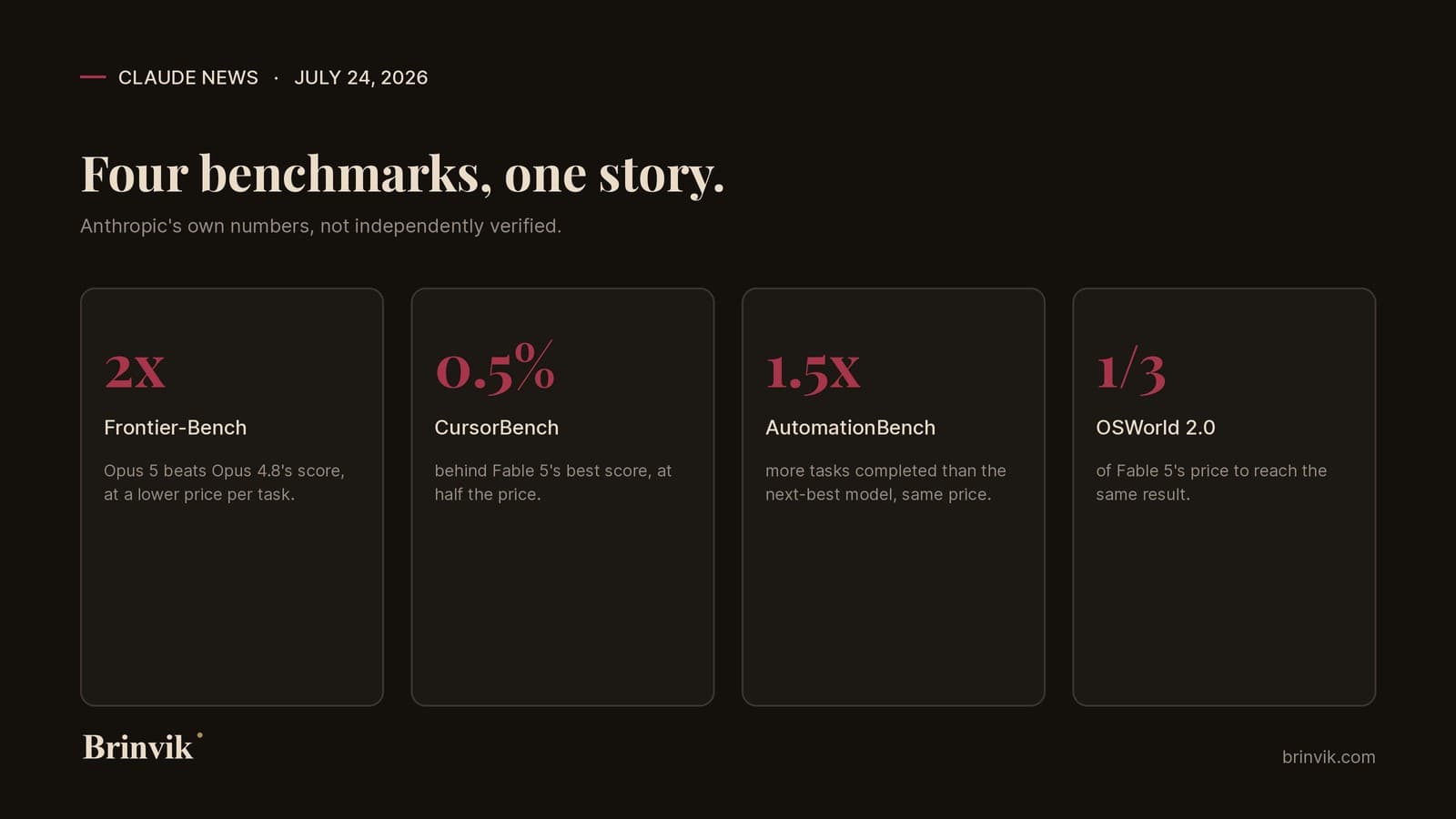
A few concrete numbers from Anthropic's own benchmarks (test scenarios that measure a model's performance, not independently verified by a third party):
- On Frontier-Bench, a test of hard software engineering tasks, Opus 5 more than doubles predecessor Opus 4.8's score, at a lower price per task.
- On CursorBench (a coding test from the developer tool Cursor), Opus 5 sits just 0.5 percentage points behind Fable 5's best score, but at half the price per task.
- On Zapier AutomationBench, which tests whether a model can complete a business task end to end without help, Opus 5 handles about 1.5 times as many tasks as the next-best model, at the same price.
- On OSWorld 2.0, a test of operating a computer independently (clicking, navigating, correcting mistakes along the way), Opus 5 beats every other model regardless of price, and reaches Fable 5's best result at under a third of the price.
These are Anthropic's own numbers, and like all vendor benchmarks they should be read as an indication, not a guarantee of how the model performs on your own tasks. But the direction is clear: Opus 5 moves what used to require the most expensive model down into a price bracket far more companies can actually afford to use continuously.
Here is my take
The interesting part of Opus 5 is not the benchmark numbers themselves, it is that Anthropic has, for the second time in a short period, delivered markedly more for the same price on top-tier intelligence. That means the model you are building your AI work on today is likely outdated in six months, not because it gets worse, but because the next model does more for the same money.
In my view, that changes how you should plan an AI investment. A year-long project where you "pick a model and leave it" is no longer the right approach. I recommend my clients keep a short commitment period and a fixed monthly review, the same cadence I run in my retainer engagements: is the model we are building on still the best choice for the price, or has something better come along that we should switch to. It sounds like a small change, but it is the difference between getting the most out of every dollar spent on AI, or staying stuck with a decision from six months ago.
This is exactly the kind of ongoing AI implementation Brinvik builds into an Internal Claude engagement: not a one-time setup, but a workflow your team can maintain and update itself, as Anthropic rolls out new models.
When to choose which model
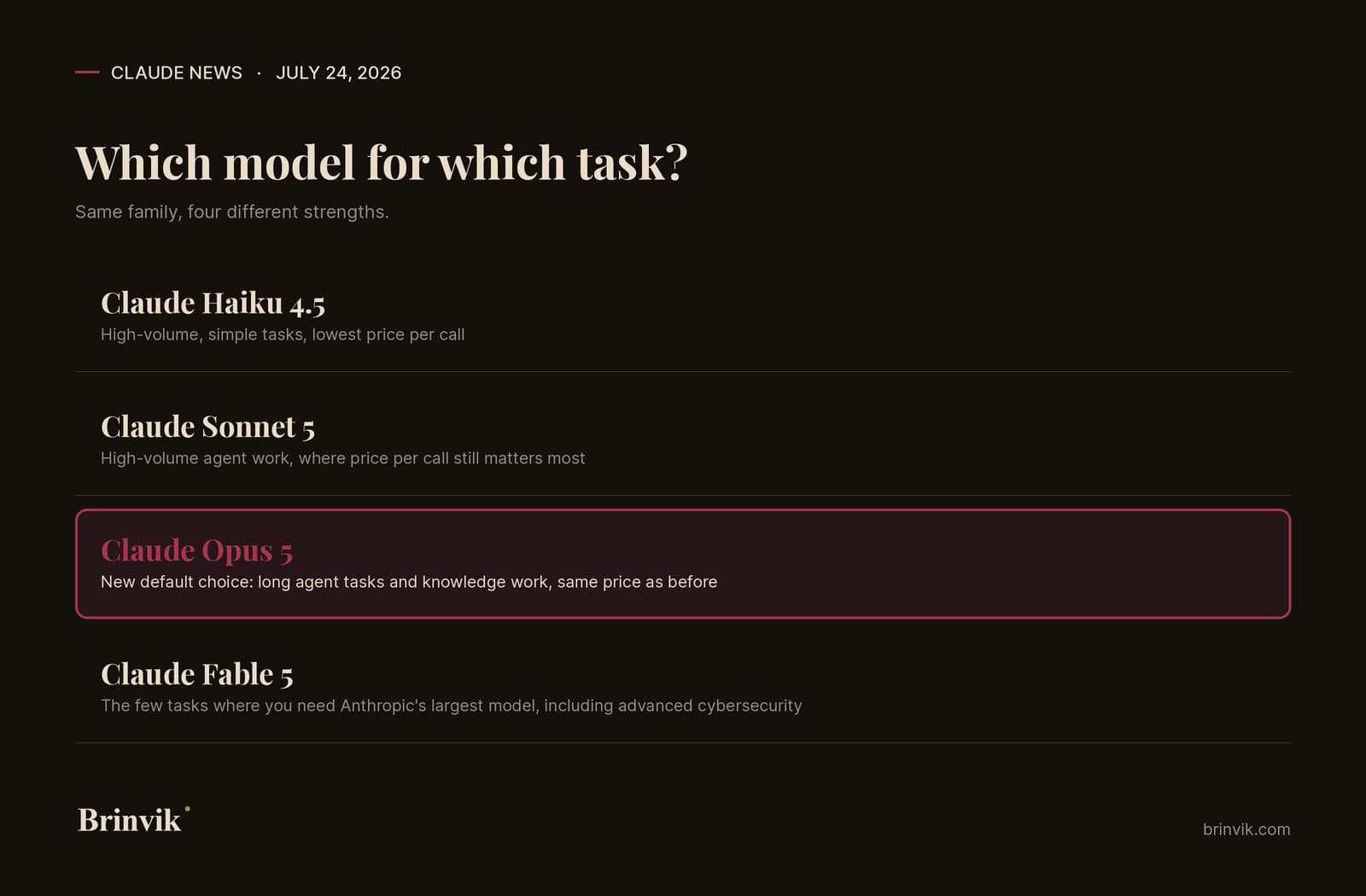
With four active Claude models in circulation, Haiku, Sonnet, Opus, and Fable, the question is no longer "should we use AI", it is "which model fits which task, at which price." Here is the short version:
| Model | Price (input/output per million tokens) | Choose it for |
|---|---|---|
| Claude Opus 5 | 5 USD / 25 USD | The new default choice for hard, long agent tasks and knowledge work. Same price as Opus 4.8, markedly better. |
| Claude Sonnet 5 | Introductory price 2/10 USD through August 31, 2026, then 3/15 USD | High-volume agent work, where Opus 5's extra depth is not needed, and price per call matters more. |
| Claude Haiku 4.5 | 1 USD / 5 USD | Simple, high-volume tasks, where the lowest possible price per call matters most. |
| Claude Fable 5 | 10 USD / 50 USD | Only the few tasks where you genuinely need Anthropic's largest model, for example advanced cybersecurity work. |
If your setup still runs on Opus 4.8, there is no good reason to stay there for new work: Opus 5 costs the same and performs markedly better. Opus 5 still lags Fable 5 on the most advanced cybersecurity work, particularly at exploiting security holes (not just finding them). That is deliberate, Anthropic has not trained Opus 5 for that type of task, and it is worth knowing if your company does offensive security testing.
Reliability and safety: what actually changes
Several of Anthropic's early test customers, including Cognition (behind the AI developer Devin), Cursor, Zapier, and Box, describe Opus 5, according to Anthropic, as a model that can better check its own work. It opens a page in the browser itself to see if a design looks right, it fixes mistakes it catches itself, and it works longer without needing to be prompted along the way. These customer statements are not independently verified, but they matter, because this is the trait that actually decides whether a team dares to let an agent run with less oversight, not raw intelligence alone.
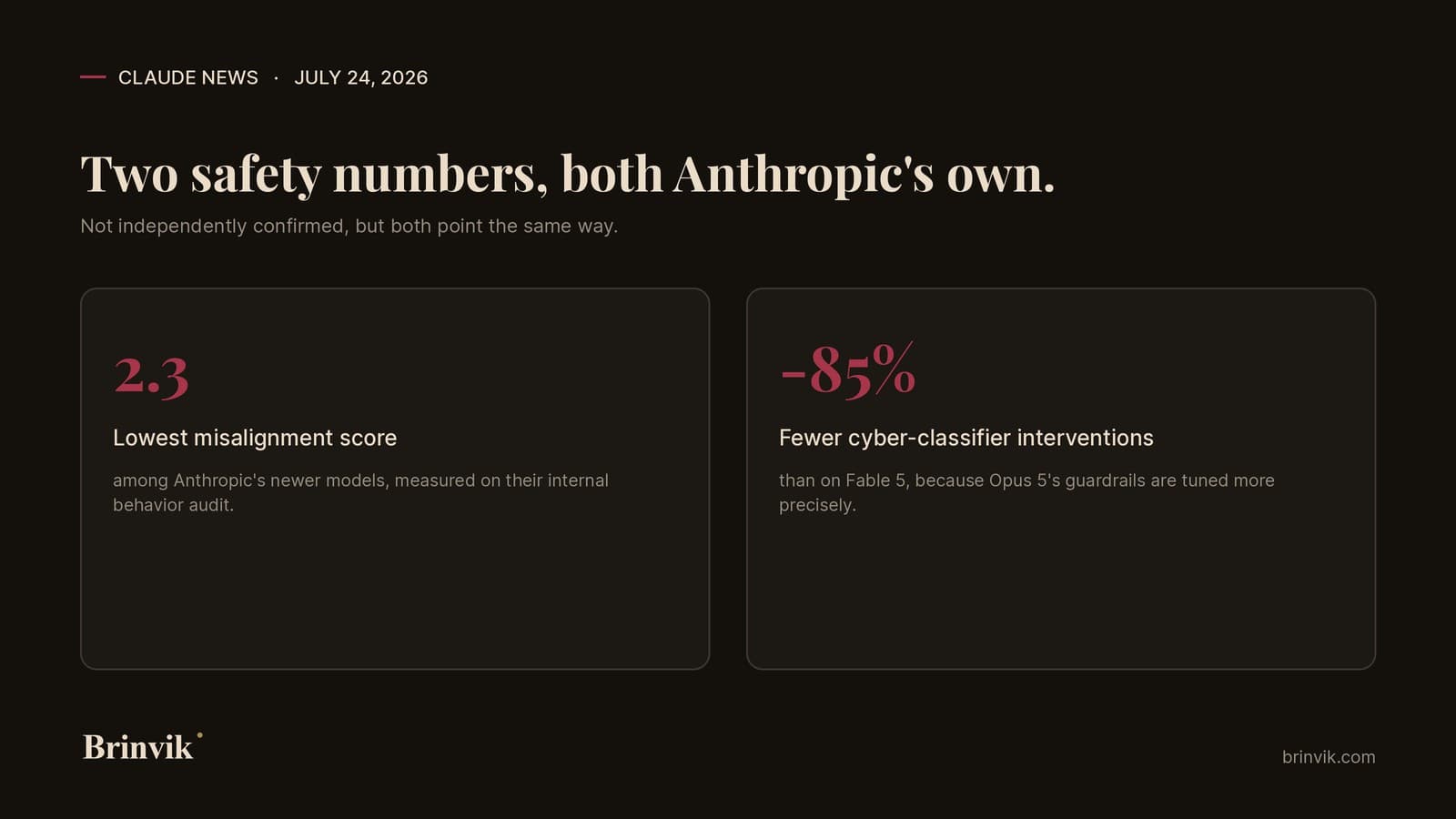
On the safety side, Anthropic highlights two numbers. Opus 5 scores lowest on their internal measure of "misaligned behavior" (actions that deviate from what the model was asked or should do) among their newer models, a score of 2.3. And the automatic cyber classifiers (filters that block requests that could be used to attack systems) intervene about 85 percent less often than on Fable 5, because Opus 5's guardrails are tuned more precisely, meaning fewer false positives, not looser limits.
Both numbers are Anthropic's own, not third-party confirmed, but they point in the same direction as the rest of the release: more autonomy for the model, governed by tighter and more precise guardrails, not looser ones. For anyone working with Claude from a governance angle, this means you should build the effort levels and fallback settings (automatic switching to another model if a request gets blocked) into your internal guidelines from day one: who is allowed to choose the highest effort level for a given task, and what should happen when a task falls back to another model. This is exactly the kind of concrete guardrail Brinvik sets up together with a team when we build an Internal Claude engagement.
What it means for SMBs
Your engineering and support teams are probably the ones who feel Opus 5 first. Coding tasks that used to require the most expensive model on the market can now be handled by Opus 5 at a fraction of the price, with a model that catches and fixes more of its own mistakes along the way. If you already use Claude for code review, documentation, or customer-facing support, this is a natural moment to test whether a workflow you held back because the previous model was not good enough can now go live, without your AI budget moving.
What it means for telemarketing and sales teams
The same abilities that let Opus 5 complete a business task end to end in the Zapier test are the ones a sales-qualifying agent needs: holding a long, messy conversation without losing the thread, and catching when something is wrong itself instead of passing a wrong answer on to a potential customer. If you are considering a Claude agent to qualify leads on your website or in your outbound sales work, this is exactly the ability that decides whether the agent can stand alone in a conversation at 11pm, without a human stepping in.
What it means for professional service firms
For audit, advisory, legal, and similar industries where knowledge work is the core product, Opus 5's jump on benchmarks like CursorBench and Frontier-Bench means more of the heavy, document-driven work, contract review, research, first drafts of reports, can be handed to a model that works longer and more independently, without a drop in quality. This is where the effort levels are especially useful: set a high level for the task where thoroughness matters most, and a lower one for routine work, where speed and price matter more.
What it means for founders and scale-ups
You can build faster for the same money, or build the same product for markedly less. Fast mode (which runs about 2.5 times faster at double the price) is worth testing if latency is a bottleneck in your product, for example in a customer-facing chat experience. And keep an eye on the effort levels as a real cost-control tool: turn it up in development, where thoroughness pays off, and down in production, where volume and price matter more, without having to switch models to do it.
GDPR, EU hosting, and security for Nordic companies
By default, Opus 5 does not retain customer data for training on standard use, the same practice as previous Opus models. The model still runs on US infrastructure by default, though, whether you access it via claude.ai or Anthropic's standard API.
If your data needs to stay within the EU, a real requirement for many Nordic companies that need to document this to their data protection authority, that happens not through Anthropic's own infrastructure, but through Claude on AWS Bedrock (with data centers in Ireland, Stockholm, and Frankfurt) or Google Vertex AI's EU regions. This is exactly the kind of setup Brinvik configures for clients who need EU residency and a signed data processing agreement (DPA) as part of the delivery, not an afterthought.
Are you thinking about how Opus 5, and the models that follow it, should fit into your workflows, without it becoming yet another one-off project that is outdated in six months? Brinvik is a Claude specialist working on AI implementation directly inside your existing workflows, not as an isolated pilot project on the side. That is exactly what an Internal Claude engagement from Brinvik solves: a review of how your team actually works today, and a setup your team can maintain and update itself, as Anthropic rolls out new models.
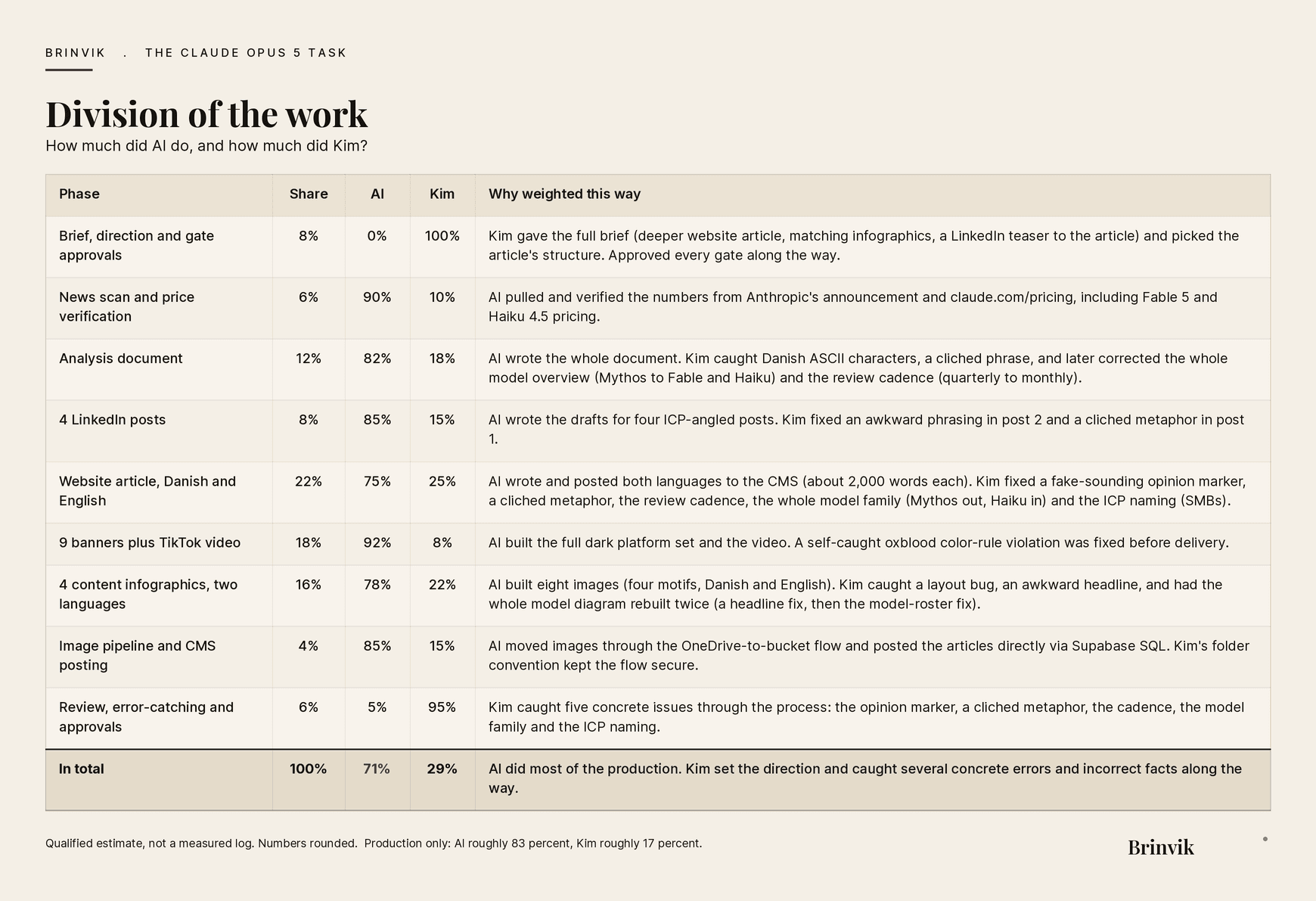
This work was produced in collaboration with AI. Overall: AI roughly 71 percent, Kim roughly 29 percent.
Sources
Primary sources:
- Anthropic, "Introducing Claude Opus 5", July 24, 2026.
- Claude, pricing page, verified July 31, 2026.
All benchmark results and customer statements in this article are Anthropic's own, and are marked as such in the text. They have not been independently verified by a third party.
FAQ
Frequently asked questions
Opus 5 costs the same as predecessor Opus 4.8: 5 USD per million input tokens and 25 USD per million output tokens. Fast mode, which runs about 2.5 times faster, costs double the price.
For new work, there is no good reason to stay on Opus 4.8, Opus 5 costs the same and performs markedly better on Anthropic's own benchmarks. If your setup is locked to Opus 4.8, it is worth planning a switch once you have time to test it on your own tasks.
By default, Opus 5 does not retain customer data for training on standard use. The model runs on US infrastructure by default, though. Keeping data within the EU requires a setup via Claude on AWS Bedrock or Google Vertex AI's EU regions, not Anthropic's own claude.ai or standard API.