I enrolled in my first Anthropic Academy course on 2 June. The sixth certificate landed in my inbox on 9 July.
Five weeks. I am not writing this to congratulate myself, but because there is a question underneath it that my clients ask me constantly: how specialised does a consultant need to be before it makes a difference to you?
I have an answer now. It is more concrete than I expected.
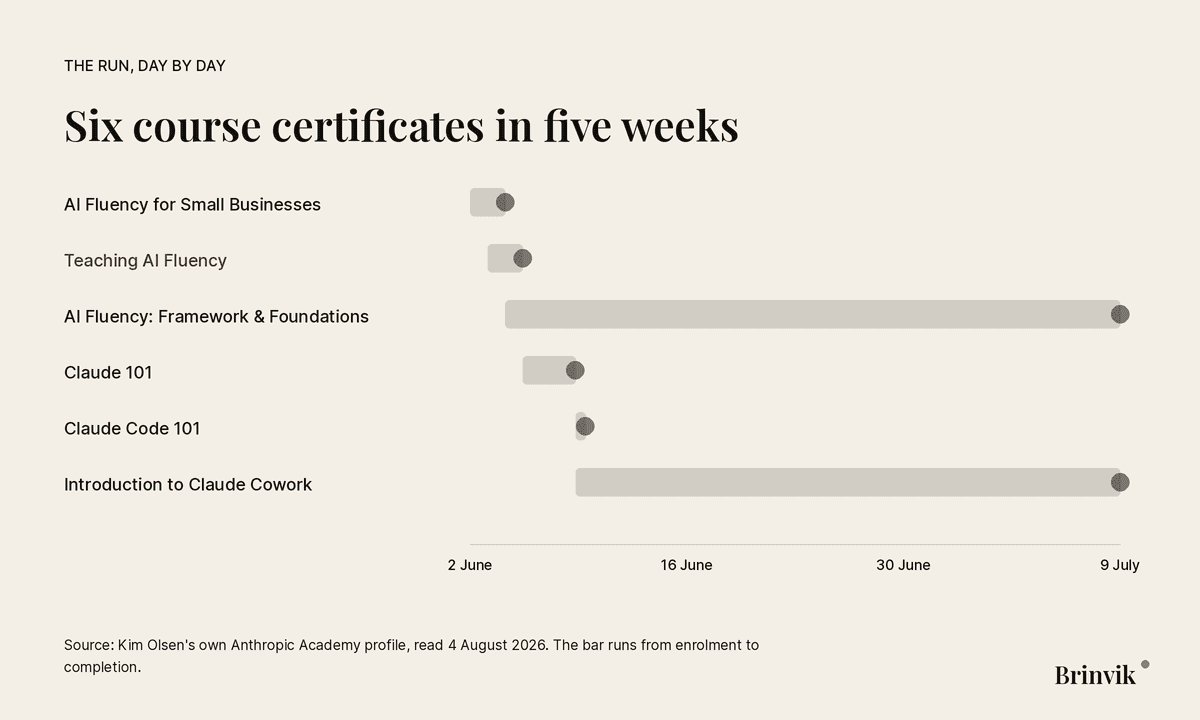
The six
For the record, so we are talking about the same thing:
- AI Fluency for Small Businesses, completed 4 June
- Teaching AI Fluency, 5 June
- Claude 101 and Claude Code 101, both 8 June
- AI Fluency: Framework & Foundations, 9 July, scored 10 out of 10
- Introduction to Claude Cowork, 9 July
These are course certificates from Anthropic Academy, Anthropic's own learning platform. They are not the separate proctored "Claude Certified" exams, and I am not an Anthropic partner. All six can be checked directly, and the links are under Sources at the bottom.
I see a lot of posts on X and Threads with short videos where someone has obviously written one prompt, let Claude work on the rest, and in a single day they have: a finished game, a website with a design nobody has seen before, or something else entirely.
There are two possibilities and neither is good. Either it is AI slop, something that looks finished in a video and falls apart the moment anyone uses it. Or it simply is not true. A real product takes time and work to build. That holds with vibe coding too. The tool moves where the time is spent, it does not remove it.
What I actually learned
I expected the payoff would be a list of what Claude can do. It turned out to be two other things, and both are duller and more useful than a list.
1. It moves faster than anyone can follow alongside a full-time job
It is not the models alone. Claude comes in four versions for ordinary use today, Haiku, Sonnet, Opus and Fable, and they differ in price and in strength. But it is everything around them that moves fastest: skills, plugins, connectors, how a project is set up properly, and which new features arrived last month.
New things arrive faster than ever. A setup that was right in June is not necessarily wrong in August, but it is rarely the best one any more. And the distance between a right setup and a nearly right one is usually money in running costs.
On top of that sits the regulatory question. What is permitted depends on the industry, on which department is using the tool, and on which data is involved. It is not one answer per company. It is one answer per department.
That is the part that is hard to handle yourself. Not because it is complicated, but because it needs someone watching every week.
2. Context matters more than the prompt
This one surprised me most.
Most of the difference between a bad and a good result does not lie in how the question is worded. It lies in what the model can reach, how the task is cut, and whether you have a way to judge the answer.
That is exactly what AI Fluency is about. Anthropic builds it around four parts, the four D's:
- Delegation: deciding what should be given to AI at all, and what should not
- Description: describing the task and the context well enough for the answer to be right
- Discernment: judging what comes out instead of taking it at face value
- Diligence: taking responsibility for the result, including when a machine wrote it
I use that framework every day, and I teach it. It is also why I keep talking about AI fluency rather than about prompts. The prompt is one of four parts, and it is not the most important one.
And one side effect
There is one practical thing I will mention anyway, because it comes up in almost every meeting: I can answer what a solution will cost to run while the meeting is still happening.
Not "let me come back to you". A number, with the assumptions said out loud.
It is not that I know a price list by heart. It is that I know the setup well enough to calculate it. For a CFO, the difference between an answer in the meeting and an answer two weeks later is often the difference between a project happening and not happening.
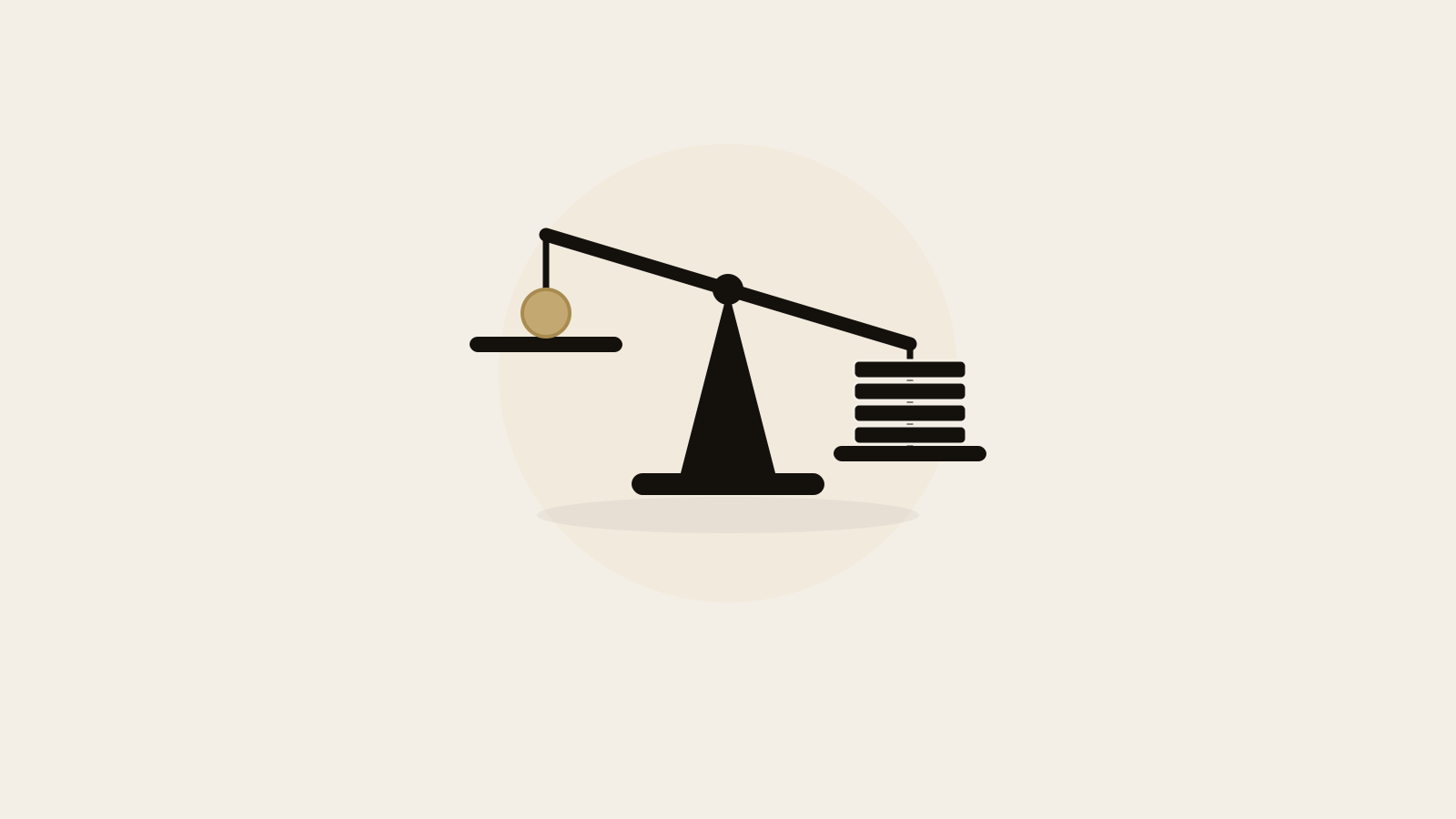
Here is my view: for a company with 20 to 80 people, a specialist is almost always the better buy than a generalist. You do not have an AI team that can translate general advice into your reality, and you certainly do not have time to follow what changed last month.
And yes, I make money from that view. It is exactly the service I sell. Weigh the argument with that in mind.
The certificate I use most
If I had to keep one of the six, it would be Teaching AI Fluency.
It is not the most technical. It is about teaching other people to work with AI, and about measuring whether they can actually do it afterwards.
I run workshops. That is a large part of what I do. And there is a real difference between using AI yourself and teaching a whole team to use it. The first skill makes you productive. The second makes an organisation productive, and that is the one you are paying for.
There is also a simple fairness argument in it. If you teach AI Fluency, you should be able to show that you are trained to teach that specific thing. Not just trained to use the tool.
The practical consequence is that I changed the shape of my workshops. A workshop where everyone nods is not a workshop that worked. Now I always build something into the day that shows whether the participants can do it themselves once I have walked out. Often it is a task from their own work that they solve without help in the last half hour.
The course I underestimated
AI Fluency for Small Businesses was at the bottom of my list when I started. I assumed it would be thin.
It is the one I draw on most often.
The reason is that it deals with the situation my clients are actually in. Not a research lab or a corporation with an innovation budget. A company where the CEO is curious, the CFO is worried about the bill, and the sales team is buried in manual work. Where nobody is available to drive the project, because everyone already has a full-time job.
That is not a technology problem. It is a prioritisation problem, and it calls for a different kind of advice.
What it led to
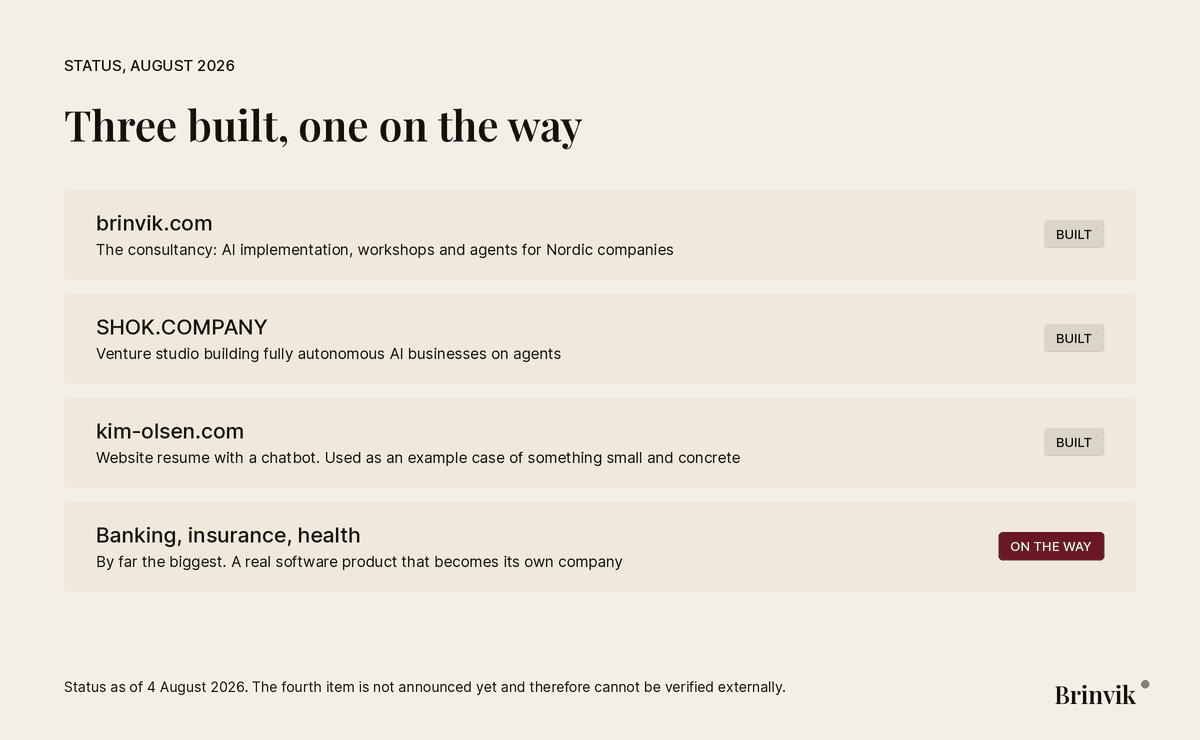
Three things are running now.
brinvik.com is the consultancy: AI implementation for Nordic companies, workshops, and agents that qualify leads on websites instead of collecting form fills nobody reads.
SHOK.COMPANY is a venture studio building fully autonomous AI businesses on agents. A bet that some kinds of company can operate with almost nobody in the daily loop.
kim-olsen.com is a website resume with a chatbot on top. I use it as an example case when someone asks what you can concretely build without setting aside half a year. It is small enough to finish, and you can talk to it instead of reading about it.
Then there is the fourth. It is by far the biggest thing I have built, and it is not a project in the same way as the other three. It is a real software product for banking, insurance and health, and it becomes its own company. The name is chosen, but it stays here a while longer. When the product is ready, I will write about it.
The numbers, with the caveats
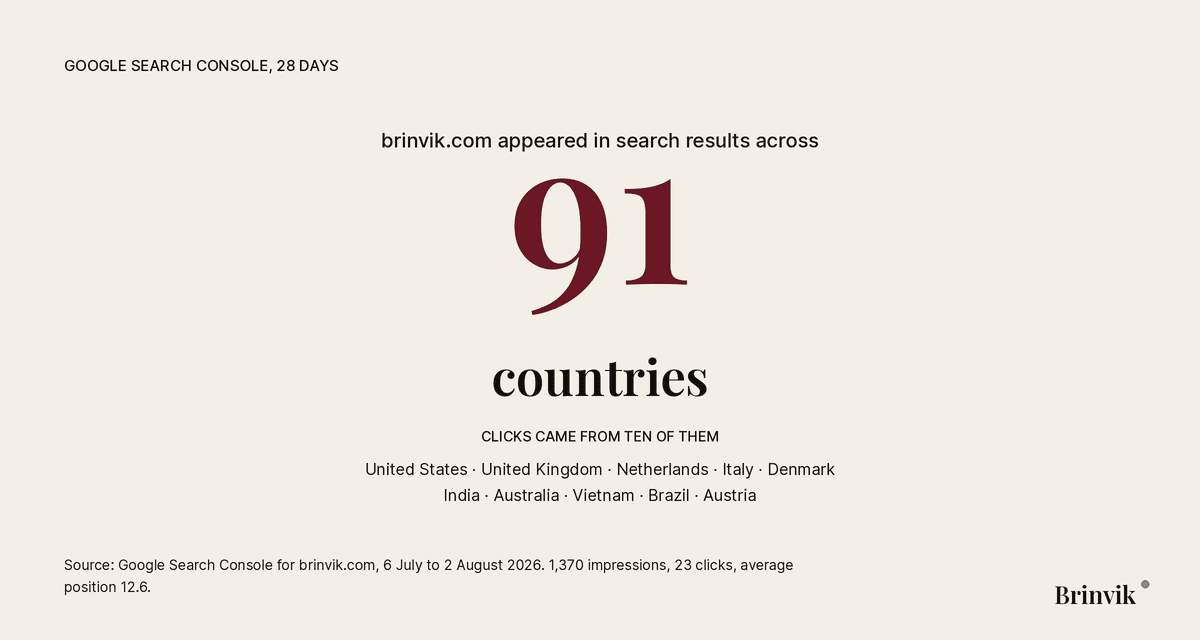
I opened Search Console last week and sat with it longer than I meant to.
brinvik.com appeared in Google results across 91 countries over the last 28 days. The clicks came from ten of them: the United States, the United Kingdom, the Netherlands, Italy, Denmark, India, Australia, Vietnam, Brazil and Austria.
Let me put the caveat up front, because the number sounds bigger than it is:
| Source | Period | Figures |
|---|---|---|
| Google Search Console | 28 days to 2 August | 1,370 impressions, 23 clicks, average position 12.6 |
| Bing Webmaster Tools | 30 days to 2 August | 223 impressions, 6 clicks |
| Google Analytics 4 | 7 July to 3 August | 245 active users, 241 of them new |
Position 12.6 is page two. 23 clicks is not a lot.
Two things are worth noticing in that table. First, Bing's figures for the last 30 days are almost identical to the figures for the last three months, 223 against 225 impressions. Everything that has happened on Bing at all happened within the last month. Second, I have not published much in the period. This is not the result of a publishing push, it is what happens on its own.
And 241 of 245 users were new. So I have reach, not an audience. Those are two different things, and I would rather say so than let a number sit there looking better than it is.
So why are there readers in Vietnam and Brazil? The simple part of the answer is that I publish in both Danish and English. That explains most of the international traffic, and there is nothing mysterious about it.
The Danish side is the more interesting one. Almost nobody writes about Claude for business in Danish. Search for it and you get hobby blogs and English articles. An empty field is the easiest position you can have, and it closes at some point.
What you can take from this
If you are dealing with AI in your own company, this is what I would take from five weeks:
Choose specialisation over breadth, even when it feels wrong. The temptation is to try everything. The gain is in knowing one tool well enough to notice when it changes.
Demand documentation from your consultant, and read it. Ask what the certificate actually covers. Is it a course certificate or an exam? Can you verify it? A no to that question tells you more than a yes.
Ask for the running cost, not the project price. An implementation fee is easy to understand. It is the consumption twelve months from now that decides whether the project survives.
Start with something small enough to finish. My own website resume with a chatbot took a fraction of the time people expect. One finished small project convinces an organisation more than a large plan.
FAQ
Frequently asked questions
No. Anthropic Academy is Anthropic's own learning platform, and a certificate from it documents that you completed a course. Anthropic also runs a separate set of proctored exams under the name "Claude Certified". They are two different things, and a consultant should say which one he holds.
No. I am neither a partner nor on my way to becoming one. I am an independent consultant who has specialised in one tool.
Because I cannot be half decent at four things and charge for being an expert in something. There are consultants who know a little about everything, and they are useful when you do not know what you are looking for. I would rather be the one you call when you already know.
It depends on the workflow and which model it runs on. The point is that you should be able to get a number before you start, not afterwards. If your supplier cannot give an estimate on the running cost in the meeting itself, that is a signal worth noticing.
Shorter than most people think, if you start small. My own website resume with a chatbot is the example I use, precisely because it is small enough to finish and concrete enough that people see the point.
No, but the weight is in the Nordics, and I work in both Danish and English.
See what an AI workshop at your company looks like →
Sources
Anthropic Academy course certificates, all verifiable:
- AI Fluency for Small Businesses, completed 4 June 2026
- Teaching AI Fluency, completed 5 June 2026
- Claude 101, completed 8 June 2026
- Claude Code 101, completed 8 June 2026
- AI Fluency: Framework & Foundations, completed 9 July 2026
- Introduction to Claude Cowork, completed 9 July 2026
Traffic figures:
- Google Search Console for brinvik.com, 6 July to 2 August 2026. Read 4 August 2026.
- Bing Webmaster Tools for brinvik.com, 30 days and 3 months to 2 August 2026. Read 4 August 2026.
- Google Analytics 4 for brinvik.com, 7 July to 3 August 2026. Read 4 August 2026.
All figures are read directly in the systems named and have not been post-processed.