
TL;DR In January 2026 Anthropic read 9,830 conversations with Claude and counted how often the user did eleven concrete things. The most common was refining and trying again: 85.7 percent. The least common was checking the facts that matter: 8.7 percent. That is what a team looks like when it has a licence and no habits. Here are five habits that can be learned in a week, and an AI policy that fits on one page so it actually gets read. Both are what AI training for teams should end with. The policy template is a download at the end of its section.
Anthropic: The AI Fluency Index (January 2026) →

Nine in ten do not check the thing that matters
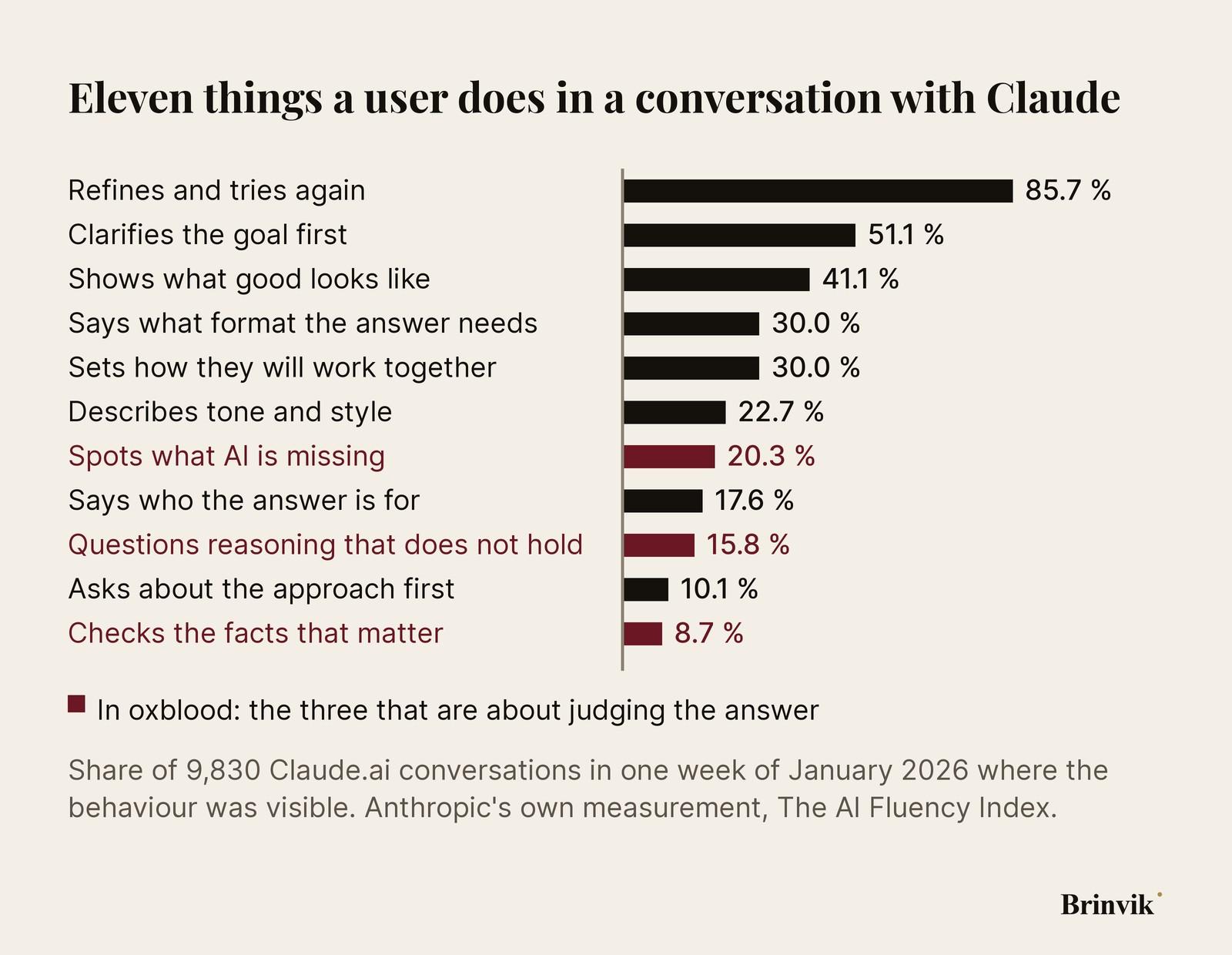
Anthropic built its measurement on a framework with four competencies, the four Ds: Delegation (what you hand to AI), Description (how you describe the goal), Discernment (how you judge the answer) and Diligence (standing behind what you send). Eleven of the behaviours can be seen directly in a conversation, and those are what they counted across 9,830 conversations in seven days.
The numbers are lopsided. Everything about describing the task is common: the user refines (85.7 percent), clarifies the goal (51.1 percent), gives examples of what good looks like (41.1 percent). Everything about judging the answer is rare: the user questions the reasoning in 15.8 percent of conversations and checks facts in 8.7 percent.
In conversations where Claude produced a document or a page, an artifact, fact checking fell to 5.5 percent against 9.2 percent without one. A tidy document gets read as a finished document.
Anthropic is measuring its own users, and the barrier in Denmark is the same: knowledge and habits, not access. In 2026, 55 percent of Danish firms with 10 to 49 employees used at least one AI technology, and 88 percent of the large ones. Among those still considering it, 80 percent say missing knowledge and experience is what holds them back, and nearly half lack an overview of the legal consequences. Both are Statistics Denmark's figures.
Access is there. The habits are missing, and the habits decide whether a quote with a wrong number reaches the customer.

Five habits your team can learn in a week
The four Ds are good because they fit any model and survive any release. I use them as the first four habits. The fifth is my own addition, and it is the one the AI Act asks about.
1. Pick the task before you open the chat. Take a forty-line quote. The structure, the first draft and the clean prose are Claude's to do. The price, the delivery date and what you promise the customer stay with you. The decision about what goes where is made before the first prompt, or the model makes it for you.
2. Describe the goal and the reader. "Write a quote" produces a quote for nobody. "The customer runs twelve trucks, he asked about three things in the meeting, the answer fits one page, and the tone is the one in our last email" produces a draft you can work from. Anthropic's figures show most people already do this.
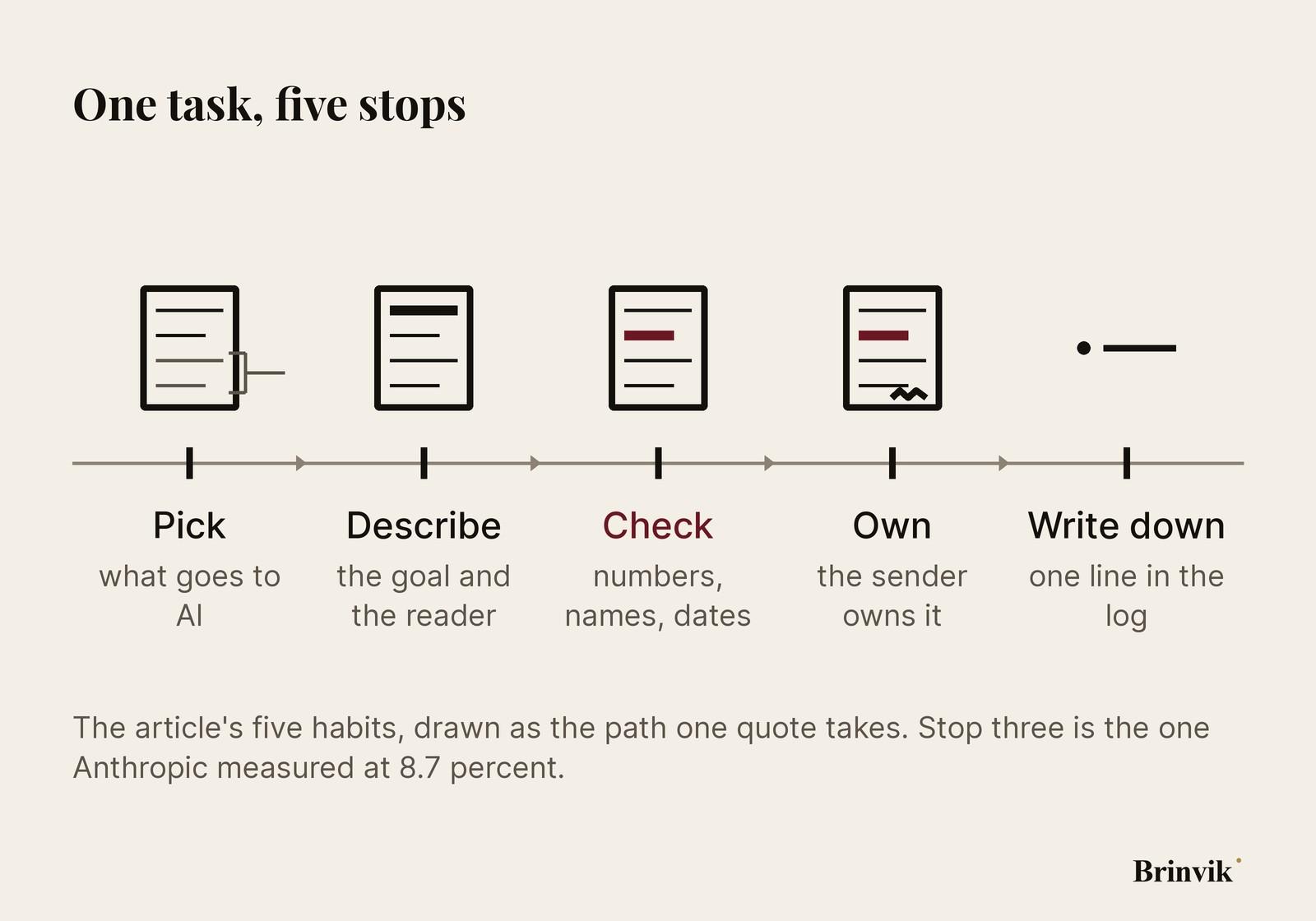
3. Check what costs money if it is wrong. Skip the magnifying glass. Find the four things that hurt if they are wrong: numbers, names, promises and dates. Those you look up in the source, every time. The rest you read through the way you would read a colleague's draft. It is the habit 91 percent of conversations lacked, and it takes two minutes.
4. Own what you send. Whoever sends the email owns the email. Claude is a co-author, not a signatory. It slips one way: the answer looks finished, the sender is busy, and "the AI wrote it" becomes an explanation afterwards. The habit is a rule your team says out loud: nobody sends anything they could not defend in the meeting themselves.
5. Write down what you decided. One line per task, in a shared log: what the task was, what went to Claude, what you checked. It takes thirty seconds. After a week the team has a list that shows where AI is actually used and where the mistakes would have landed. After a month the same list is the first thing you put on the table when a customer or an authority asks what you have done.

What should AI training for teams include?
AI training for teams should train judgment on the team's own tasks, not prompt tricks on made-up examples. Eight people per group at most, so the examples on the screen are theirs. A follow-up two weeks later, because the real questions only arrive when someone tries the tool on a real customer file. And a written result the team wrote itself: a decision log and a policy.
I sell this kind of training, so read the next part with that in mind. A course day without follow-up is a pleasant day. The habits set in the weeks after, when someone is holding a customer email and is not sure what may go in. If there is nobody to ask, people leave it alone, and the licence is back in the chat window where it started. That is why I do not sell a single day.
The four Ds are also what Anthropic teaches on its own courses, and they are what I am certified in myself.
I am also turning the method into a game: The Five Moves, an AI fluency game. Each player gets the work of an ordinary week in a small village called Brinvik. Get it wrong and you see the consequence. It takes about an hour per person in the browser, and it will be sold per seat once it is ready.

A one-page AI policy
A twelve-page AI policy gets read by the person who wrote it. One page the whole team has read beats a binder nobody opens. And on day one only one line matters: what never goes in.
The page has five boxes. That is all of it:
- What we use AI for. Three tasks, as concrete as "first draft of a quote".
- What never goes in. National ID numbers, salaries, passwords, and customer data until a data processing agreement is in place. This is the data rule.
- What we always check before sending. Numbers, names, promises, dates and references to legislation. Against the source, not against memory.
- Who owns the page and the log. A name and a role. And which tools we use, so "AI" does not mean three different things.
- When we look at it again, and who has been trained in what, with a date. That box is what article 4 is about.
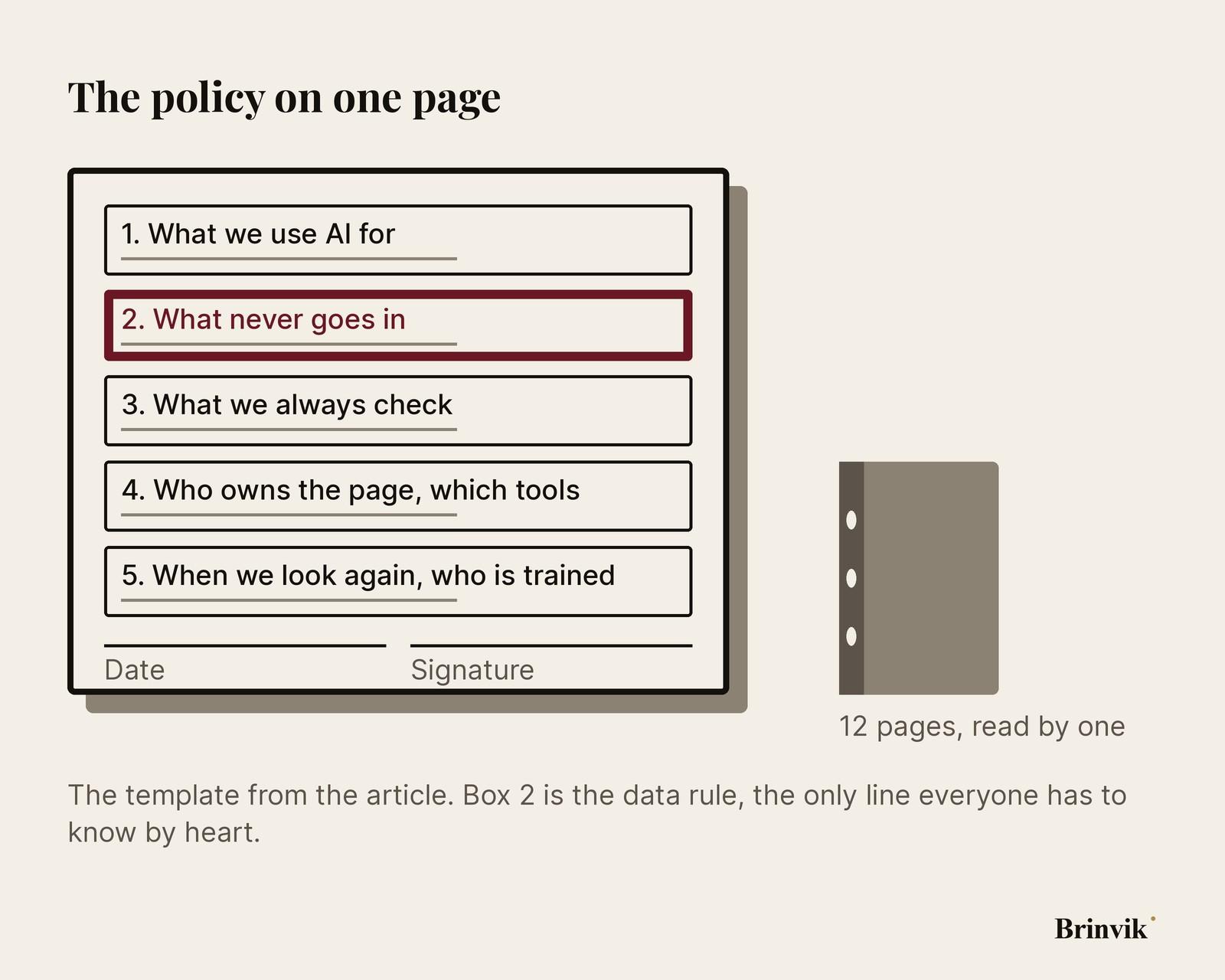
The template is here as a text file you can download and fill in: one-page AI policy, English template and the Danish version. It takes thirty minutes with the team in the room, because boxes 1 and 2 have to be written by the people who will follow them.
Then article 4. Since 2 February 2025 the EU AI Act has required companies that use AI to take measures that support their staff's AI literacy. Since the Digital Omnibus, Regulation (EU) 2026/1744, took effect in July 2026, the article no longer asks for a specific level in any one person, but the duty to act stands, and national authorities supervise it from 2 August 2026. It is set out by the Commission and, for Denmark, by the Danish Agency for Digital Government. The log from habit five and box 5 on the page are what you can show. Neither is a certificate, and neither needs to be.

As an AI consultant I run the training and write the policy with your team
As an AI consultant in Copenhagen I run an AI workshop where your team learns the five habits on their own tasks, and where we write the page together on the course day so it is filled in before anyone goes home. Office hours in week two and a review in week four are in the price, because that is where the habits set. If your team already uses Claude for business, read the plan for the first 30 days first; the two fit together. Habits first, licence second. That is the order I keep to.
FAQ
Frequently asked questions
On their own tasks, in groups of eight at most, with a follow-up two weeks later. Train the four competencies from Anthropic's framework and add the fifth habit: write down what you decided. A course without follow-up gives a good day and no habits.
Start with one page: what you use AI for, what never goes in, what you always check, who owns the page, and when you look at it again. Fill it in with the team in the room. Then a week of the five habits on real tasks, and a log that shows what was done.
Take measures that support your staff's AI literacy, fitted to their tasks. Since the Digital Omnibus in July 2026 no specific level is required of any one person. A dated log of who was trained in what, and a written policy, are measures you can show. Authorities supervise from 2 August 2026.
Five boxes: what you use AI for, what never goes in, what you always check, who owns the policy and which tools you use, and when you look at it again. One page is enough. The data rule in box two is the only line everyone has to know by heart.
Write the data rule first: national ID numbers, salaries, passwords and customer data without a data processing agreement never go in. Pick a tool that comes with a data processing agreement, as Claude Team and Enterprise do, and keep customer data inside it. The log from habit five shows afterwards what actually went in.
With me, 265 to 395 euros per employee with a five-person minimum, and the price covers four weeks with office hours and a review, not one day. An open one-day course in Copenhagen typically lists at 4,995 to 6,400 DKK per person. The prices are on my workshop page.
Sources
Primary sources:
- Anthropic: The AI Fluency Index, 9,830 conversations, January 2026. Anthropic's own figures about Anthropic's own users.
- AI Fluency: Framework and foundations, the free Claude Academy course on the four Ds.
- European Commission: AI literacy questions and answers, article 4 after the Digital Omnibus.
- Danish Agency for Digital Government: AI literacy, the Danish guidance on article 4 (in Danish).
Third party:
- Statistics Denmark: Digitalisation, firms' use of artificial intelligence, 2026 (in Danish).
- Statistics Denmark: More firms use artificial intelligence, the barriers among firms considering it (in Danish).