
Picture an ordinary workday in your company. Someone asks Claude to write a draft, summarize a long thread, find an answer, clean up a text. Click after click, task after task. But when did anyone last stop and ask: are we using this well, or are we just using it a lot?
Few people do. Not because they do not care, but because there has not been a place to see it. Now there is.
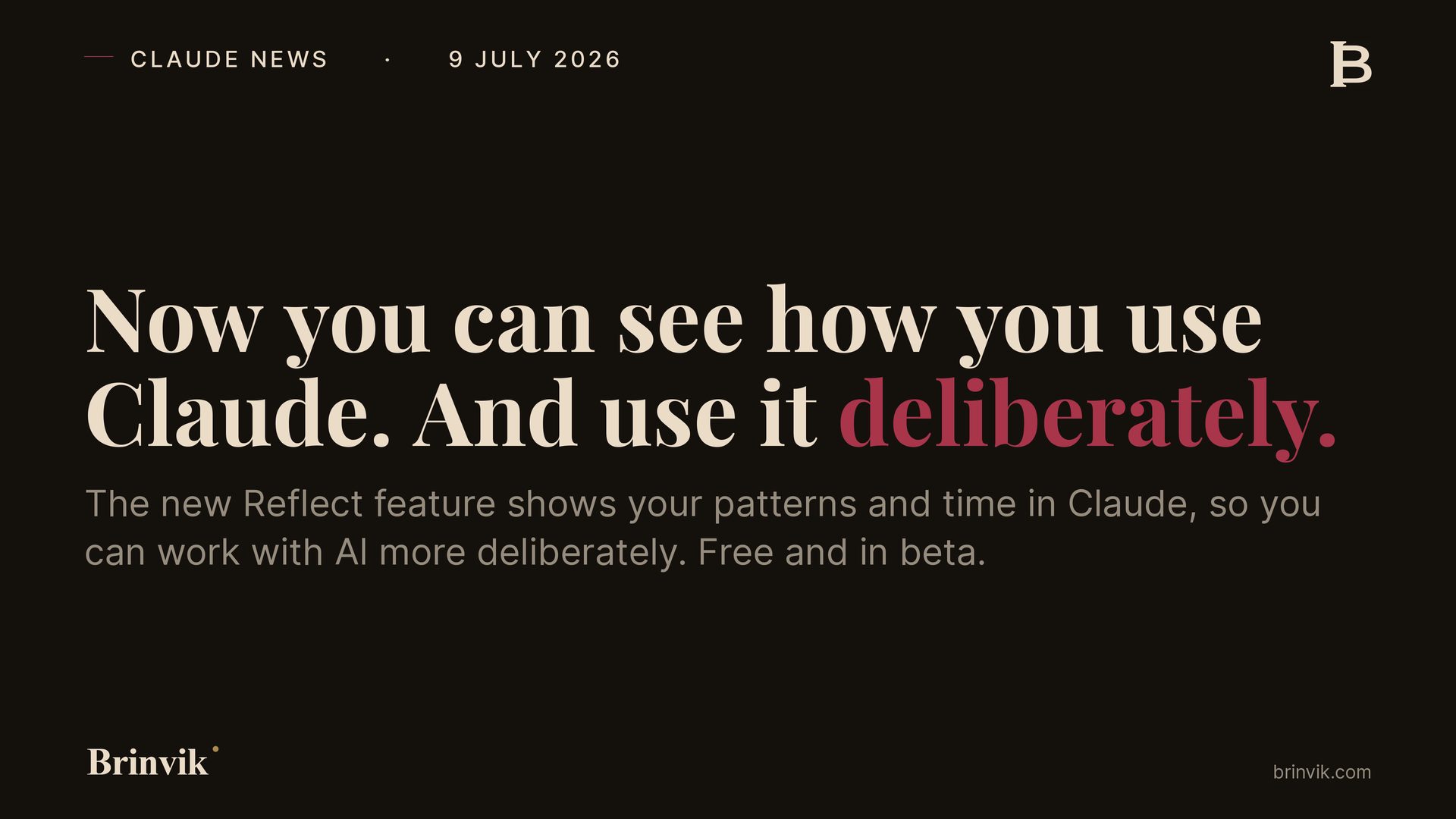
TL;DR: Anthropic has launched Reflect, a new feature in Claude that shows you how you actually use AI. Topics, patterns and time spent, plus a few good questions for yourself. It is private, free and in beta, and it requires memory to be on. The point is not a number on a screen. It is that it moves the conversation from "use more AI" to "use AI deliberately". And deliberate use is, in my view, the most important AI skill right now. It is also what I help companies with, among other things through AI training for teams.
Anthropic: Introducing a way to reflect on how you use Claude (9 July 2026) →
What is one thing you want to keep doing yourself, even if Claude could do it faster?
What Reflect actually is
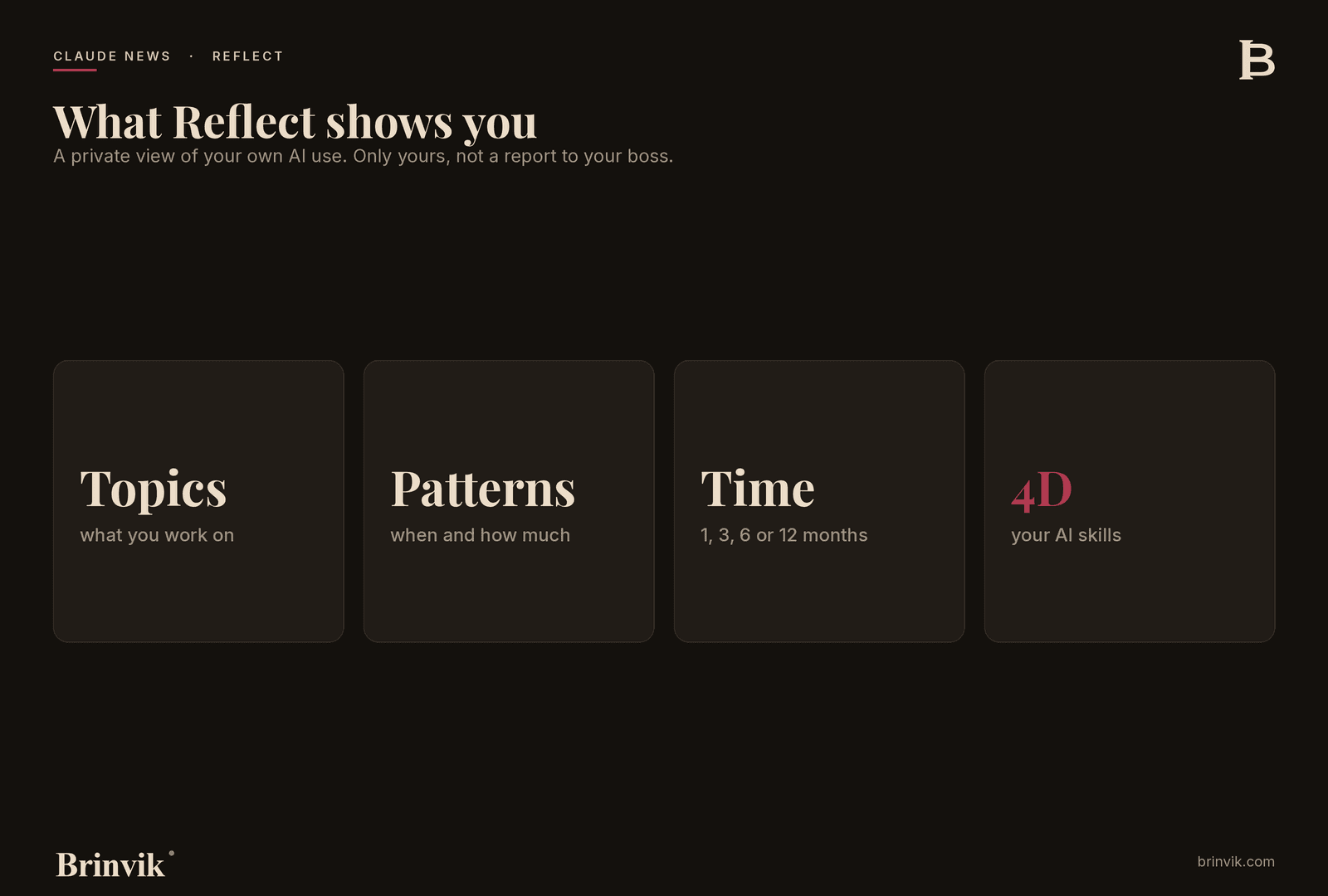
Reflect sits under Settings in Claude on web and desktop. It starts with a summary of how you have been using Claude: your key topics, your patterns over time and the kinds of tasks you most often work through. You can look back over 1, 3, 6 or 12 months. On top of that sits an overview of when in the week and day you use Claude most, and what the time went to. A view of how much time you have spent is on the way.
Then it goes a step further than most tools do. Every so often it surfaces a question that makes you step back, like the one above, and gives you the chance to talk it through with Claude. Next to the reflection itself, you can set optional break reminders and quiet hours under a new section called Time and focus. These are reminders of your own preferences, not locked rules, and they can be dismissed.
One important note, so expectations are right. The feature is in beta (an early version that is still being improved). It requires memory to be on, it covers web and desktop, and reflection over your Cowork conversations is not included yet. It is a start, not a finished product. But the direction is clear.
Why deliberate use beats more use
The most important AI skill right now is not using AI the most. It is knowing when you should, and when you should not.
Much of the market has run on the opposite. More use, more licenses, more agents. But a company where everyone uses AI constantly without thinking about when it makes sense is not ahead. It has just moved the routine work from hand to prompt. The value comes when people use their judgement to pick the right tasks to give to AI, and hold on to the tasks where the human wins.
That is why Reflect is more interesting than it looks. It does not measure how productive you are. It gives you a mirror, so you can see your own habits and adjust them. A tool that asks you to consider what you want to keep doing yourself pulls in the exact opposite direction of "let AI handle everything". And that is the direction that builds companies where people can still think for themselves a year from now.
The four skills behind good AI use
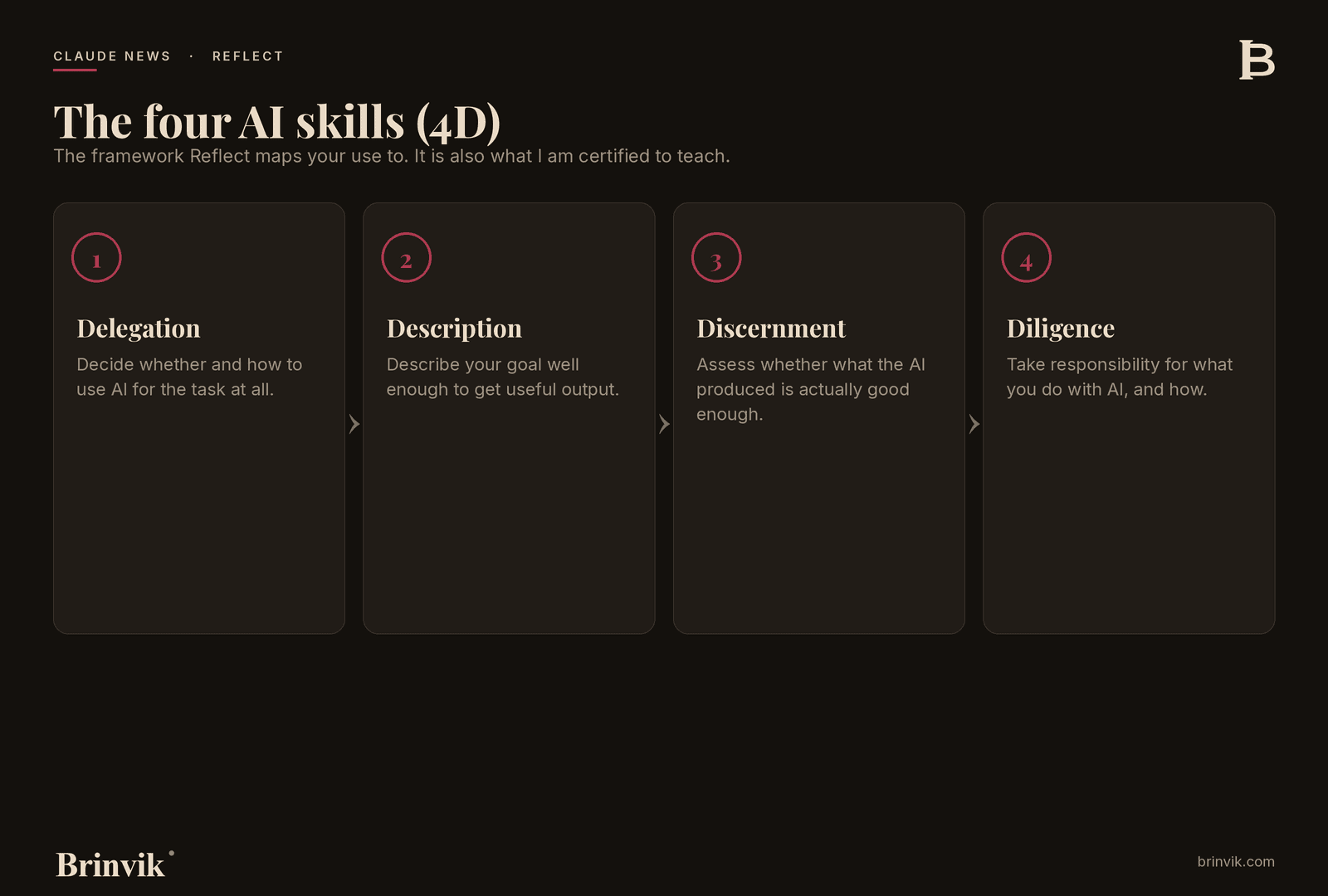
Reflect links your use to a recognized framework for AI skills, called the 4D framework. It describes four skills that together make someone work well with AI, not just a lot.
Delegation is deciding whether and how to use AI for a task at all. Description is describing your goal well enough to get a useful answer. Discernment is assessing whether what the AI produces is actually good enough. Diligence is taking responsibility for what you do with AI, and how.
Reflect gives you a picture of how you collaborate with Claude on each of the four. For example that you often rewrite email drafts in your own voice, or only delegate once you have set the strategy yourself. And it offers practical suggestions, like starting a Project in Claude instead of re-explaining the same context every time.
This is, incidentally, exactly AI fluency and the 4D framework that I am certified to teach. It is also the core of the AI training for teams I run for companies that want their people working deliberately with AI from day one.
Private by design
When a tool looks at how you use AI, it is fair to ask where the data ends up. Here is what Anthropic states.
Reflect does not draw from your incognito conversations. It does not pull in the underlying files from your connected tools. If you asked Claude to summarize your inbox, for example, the summary itself may appear in your reflection, but the source emails do not. Any conversation connected to a health integration tool is left out entirely. And the insights stay where they are. They are not used for any other purpose. Anthropic states that it developed the feature together with experts in digital wellbeing, and that sensitive conversations appear only at a high level.
Most important for you as a company: Reflect builds on memory being on, meaning Claude remembers context across your conversations. That is a deliberate decision you need to consider and write down, not a setting you simply leave on. More on that below.
The shift: from more to deliberate
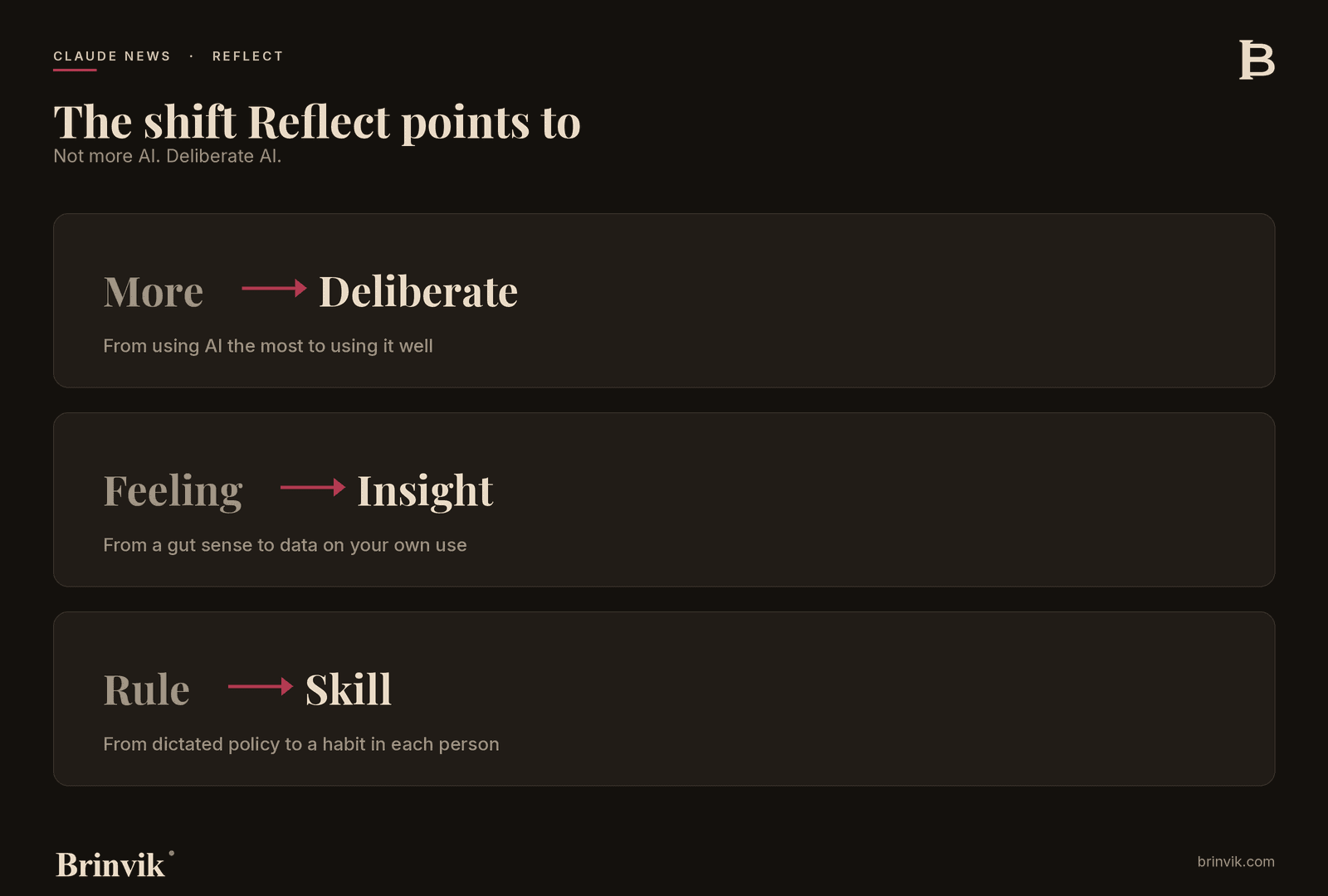
Draw the line, and a shift takes shape. From using AI the most to using it well. From a gut sense of how the team uses AI to a concrete picture. From AI competence as a policy that management writes to a skill the individual actually practices.
It sounds banal, but it is not. It is the difference between an organization that has bought a lot of licenses and an organization where people have genuinely gotten better at working with AI. Reflect is a small step in the second direction, and that is the direction I believe the next couple of years are about.
What it means for Nordic B2B SaaS companies
In a SaaS company, product, sales and customer service already sit with Claude open most of the day. This is exactly where the difference between a lot of use and deliberate use becomes costly or valuable. Reflect gives each employee a private picture of where their AI time goes, and where they can tighten up. Use it to find out which heavy, repeated tasks people have already moved to Claude, and where human judgement still needs to steer. It is also a good basis for deciding which workflows are mature enough for a fixed integration, rather than ad hoc use.
What it means for sales and marketing
For a sales or marketing team, the danger is not that people use too little AI. It is that they lean on it so much that the thing that actually moves the needle, the right tone, the right timing, the right human judgement, gets dulled. Reflect lets the individual see their own habits. Where does Claude genuinely help with research, follow-up and drafts, and where is it smarter to keep hold yourself. It builds confidence and keeps the human where the human wins, whether that is a seller closing the deal or a marketer guarding the brand's voice. Each person uses it on themselves, not as a report to the lead.
What it means for professional services firms
Lawyers, accountants, agencies and consultants sell their judgement. That is why diligence, the fourth of the four skills, matters extra here. Reflect helps the individual professional see where AI genuinely saves time, and where it is crucial to check and stand behind the result yourself. For a company where mistakes are expensive and trust is the whole business, it is a cheap way to make deliberate, responsible AI use a habit rather than a rulebook no one reads.
What it means for founders and scale-ups
In a fast team, the pace is high and the hands are few. The more pressed you are, the more tempting it is to just take the AI's answer at face value and move on. That is exactly where discernment and diligence, two of the four skills, quietly slip. Not from laziness, but from busyness. Reflect makes that slope visible. It shows the individual how much is being handed to Claude without a critical eye, so you can catch it before it becomes a habit. For a team growing fast, that is the difference between building speed on top of good judgement and building speed on top of shortcuts you later pay for.
GDPR, memory and EU hosting
The privacy model in Reflect is strong. No incognito, no source files, health data kept fully out, insights that are not reused. The one point a company should note is the memory requirement. That Claude remembers context across conversations is data processing you need to consider, and for some sectors write into your documentation, if you are working toward SOC 2, ISO 27001 or ISO 42001.
Native Claude.ai is still hosted in the US. If you need data to be processed in the EU, you run Claude through AWS Bedrock or Google Vertex AI in an EU region. This is the kind of thing I help set up right from the start, so deliberate AI use also becomes secure AI use.
How to get started with Reflect
It takes two minutes to get started, and it is a good idea to do it yourself before you suggest it to the team.
First, make sure memory is on under Settings. Without it, Reflect cannot build your report. Then open Settings and select Reflect. Start by looking three months back. Notice two things: which task types take up the most room, and is there anything you have handed to Claude that you would actually like to keep being able to do yourself?
Pick one thing to change. Maybe that from now on you set the strategy yourself before you delegate. Maybe that you book a fixed break in a busy week. Small, concrete adjustments hold better than big resolutions. Once you have tried it yourself, it is far easier to ask your colleagues to do the same, each on their own, private report.
If you cannot find Reflect yet, it has probably not rolled out to your account. The feature is in beta, so wait a little and keep an eye out for an update, and it should land in your account.
If you want your team working deliberately with AI, not just a lot, that is exactly what I help with. Through AI training for teams, your team learns to use Claude well from day one, with the 4D framework as the foundation and your own workflows as the starting point. Write to me and we will talk about where you stand.
Sources
Primary sources:
- Anthropic, "Introducing a way to reflect on how you use Claude", 9 July 2026: https://www.anthropic.com/news/reflect-with-claude
- Claude Release Notes, "A new way to reflect with Claude", 9 July 2026: https://support.claude.com/en/articles/12138966-release-notes
Third-party source:
- Dakan, Rick and Feller, Joseph, "Framework for AI Fluency", version 1.1, Ringling College of Art and Design, 2025: https://ringling.libguides.com/ai/framework
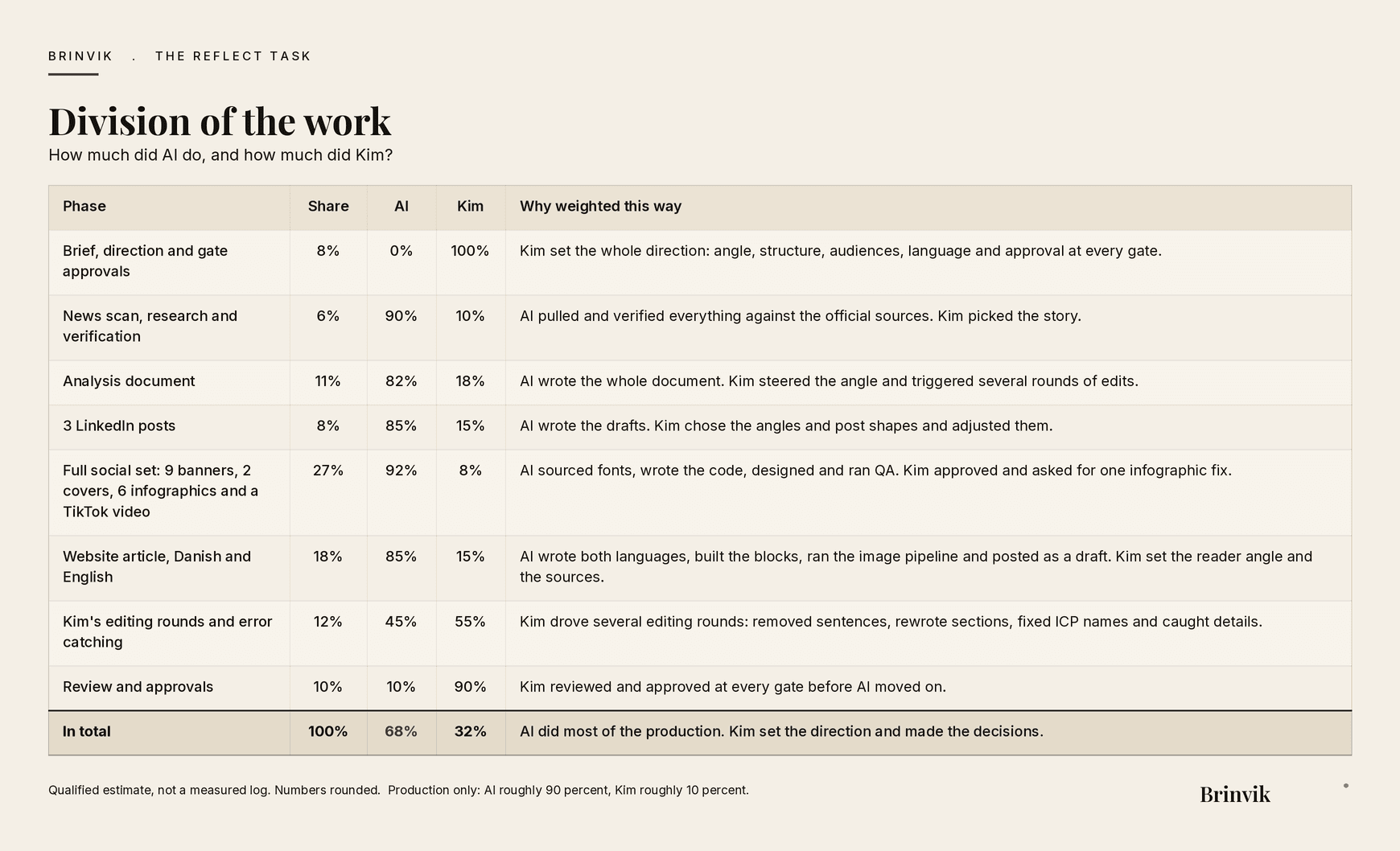
This work was produced in collaboration with AI. Overall: AI about 68 percent, Kim about 32 percent. Production only: AI roughly 90 percent, Kim roughly 10 percent. A qualified estimate, not a measured log.
FAQ
Frequently asked questions
Reflect is a new feature in Claude that shows you how you use AI. It gathers your topics, your patterns and your time spent over 1 to 12 months and asks you questions that prompt you to reflect on your own use. It is private, free and in beta, and it requires memory to be on.
Start by making deliberate use a shared habit. Reflect gives each employee insight into their own habits, and AI training for teams gives the team a shared foundation in the 4D framework and concrete workflows. At Brinvik we build the training around your own tasks, so it works from day one.
Reflect is built private. It does not use incognito conversations, does not pull in source files and keeps health data out. What you need to consider is that the feature requires memory to be on. If you need EU hosting, Claude can be run through AWS Bedrock or Google Vertex AI in an EU region.