
“verify twice.”

Two words. They're probably sitting somewhere in your setup, because somebody wrote them back when the model needed keeping on a short leash. On 8 September Anthropic published what that kind of sentence costs now: prompts written for Claude Opus 4.8 cost 36% more per support ticket on Claude Opus 5, with no gain in accuracy at all. Removing those two words alone cut the cost per ticket by a third. Every figure here is Anthropic's own measurement on Anthropic's own support desk.
One thing up front, so nobody reads four sections for nothing. These figures are measured on systems that call Claude from their own code. If all you have is seats on claude.ai, you've got neither a cache hit rate nor an effort setting. The mechanism still applies: a sentence written for an older model is sitting wherever your prompts are kept, and being forgotten doesn't improve it. And two of the things further down work without a single line of code, one of them in a meeting rather than in the code.

Same prompt, newer model, bigger bill
Anthropic describes the mechanism plainly. A prompt accumulates text written for a model you no longer use. The usual case is over-specific instruction added to compensate for an older model: “verify twice”, “be maximally thorough”, a mandatory step-by-step procedure, a hand-rolled reasoning scratchpad.
A newer model follows them to the letter. It takes the extra tool rounds, it writes the extra text, and the bill goes up. Accuracy stays where it was.
Two figures must not be run together here, and they often are. The 36% is Opus 4.8 measured against Opus 5 with the prompt untouched. The 14% further down is the audited prompt against the unaudited one, both on Opus 5. So the audit does not win the 36% back. Anthropic never claims the audited setup on Opus 5 ended up cheaper than Opus 4.8 was, and neither do I.
A model upgrade is filed as an improvement. It arrives as something that makes the system better, it is approved by someone who is right that the model is better, and after that nobody books a review against it.
A model upgrade is a price change. It simply never gets treated as one.

What did that sentence cost?
Anthropic measured the individual deletions, and the figures are unusually concrete for this kind of guidance.
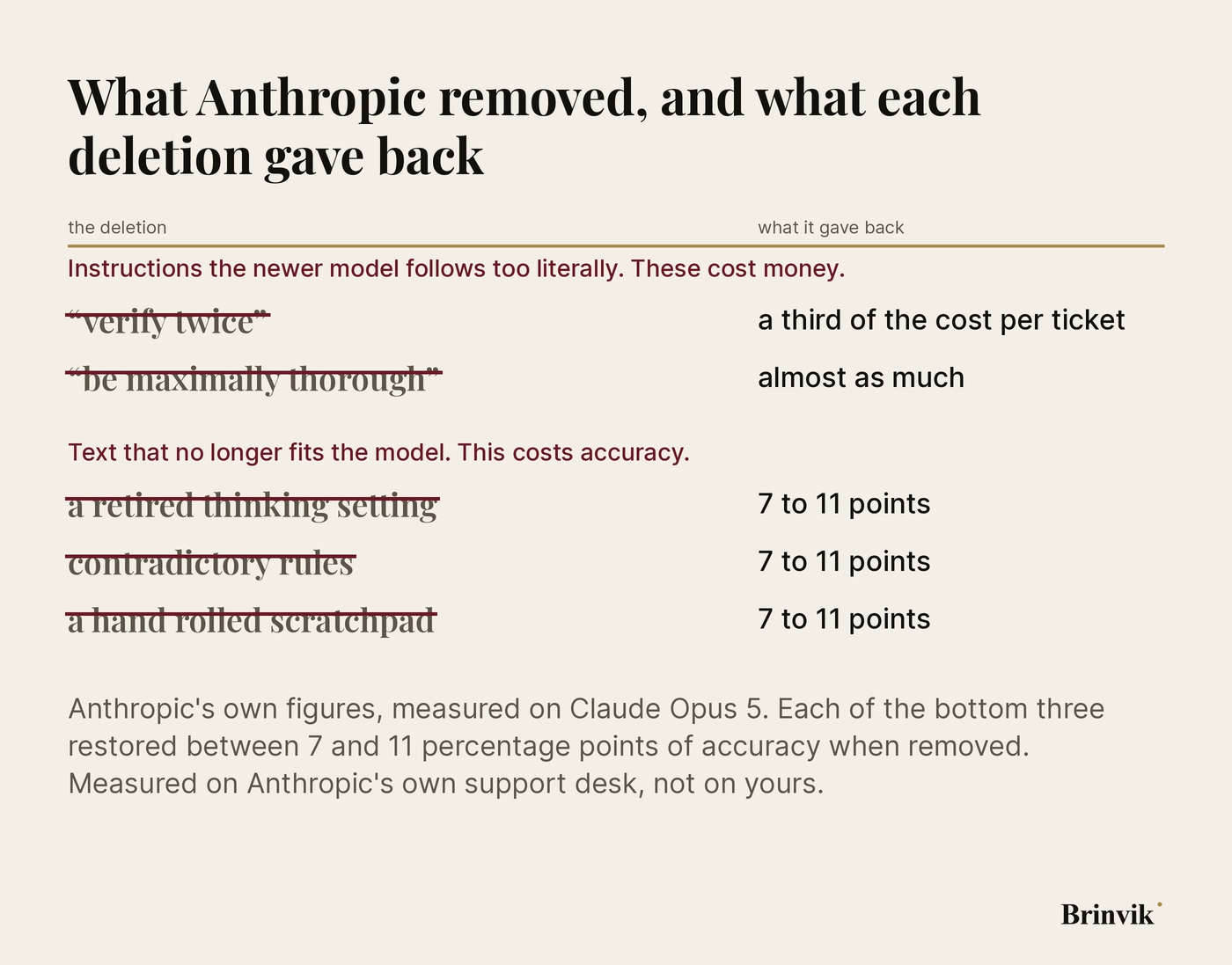
Removing “verify twice” cut Opus 5's cost per ticket by a third. Removing “be maximally thorough” cut almost as much. Those are instructions the newer model follows too literally.
The other kind costs accuracy rather than money: a retired thinking setting, contradictory rules, and a hand-rolled scratchpad that conflicts with the model's own thinking. Each of them restored between 7 and 11 points on Opus 5 when it was removed.
Anthropic shows what one of these edits looks like. Before: “After any refund or escalation, verify twice before submitting: re-fetch the order, re-check every figure in your reply against the fresh lookup, and review the reply a second time for errors.” After: “Before submitting a refund or an escalation, re-fetch the order and confirm every figure in your reply matches the fresh lookup.”
Same control. One pass instead of two.
The audit itself is a Claude Code command, /claude-api prompt-audit, which reads a project's prompts and request code and reports what was written for a different model. It is not something a non-developer kicks off over lunch. A person can look for the same things, though, and the list above is the whole list.

Ask for your own cache hit rate
Caching is the largest single lever in the whole set, by a wide margin. Anthropic writes that it cut agent-loop cost by a factor of 2.7 to 5.3 on their benchmarks, and cut a small triage agent's bill by 83%, or 88% with input trimming added.

The figure you can actually use is a different one, and you can get it yourself. Over a full day of real traffic, agent loops read a median 84% of their input from the cache, and the top 10% of setups, coding or not, read 94% or more.
That's a measuring stick. Whoever built your setup can answer this without touching the code: what is our cache hit rate, and why is it under 84? An ops lead who writes no code can both ask that and judge the answer. The number is in the Claude Console.
I have written about the cache before, when Fable 5.1 landed, and that piece was about the price of a cache read when you pick a model. Different number, different decision. This one is about the rate your running system hits today.
Underneath that rate sits a handful of settings that should not be something you set once and never look at again. Cache duration is the clearest. Anthropic recommends the one-hour duration when about 1 turn in 20 follows a pause of between five minutes and an hour. Without those pauses, the five-minute default cost 15% less than the one-hour setting on Sonnet 5 and 11% less on Opus 5. So the longest cache is the most expensive one if you don't pause.
The effort setting belongs in the same category. On Anthropic's research and knowledge-work benchmarks the curve is nearly flat: low effort gave up 1 to 3 points for a third to a half off the cost. On long coding tasks it isn't flat. There, low effort gave up about 8 points for a quarter of the cost, and Anthropic itself calls that a real tradeoff. One setting, two completely different sums.

One of the levers cost 74% more
Anthropic's own page carries a row that no vendor sets in large type.
Context editing and compaction, meaning tidying the conversation as it runs, saved nothing on a 20-issue run. It cost 74% more. On a longer run, pruning saved 39% and compaction 32%. The same lever saves money on a long run and loses it on a short one. The length of the run decides which.

That one row changes what the whole list is. A list where one of the items can cost 74% more is a set of bets on your own workload. Somebody has to measure before anybody changes anything.
The same goes for the figures that look best. Every one of them is measured on Anthropic's own benchmarks: a support desk, DeepResearch Bench II, SWE-bench Pro, LegalBench, tau2-bench, CursorBench, Humanity's Last Exam. None of them is your work. The direction transfers. The magnitude does not, and you won't get 36% because Anthropic did.

Two things work without a single line of code
Two results in the set need neither a developer nor a change to the code.
The Batch API takes 50% off every token of a request, including the ones read from cache, in exchange for the answer arriving sometime within 24 hours. The decision belongs in a meeting rather than in a pull request: which of your work actually has to be instant? Overnight summaries, classifying an inbox, cleaning up a data set. A lot of what runs synchronously today doesn't need to. Batch is not available for Claude Managed Agents sessions.
How you hand over data is the other one. Anthropic measured the same data file pasted into the prompt against uploaded and read with code execution. Pasted in: 6 of 25 correct, $5.01. Uploaded: 25 of 25 correct, $0.40. Price and accuracy moved in the same direction, which they rarely do.
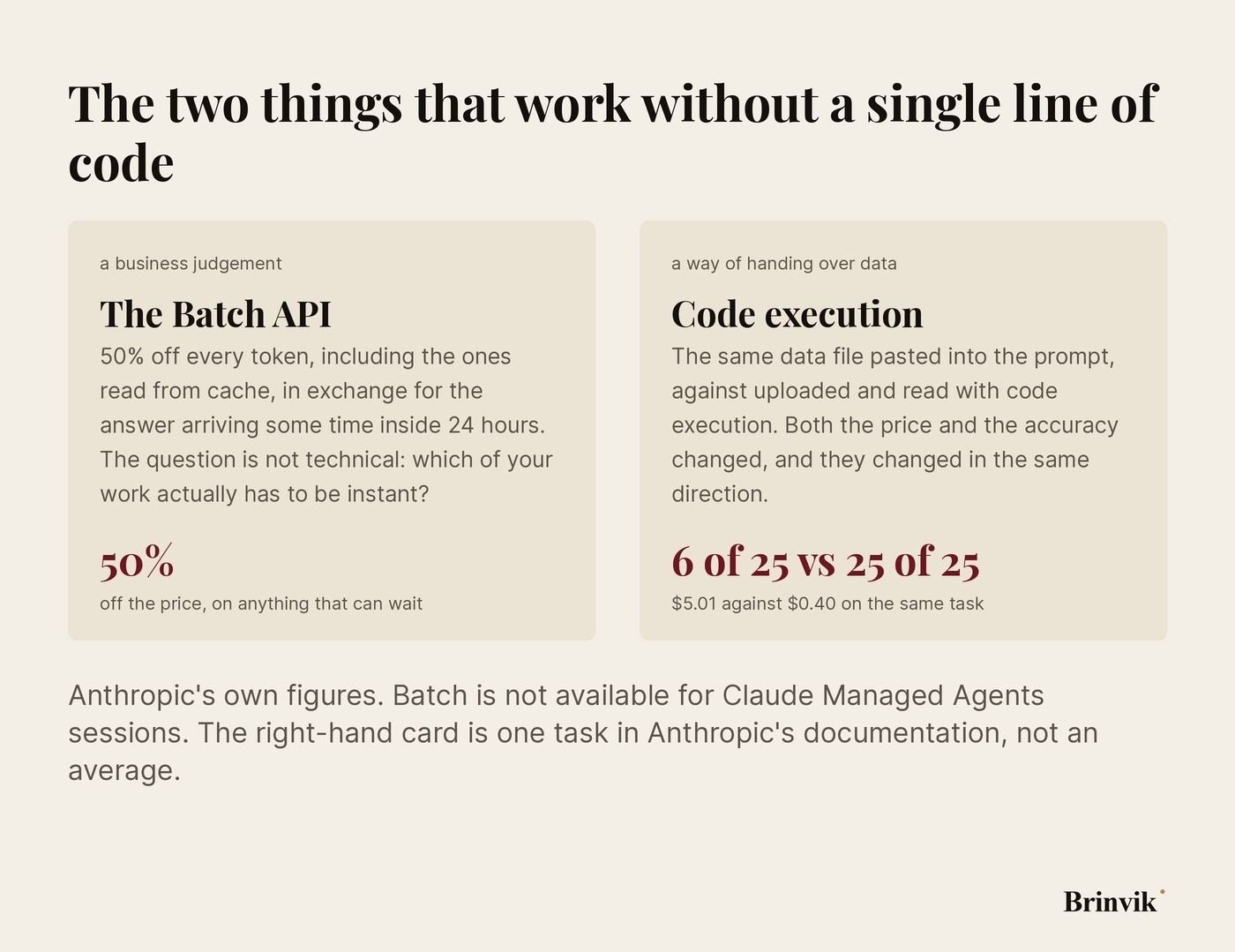
Both are decisions about how the work is arranged rather than how the code is written. That's the kind of thing an owner or an ops lead can settle in a meeting.

One support desk, all the way through
One workload, followed the whole way, shows all of it at once. Anthropic describes it in two places, and the two accounts do not add up to one run against one shared baseline, so I keep them apart.
In the documentation: prompts written for Opus 4.8 cost 36% more per ticket on Opus 5, with no change in accuracy. The same prompts, after the audit, came out 14% cheaper than the unaudited version and more accurate on Opus 5, 97% of tickets against 92%. Anthropic says that gain sits outside the noise. On the Sonnet 4.6 to Sonnet 5 migration, the audit took 14% off with accuracy unchanged.
In the blog post of 8 September: the same workload ended up on Sonnet 5 at low effort at 1 cent per ticket with 98.9% accuracy, and 90.5% on the held-out test against 78.6% at the start. Roughly a fifth of what it had been costing.
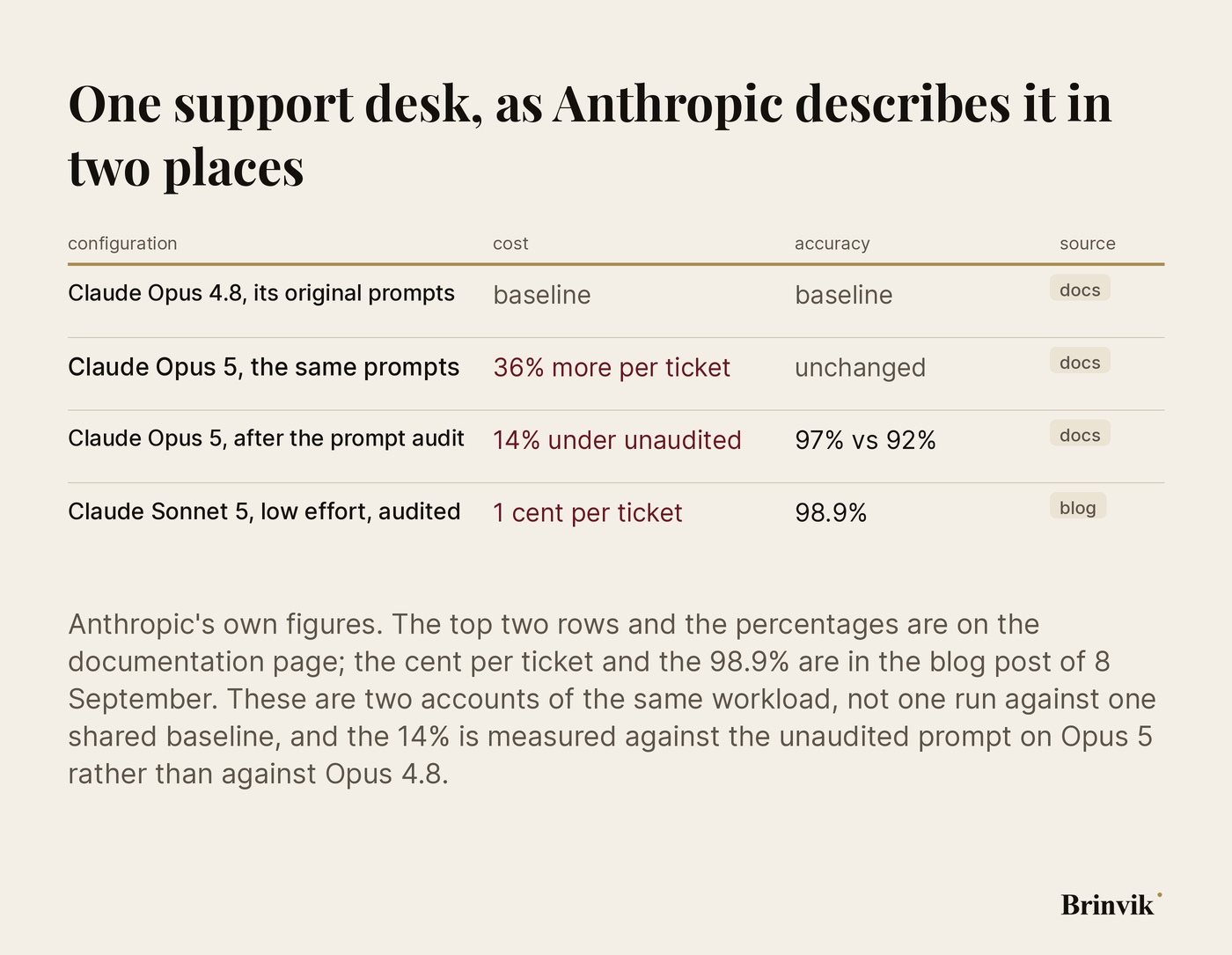
Look at the order of the decisions. The prompt was read, and then the model was chosen. Had they done it the other way round, they would have picked a model on a basis that was 36% wrong.

The bill has no owner
Here is the part I run into most often, and it is not technical.
In a company of 20 to 200 people the cache, the wording of the prompt and the choice of model are rarely spread across three people. They usually sit with the same person, and that is often the only person who has built anything. That's not the problem. The problem is that nobody has ever asked that person for a number.
The invoice lands somewhere else, with somebody who can see the total and doesn't know what to ask for. So the most expensive lever in the building stays untouched for another quarter, not because anyone decided that, but because nobody has their name on it. That is usually where I get brought in as an AI consultant: not to pick a model, but to put a name on the three numbers.
Three questions to ask. All three can be answered in an afternoon.
What is our cache hit rate right now? It's in the Claude Console. Hold it against 84.
When were our prompts last audited, and which model were they written for? The date is the answer. The model name is the point.
What did a completed task cost before and after our last model change? Not per token. Per completed task.
Then there is the audit nobody schedules. The next time you change models, your old instructions change sign the same day. Put it in the calendar of whoever gets the invoice, and make it a condition of the change rather than a tidy-up afterwards.

How do I keep AI costs low?
Short answer: by measuring three numbers before you change anything, and by reading the prompts you are already paying for. The cache hit rate, the date of the last prompt audit, and the cost per completed task before and after the last model change together decide far more than the choice of model itself. AI costs come down when somebody owns those three numbers.
That is the review I run as an AI consultant for companies of 20 to 200 people. I read your prompts, hold them against the model you are actually running, and find the sentences written for a model you no longer use. If somebody needs to keep owning those three numbers afterwards, that is what an external AI lead on a retainer is for. It is the same work as setting artificial intelligence up properly in the first place: somebody has to configure it, and somebody has to keep reading the numbers afterwards. Claude implementation and AI workflow automation belong in the same place once the bill is under control.
FAQ
Frequently asked questions
Measure three numbers before you change anything: your cache hit rate, the date of the last prompt audit, and the cost per completed task before and after the last model change. Anthropic's own measurements suggest prompts written for an older model and a low cache hit rate cost more than the choice of model does.
Because the prompt came along unchanged. Anthropic measured that prompts written for Claude Opus 4.8 cost 36% more per support ticket on Claude Opus 5 without becoming more accurate. Instructions like “verify twice” were written to compensate for a weaker model, and a newer model follows them to the letter.
A review of the prompts a system runs on, held against the model it actually uses now. Anthropic has put it in a Claude Code command, `/claude-api prompt-audit`, which reads prompts and request code and reports what was written for a different model. It can also be done by hand, because the list of things to look for is short.
Anthropic measured over a full day of real traffic that agent loops read a median 84% of their input from cache, and that the top 10% read 94% or more. Your own number is in the Claude Console, and 84 is the median to hold it against.
Two of Anthropic's results need no code. The Batch API takes 50% off any work that can wait up to 24 hours. And handing a data file over as an upload rather than pasting it into the prompt moved one task in their measurement from 6 correct out of 25 to 25 out of 25, and the price from $5.01 to $0.40.
The direction does, the magnitude does not. Every figure is Anthropic's own measurement on Anthropic's own benchmarks, and one of the levers went the wrong way on a short run: context editing and compaction saved nothing and cost 74% more on a 20-issue run. That's why somebody has to measure your own workload before anything changes.
One named person, ideally the same one who can answer the three numbers. In companies of 20 to 200 people the cache, the prompt and the model choice typically sit with the same employee while the invoice lands with somebody else. That distance is what leaves the cheapest fix undone.
Sources
- Reducing cost and improving performance with Claude Platform, Anthropic, 8 September 2026
- Optimizing for cost and intelligence, Anthropic, documentation
- Claude Platform release notes, Anthropic
- Effort, Anthropic, documentation
Every figure on cost, accuracy and cache hit rates is Anthropic's own measurement on Anthropic's own benchmarks.