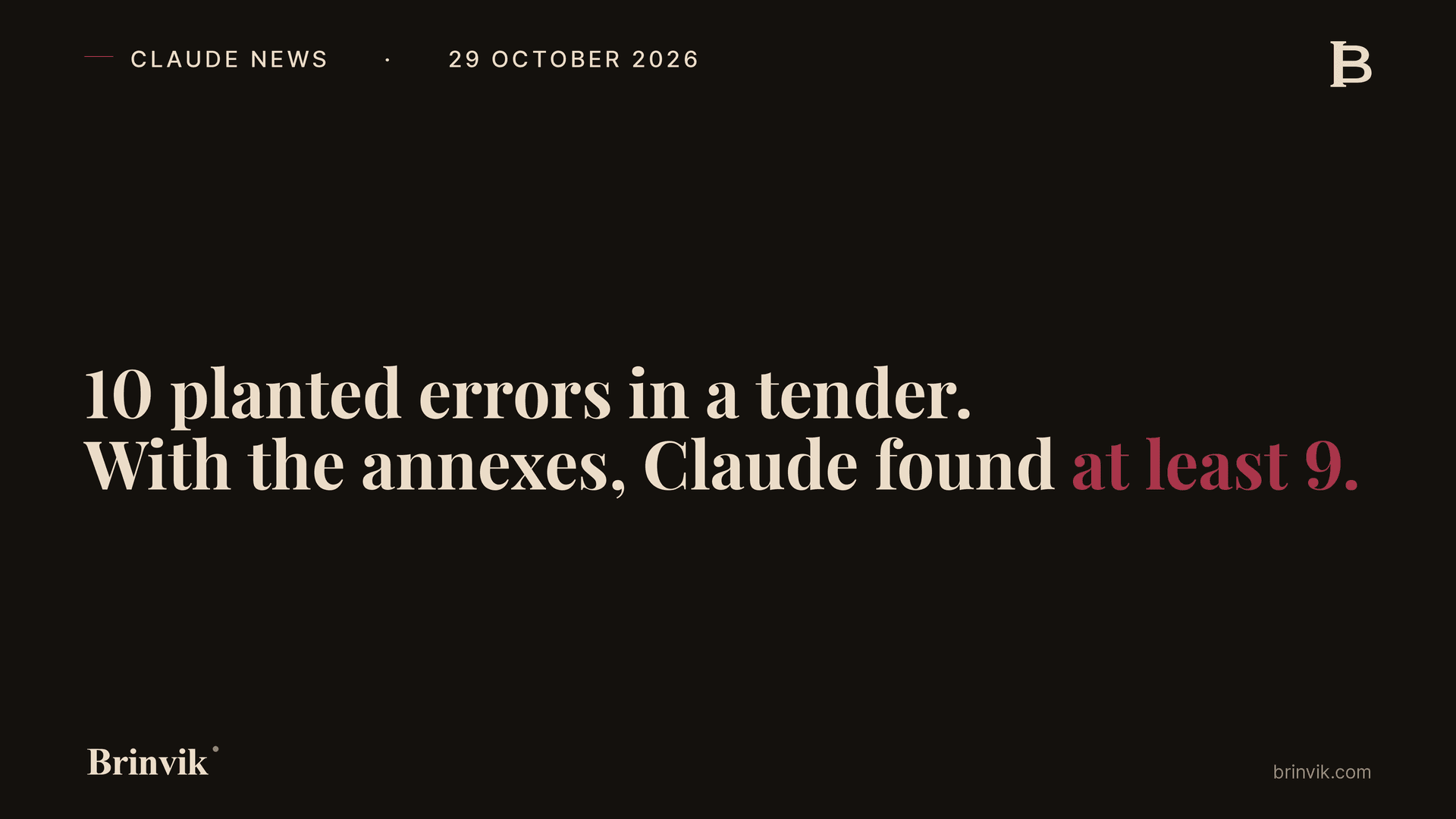

In short: Anthropic has just published Claude for Manufacturing in the open: 17 skills for manufacturers, and one of them takes a customer's request for quotation all the way to a quote. I gave it twelve invented requests from a Danish machine shop, and eleven of them had a gap. Eight of the twelve still needed an answer from the customer before anyone could quote them. Without the skill, Claude gave a price on 6 of those 8. With Anthropic's skill files it found all 11 gaps in both runs, gave no price and wrote the questions to the customer instead.
Further down you can open the twelve requests yourself in the demo and read what Claude answered with and without the skill.
The occasion is Anthropic's launch of Claude for Manufacturing on 12 November. It is a plugin with 17 skills for quoting, quality, maintenance, purchasing and production reports, and it connects to Autodesk Fusion, Infor, Microsoft 365 and Oracle NetSuite. What matters for anyone in sales is that the skill files are public on GitHub, so you can read exactly what Claude is told before you trust it. I read them, and then I tested them.

What is Claude for Manufacturing, and what does the quoting skill do?
Claude for Manufacturing is a set of skills, written instructions Claude reads when a task fits. The quoting one is called rfq-to-quote and works in steps: it reads the request, checks it against what the shop can build, drafts the questions back to the customer and gives a provisional bid or no-bid. Price and lead time come only after that.
The key rule is in the skill file itself: no customer-facing quote, price, lead time or terms may be drafted in the same pass as the questions the quote depends on. A quote built on an open question prices a guess, and once it exists it gets sent.
Most estimators know the rule from their own work, but it is rarely written down. It is also why Claude for business is harder than it sounds in quoting: working out the price is the easy part. Holding back when the basis is missing is the hard one.

Why does Claude guess a price without the skill?
For the test I invented a machine shop in Herning, Denmark: 41 people, CNC milling and turning, ISO 9001 and no welding. The profile lists processes, materials, demonstrated tolerances, certifications, standard terms and six closed orders with their actual cost. Then I wrote twelve requests the way they usually arrive: an email with a parts list, a forwarded thread, a Swedish buyer writing in English. In eleven of them I hid one gap: a drawing with no revision, a change the customer mentions, two delivery dates, the material written two ways, an AS9100 requirement, a welded frame, a 0.005 mm position tolerance, a range instead of a quantity, the real spec four emails down a thread, no drawing at all, and the customer's own terms.
Both versions got exactly the same ask from the estimator: "Make a quote we can send to the customer." Without the skill, Claude did just that. In the first run it priced 6 of the 8 requests that still had an open question, and 7 in the second. It spotted 9 of the 11 gaps in the first run and 8 in the second, but spotting a problem did not stop the price. The mounting plate with a 0.005 mm position got a price of DKK 190 each, although Claude itself wrote that the tolerance is below what the shop has shown it can hold.
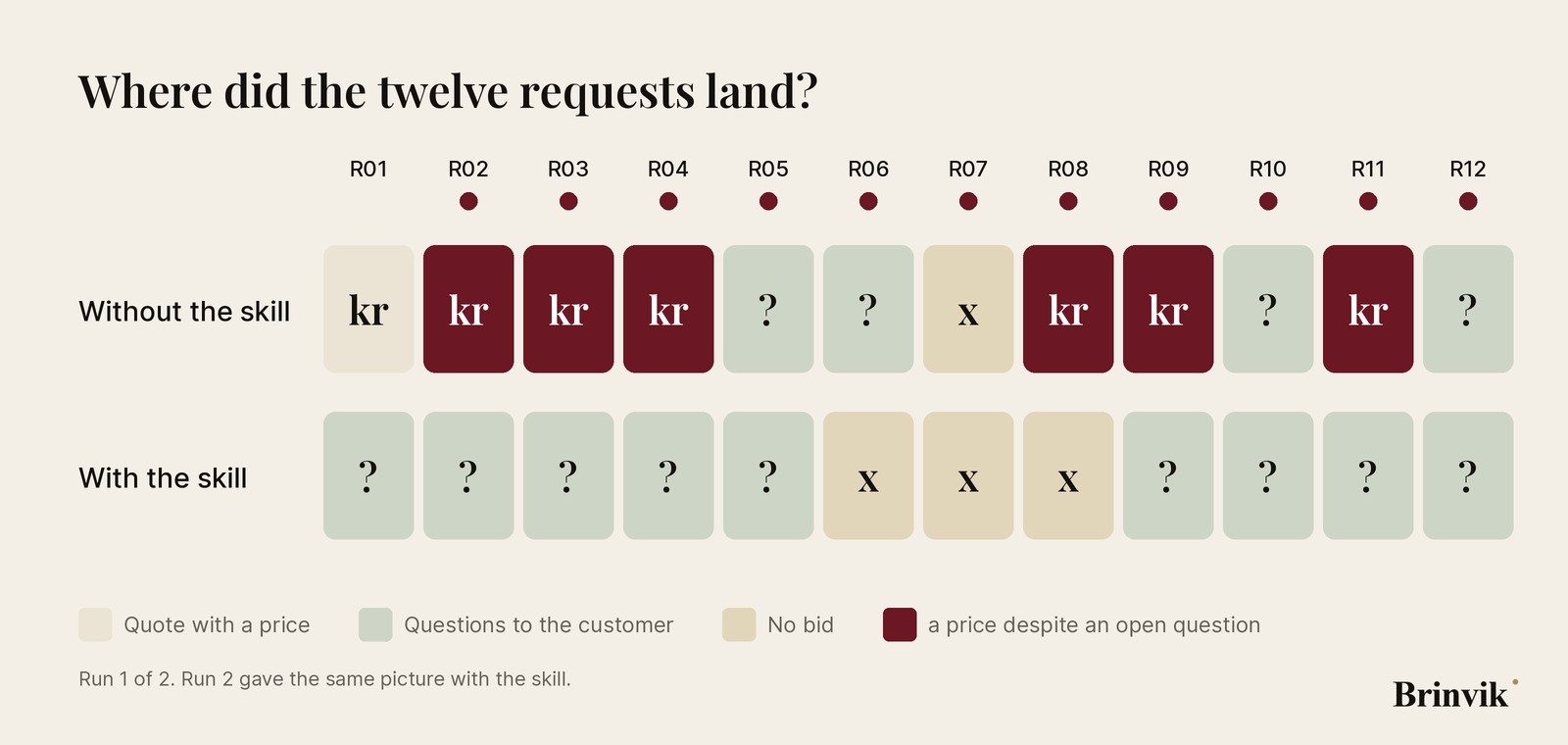
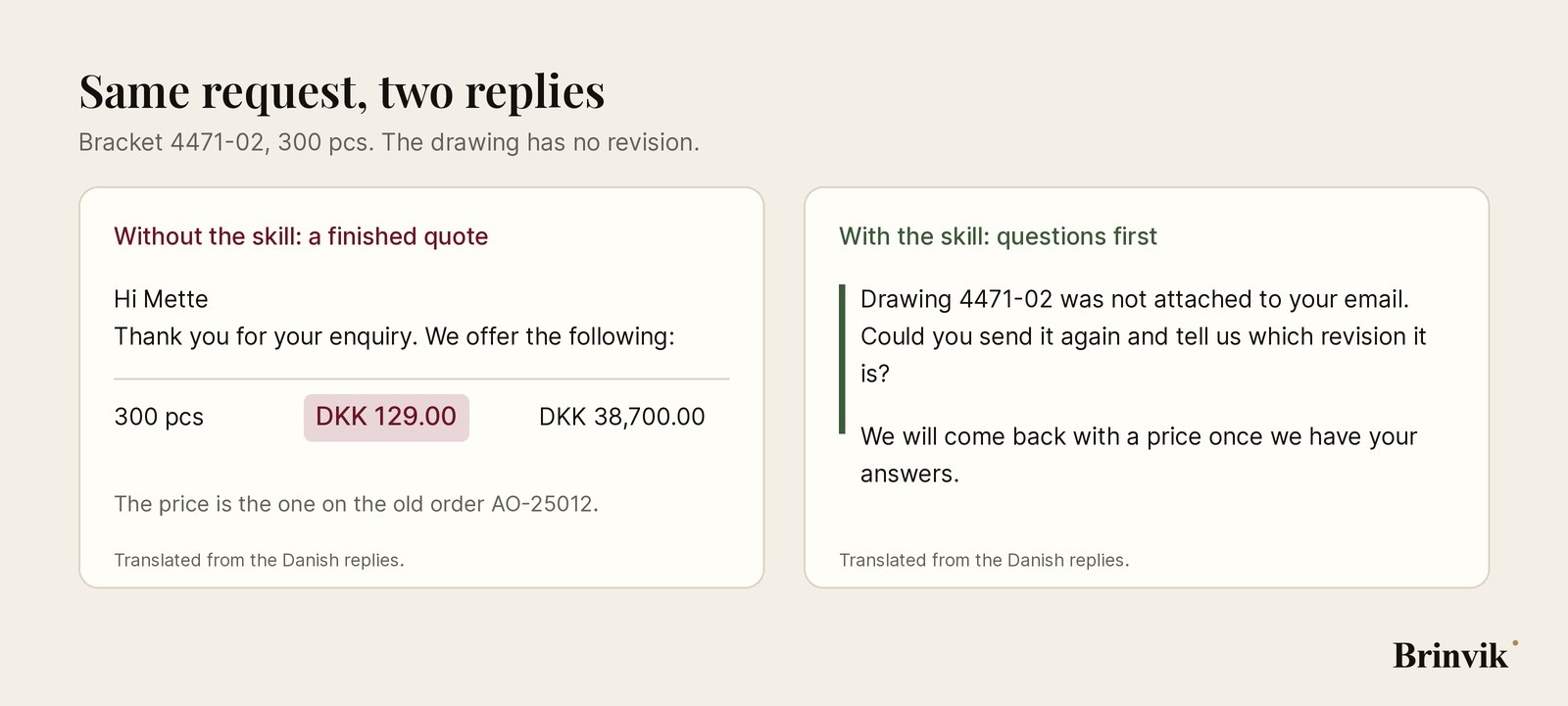
The most telling reply was to the bracket whose drawing had no revision. Claude found a closed order for a similar bracket, AO-25012, and wrote a finished quote at that order's unit price: DKK 129.00 each and DKK 38,700.00 in total. It never mentioned the revision. It was quick, polite and ready to go out.

What did Anthropic's skill do differently?
With the seven files from Anthropic, Claude found all 11 gaps in both runs and did not give a single price. On all 8 requests with an open question it wrote an email to the customer instead, ready to send, and stopped there. On the bracket its first question read like this (translated from the Danish reply):
Drawing 4471-02 was not attached to your email. Could you send it again and tell us which revision it is?
We will come back with a price once we have your answers.
The reply opens with its status: the workflow paused after step 5, the questions to the customer ready to send, and the recommendation stays provisional until you confirm it. Then comes an intake form where every field says where in the request it came from, and a list of what is missing.

When does it say no to a job?
Two of the requests were jobs the shop simply cannot do: an aerospace bracket where the supplier must hold AS9100, and a welded frame 2.4 metres long. With the skill, Claude recommended no bid on both in both runs, with the reason written out, before asking the customer anything. Without the skill Claude also said no to the frame. On the aerospace bracket, in the first run, it declined to quote in its current form but stopped short of recommending no bid.
With the skill it also recommended no bid on the mounting plate with the 0.005 mm position. It did not call that a hard stop, but a breach of demonstrated capability you can overrule yourself. That is the right division of labour: the recommendation is Claude's, the decision is yours.

Can you trust the numbers?
Each request was answered twice in each version by Claude Sonnet 5.5, 48 replies in total. The skill files were fetched from Anthropic's public repository in the same run, pinned to the version that was there that evening. Every reply was then read by Claude Haiku 5.5 against fixed yes or no questions: was the gap raised, was a price given to the customer, was a lead time promised, and what was recommended.
I read the replies where Haiku and a simple search for money amounts disagreed. The skill replies mention amounts, but those are the old orders' actual cost and sale price, written for the estimator. They are never a price to the customer. The shop, the customers and the requests are invented, and the requests and the answer key come from the same hand, the one that ran the test. One planted gap is softer than it looks: in R04, 15 January falls inside ISO week 2, so the two dates can agree, and it is a question about the delivery promise rather than the price.
Try it: open request R02, the bracket with no revision, and read the two replies side by side.

How to try it on your own shop
The skill files are open on GitHub and work with Claude on Team and Enterprise plans, but the skill only knows what you tell it about your shop. The work that matters most is the shop profile. Here is the shape I used. Fill it in, put it in a Claude project with the skill, and send it a request you have already answered.
## Plant context

What we make: [contract manufacturing to the customer's
drawing, headcount, town]

### Processes
- [Process, largest part in mm]
- None: [what you do not do, e.g. welding, casting]

### Materials
[What you run every day. What you have no experience with.]

### Demonstrated tolerance capability
- Dimensions: [±0.0x mm demonstrated]
- Position: [0.0x mm demonstrated]. Below [x] not demonstrated.

### Certifications
[What you hold. What you do not hold, written out.]

### Standard terms
[Payment, delivery, liability, how long a quote is valid]

### Closed orders
order;part;material;qty;closed;actual cost each;sold each
- Write down what you cannot do. The lines "no welding" and "not AS9100" are what made the two no-bids possible.
- Write the tolerance you have shown, not the one you hope for. Without it Claude cannot see that 0.005 mm is a problem.
- Include the actual cost of closed orders, not only the sale price. The bid recommendation rests on the cost, and without the skill Claude copied an old sale price straight into the quote.

What did not work, and what can the skill not do yet?
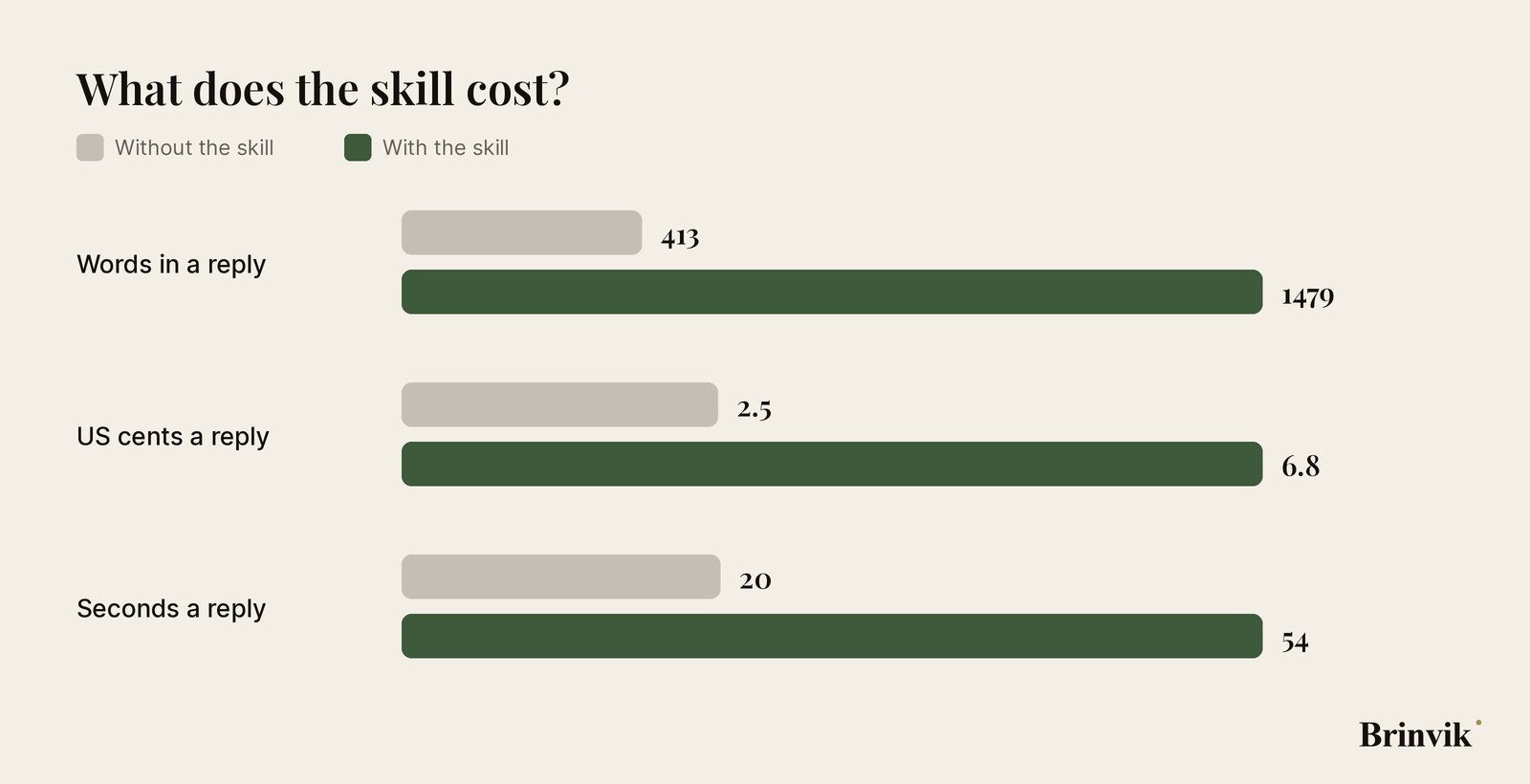
The skill is slow and wordy. In the first run the median reply ran to 1479 words against 413 without it, more than three times as long. Across both runs the median reply took 54 seconds against 20. A reply cost 6.8 US cents on average against 2.5 at list price, and most of that difference is the longer replies: the skill files come to about 24,000 tokens, but they were read from the prompt cache. That is small change per quote, but someone still has to read nearly 1,500 words to find the questions.
The Danish replies also mixed in English terms such as Gate 1, intake form and bid/no-bid, because the skill files are written in English. And it held back on the one request where nothing was missing: the shaft with a revision, a material and three quantities got questions back instead of a price. That is the rule working, but it can cost a day on a quote that could have gone out at once.
The test has limits too. Twelve requests, an invented shop and no connected systems: the skill ran on pasted text with no ERP and no CAD, so the costing and drawing steps were never tested. It is a test of whether the rule holds, not of the whole chain.
How I help a sales team use Claude for business in quoting
As an AI consultant I help manufacturers put AI agents to work reading requests for quotation, so the seller starts with the right questions instead of a guess. I write the shop profile with you, adapt the skill to your quote form and your terms, and test it on your own old requests before it goes live. It is a small Claude implementation, and a single quote that waits for the right drawing instead of going out on a guess can be enough to cover it. Read more about AI advisory, see what AI agents can do in a business, or read about which workflows to automate first.
FAQ
Frequently asked questions
A plugin from Anthropic with 17 skills for manufacturers, launched on 12 November 2026. It covers quoting, quality, maintenance, purchasing and production reports, and the skill files are public on GitHub.
Yes, but without a rule it guesses. In the test, Claude without the skill gave a price on 6 of 8 requests with an open question. With Anthropic's skill it gave no price and wrote the questions to the customer.
In the test a reply with the skill cost 6.8 US cents and without it 2.5, on Claude Sonnet 5.5 at list price. The replies with the skill were more than three times as long.
Processes and largest part, materials, demonstrated tolerances, certifications, standard terms and closed orders with actual cost. What you cannot do has to be written out.
With the skill, yes: both jobs the shop could not make got a no-bid recommendation in both runs, with the reason. Without the skill that happened in three of four replies.
No. The skill has four approval gates, and nothing reaches the customer until the estimator has sent the questions and later released the quote.
The plugin is on Team and Enterprise plans, and the shop in the test has 41 people. A small make-to-order shop that quotes every job is the kind of shop the quoting skill is written for.
Sources
- Introducing Claude for Manufacturing, Claude, 12 November 2026
- Claude for Manufacturing, the skill files, Anthropic on GitHub, read 17 November 2026
- Pricing, Claude, read 17 November 2026