On 15 January this year, the Carnegie Endowment for International Peace announced that its president would step down in the summer. He was going back to Stanford to lead two programmes there.
On 4 August he went to Anthropic instead.
His name is Mariano-Florentino Cuéllar. Everyone calls him Tino. He is now Anthropic's first Chief Global Affairs Officer, meaning the person responsible for the company's relationships with governments and regulators worldwide.
I am not writing about this because a personnel announcement is interesting on its own. I am writing about it because his CV is close to the most unusual I have seen in this industry. And because a hire like this tells you something about a vendor that no roadmap does.
What actually happened
Anthropic announced the appointment on Tuesday 4 August 2026. Cuéllar reports directly to Anthropic president Daniela Amodei and is based at the San Francisco headquarters. The role covers policy, international engagement and relationships with governments in the many countries where Anthropic is expanding. He takes a leave of absence from Stanford Law School, where he is a professor, and from the Stanford Institute for Human-Centered Artificial Intelligence.
The timing is not accidental. Reuters describes two conflicts Anthropic is in the middle of right now. The Pentagon blacklisted Anthropic's technology earlier this year, and Anthropic is challenging that decision in court. And the Trump administration issued an export control directive that temporarily barred Anthropic from selling Mythos 5 and Fable 5 to foreign nationals on national security grounds.
You may already know the second one from here. I wrote about the suspension on 12 June and about the return on 30 June. It is the same story, now with an organisational consequence: Anthropic has decided that its relationship with governments deserves its own seat at the executive table.
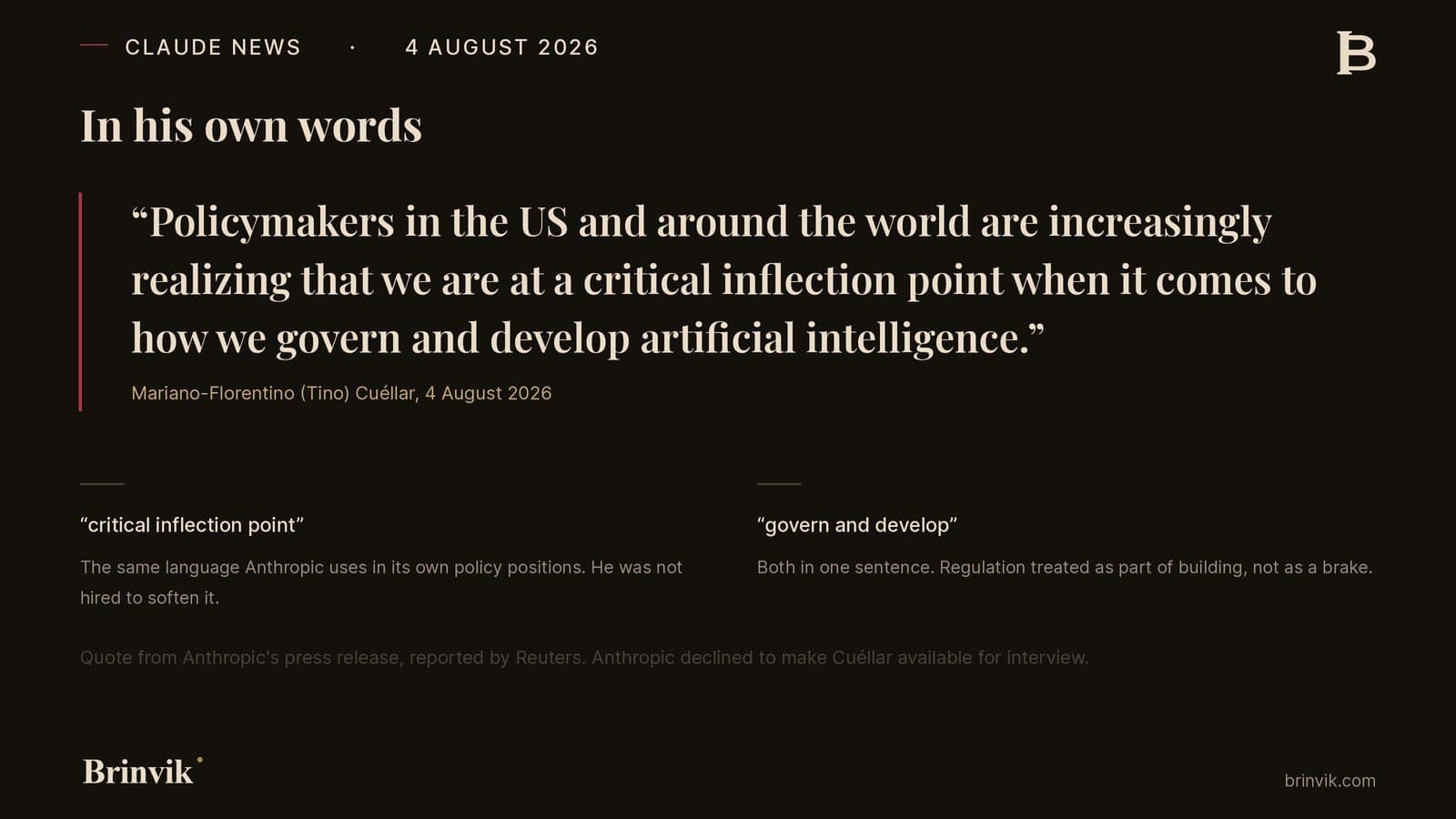
Policymakers in the US and around the world are increasingly realizing that we are at a critical inflection point when it comes to how we govern and develop artificial intelligence.
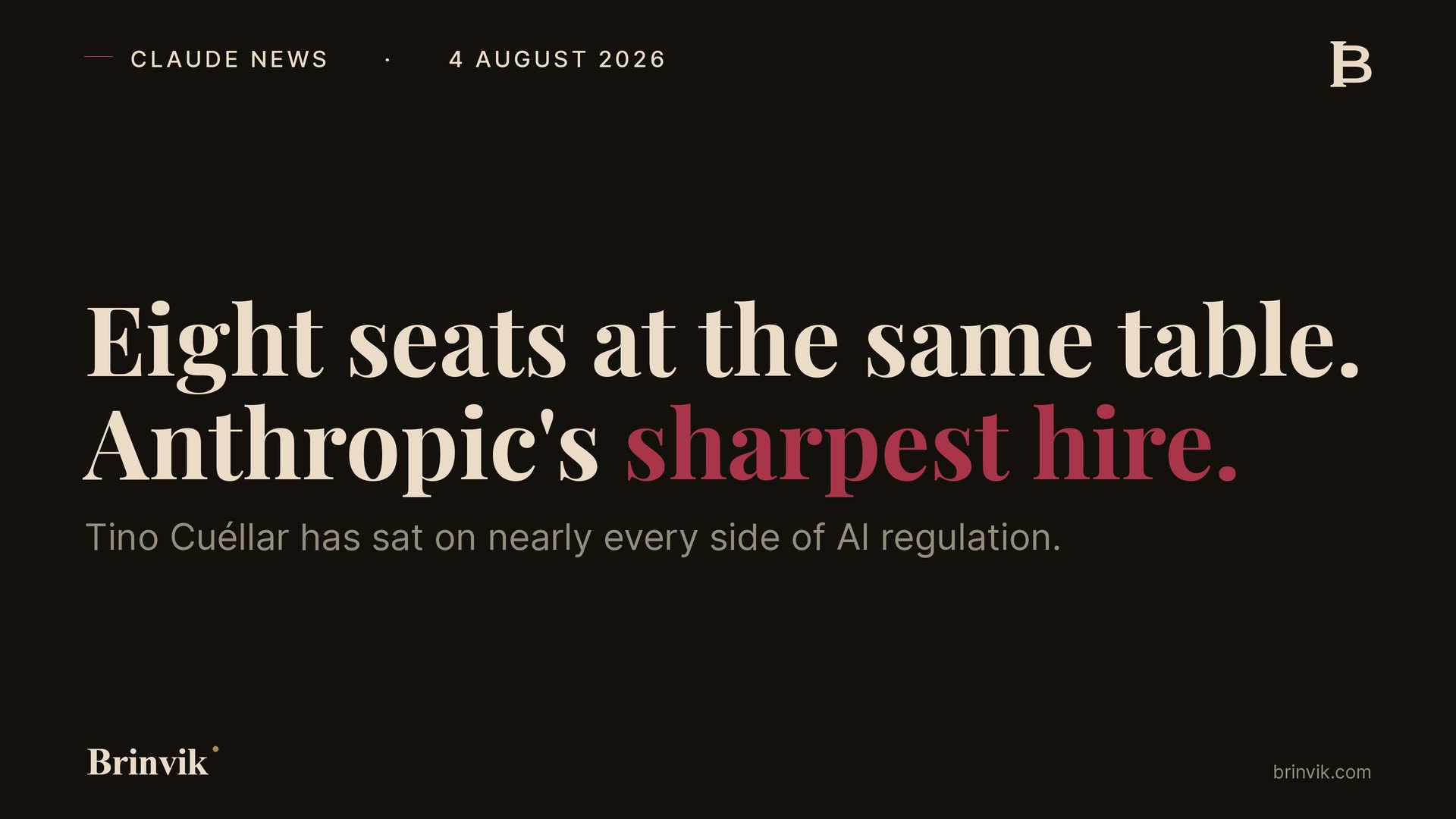
Eight seats at the same table
Going through his career, one thing kept repeating. Cuéllar has sat in almost every seat around the same table. He has looked at the question of how you govern a technology nobody fully understands yet from eight different sides.
Anthropic just bought the eighth.
2001. The scholar. He joins Stanford Law School and writes on administrative law and on how institutions handle risks they do not yet understand. He becomes co-director of the university's centre for international security, leads the Stanford Cyber Initiative and in 2013 becomes director of the Freeman Spogli Institute. What Anthropic buys here is the habit of studying a system before judging it.
2009. The rule writer. He takes leave and becomes Special Assistant to the President for Justice and Regulatory Policy in the White House under Obama, leading work on criminal justice, public health and immigration. What Anthropic buys here is experience getting something through a political system that does not agree with itself.
2015. The judge. Governor Jerry Brown appoints him to the California Supreme Court. The State Bar's independent evaluation commission gives him its highest rating. For nearly seven years he writes opinions on technology and privacy, on the separation of powers and on international agreements. What Anthropic buys here is someone who has had to decide a case where the rules were written before the technology existed.
2020. The auditor. He is a principal adviser on Government by Algorithm, commissioned by the Administrative Conference of the United States. It maps AI use across the 142 most significant federal agencies, goes deep on eight of them, and then examines what that does to accountability, transparency and non-discrimination. This is not theory. It is an inventory first and a judgement second. That is exactly the order I work in when I start with a new client.
2021. The diplomat. He becomes president of the Carnegie Endowment for International Peace and co-chairs a bipartisan task force on nuclear proliferation and American security, the first high-level effort of its kind since 1964. Reuters notes that several AI industry leaders have looked to nuclear arms control as a model for managing the technology's risks. What Anthropic buys here is experience with the one technology the world has so far tried to keep on a leash across borders.
2025. The author. With Fei-Fei Li of Stanford and Jennifer Tour Chayes of Berkeley he writes The California Report on Frontier AI Policy. Three load-bearing principles: weigh both risks and benefits, ground governance in evidence, and build trust through transparency and verification.
January 2026. The watchdog. He joins Anthropic's Long-Term Benefit Trust, the independent four-seat body meant to hold the company to its public benefit mission.
4 August 2026. The regulated party. He steps off the Trust and into the executive team.
Why I think it is a brilliant move
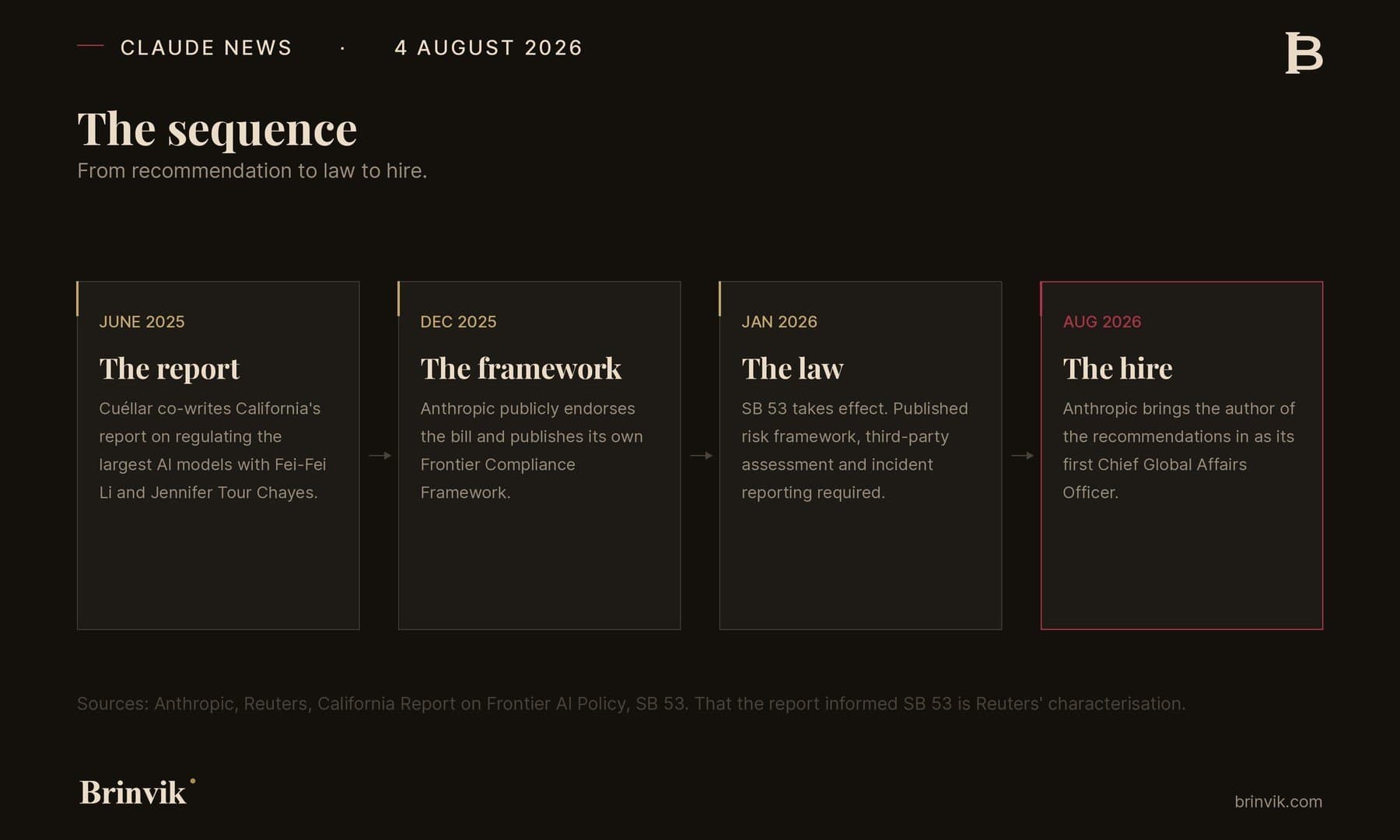
Look at the order. He wrote the recommendations. They became law. The law regulates Anthropic. Anthropic hired him.
Reuters reports that the June 2025 study helped inform the passage of SB 53, the Transparency in Frontier Artificial Intelligence Act. It took effect on 1 January this year. It requires large model developers to publish a framework for how they assess catastrophic risks, to issue transparency reports before deployment, to involve third-party assessment and to report incidents. It protects whistleblowers and carries a maximum fine of one million dollars per violation. Smaller developers are exempt. Anthropic endorsed the law publicly and published its own Frontier Compliance Framework on 19 December 2025.
Here is my view: this is the sharpest hire Anthropic could have made, and I struggle to see a better alternative.
Turn the question around. Who else is there who knows more about the rules Anthropic is subject to than the man who helped write the recommendations behind them? The list gets short very quickly. Most candidates have done one of the things he has done. He has done all of them.
Then there is the difference between the two kinds of people companies usually hire for a job like this. Most hire a lobbyist. A lobbyist sells relationships, and relationships last until the next election. Anthropic hired substance. Someone who understands the subject himself, can read a statute and can sit across from a civil service without needing a translator. That does not lose its value when an administration changes.
There is an obvious counter-argument. Is it not convenient to hire the man who wrote the rules, so you can find the loopholes? It would be, if he had written a weak framework. He did not. The report rests on transparency, independent assessment and verification, and the law it led to has whistleblower protection and a real financial penalty. Anthropic backed that law before it hired him.
You do not hire the author of a demanding law to get around it. You hire him because you have worked out that the rules are coming either way, and that understanding them beats fighting them.
A note on my own interest: Brinvik makes its living implementing Claude. When I write that Anthropic has made a smart move, I profit from you agreeing. Read it with that in mind.
The question that also needs asking
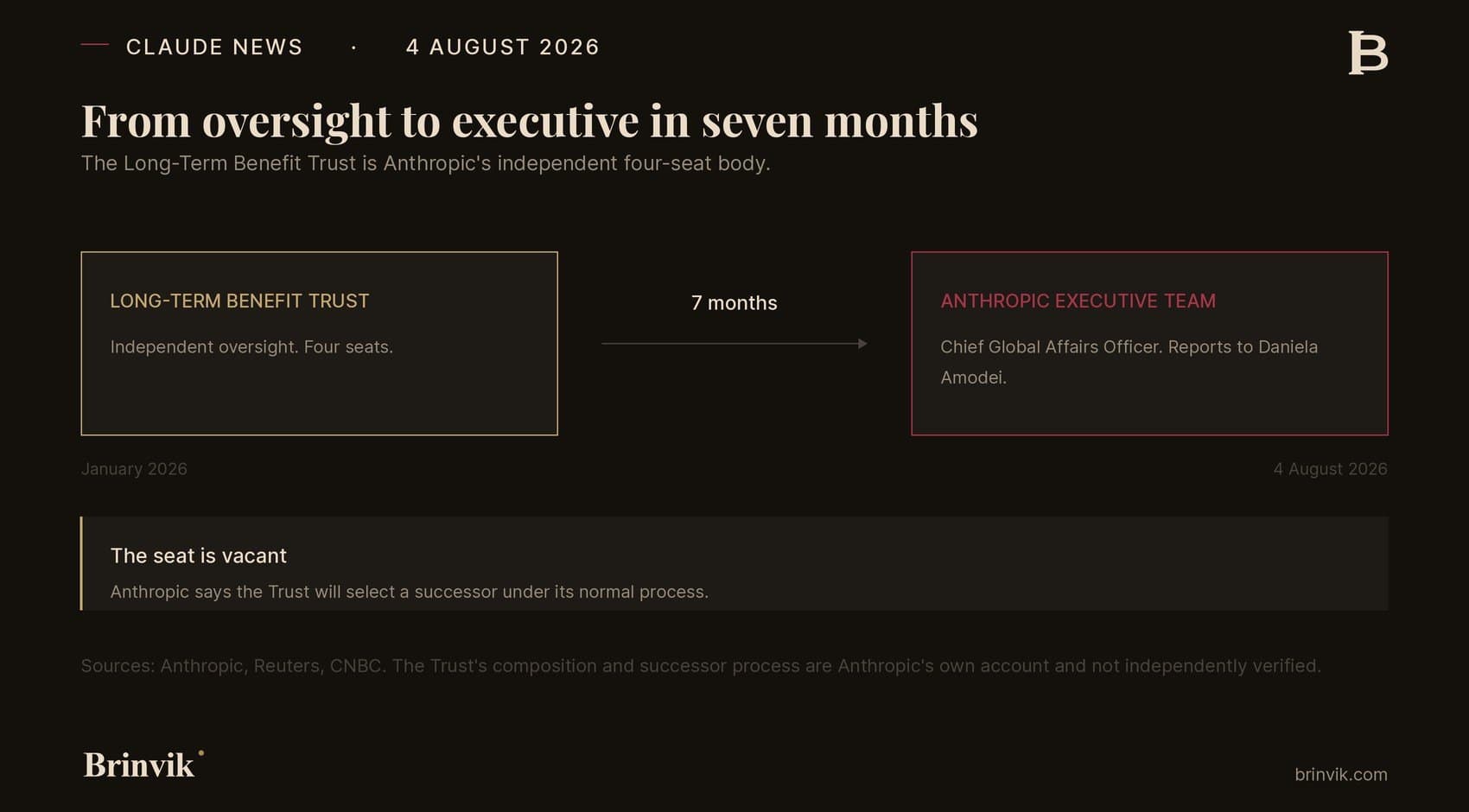
Cuéllar sat on the independent oversight body for seven months and is now an executive at the company that body is meant to watch. I think that is worth saying out loud.
There is a reasonable answer. He is probably the best qualified person in the world for the job, and it would be odd to disqualify him because he also served on the Trust. Anthropic says the Trust will select a successor under its normal process, so the seat will not stay empty.
There is also a reasonable counter-question. An independent oversight body loses something if a seat on it can work as an antechamber to an executive role. Independence is not only about who sits there now. It is also about what people assume the seat leads to.
Here is how I see it: this is the right hire, and the question is still fair. Both can be true at once. I would rather buy from a vendor where that question can be asked out loud than from one where it cannot.
What we do not know
I cannot tell you why the plan changed. In January, Carnegie announced that from July Cuéllar would return to Stanford to lead the Center for Advanced Study in the Behavioral Sciences and succeed former Stanford president John Hennessy as director of the Knight-Hennessy Scholars Program. In August he takes leave from Stanford and goes to Anthropic.
None of the sources explains what happened between those two announcements, or whether the Stanford roles are postponed or dropped. I am not going to guess. The question you can answer with facts is not why he switched. It is what he brings with him.
A few more things should be stated plainly. Anthropic's own description of the scope of the role, and the characterisation of Cuéllar as a consensus builder, come from the company itself through a spokesperson to Reuters. The assessment from Oren Cass of the think tank American Compass is a third party's opinion, not an established fact. Reuters reports that Anthropic declined to make Cuéllar available for interview. None of those three is independently verified.
How to read your own vendor
Here is the part you can use, whether you run Claude or something else entirely.
A roadmap is marketing. It costs nothing to write and can be changed quietly. A senior hire is a multi-year commitment with a real salary and a real title attached. It tells you where the company itself believes the pressure is coming from over the next few years.
Look at Anthropic's order over the past year, all of it public on their own newsroom. July 2025: the first Chief Commercial Officer. September 2025: a Managing Director International. October 2025: a Chief Technology Officer. August 2026: the first Chief Global Affairs Officer.
Commercial. International. Technical. Political.
A company that thought it mainly had a product problem would not hire in that order. This is a company that has worked out that its biggest risk is not the model, but market access and the patience of regulators.
For you as a buyer that means two things. Your vendor's regulatory position is part of your ability to deliver, not a detail for the lawyers. And you can check it without calling anyone.
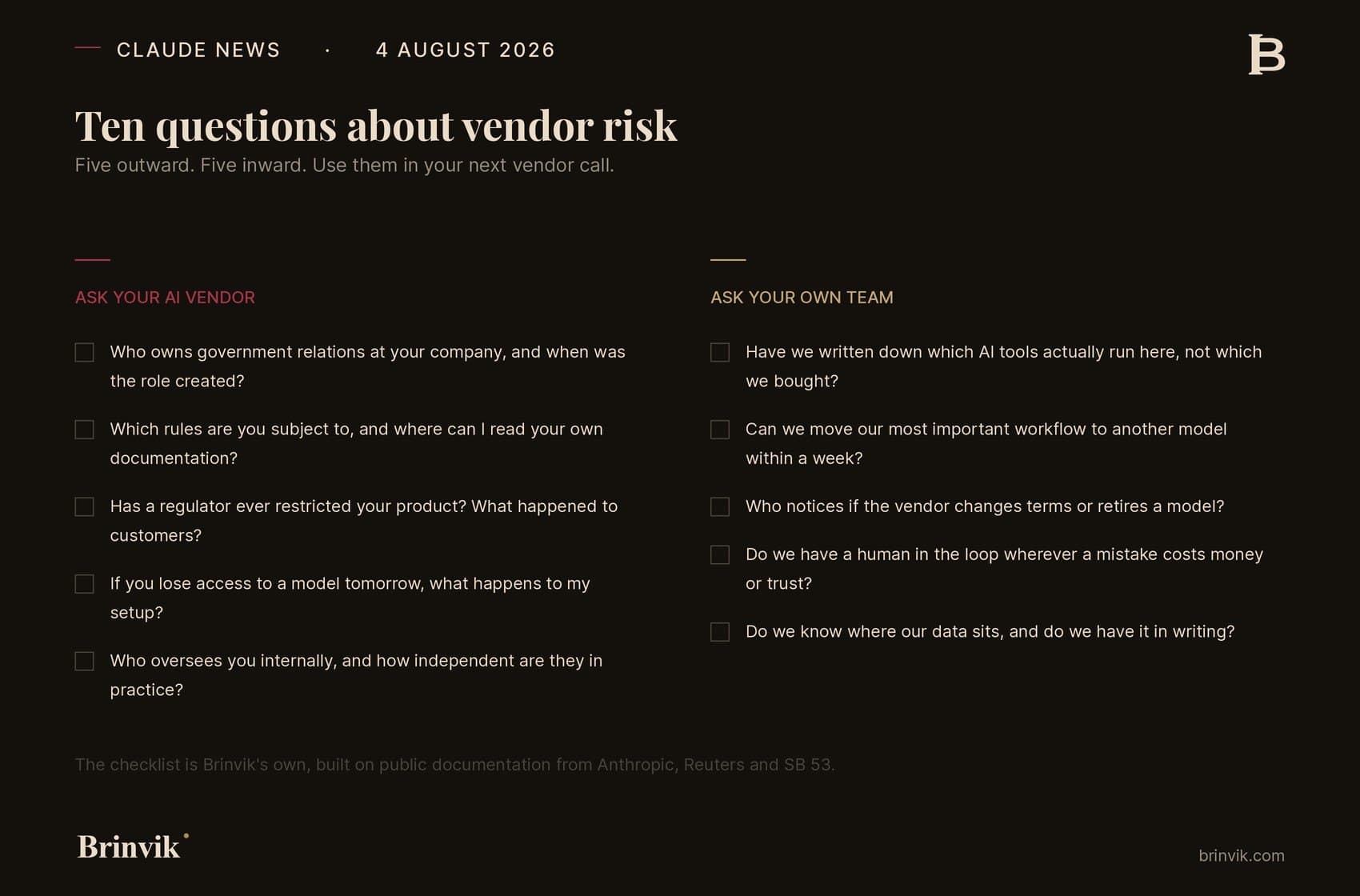
As a Claude specialist I use questions like these myself when I assess whether a setup will hold. The interesting part is rarely the answer itself. It is how long the vendor takes to find it.
If you do not get an answer to question five, that is an answer too.
See what a Claude engagement looks like in practice →
Transparency on AI in this work
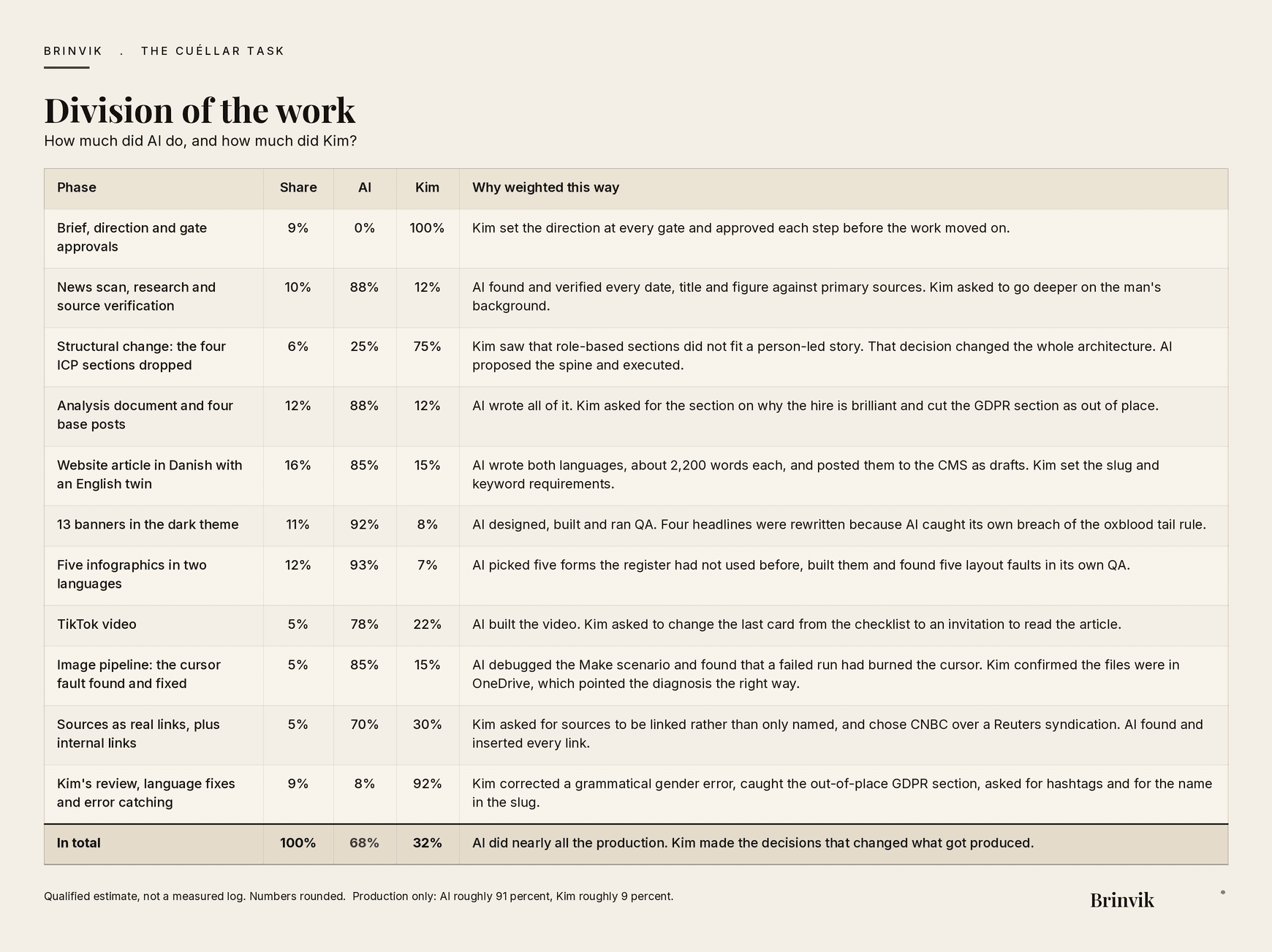
This work was produced in collaboration with AI. Overall: AI roughly 68 percent, Kim roughly 32 percent. Looking only at production, meaning the text, code and graphics actually made, the picture is AI roughly 91 percent and Kim roughly 9 percent.
The AI share is lower than in recent articles, and the reason is worth stating. Partway through, the whole architecture of the piece was rebuilt, because the standard role-based sections did not fit a story about one person. AI cannot make that call. The numbers are an informed estimate, not a measured log.
FAQ
Frequently asked questions
Mariano-Florentino Cuéllar, known as Tino, is a former Justice of the California Supreme Court, former president of the Carnegie Endowment for International Peace and a professor at Stanford Law School. From 4 August 2026 he is Anthropic's first Chief Global Affairs Officer.
The role covers policy, international engagement and relationships with governments and regulators in the countries where the company operates. At Anthropic the position reports directly to president Daniela Amodei.
SB 53, the Transparency in Frontier Artificial Intelligence Act, is a California law that took effect on 1 January 2026. It requires large model developers to publish their framework for assessing catastrophic risks, issue transparency reports, involve third-party assessment and report incidents. The maximum penalty is one million dollars per violation, and smaller developers are exempt.
It is an independent four-seat body meant to ensure Anthropic delivers on its public benefit mission. Cuéllar joined the Trust in January 2026 and stepped off it to take the executive role. Anthropic says the Trust will select a successor under its normal process.
No. There is no product change, no price change and no change in availability. The significance is directional: it tells you Anthropic rates its relationship with governments highly enough to give it a seat on the executive team.
Start with five outward questions: who owns government relations there, which rules they are subject to, whether a regulator has restricted their product before, what happens to your setup if a model is withdrawn, and who oversees them internally. Then ask five inward ones about your own tools, your ability to switch model, your monitoring of changed terms, human in the loop, and where your data sits.
The dates, titles and legal content come from Anthropic's own announcement, from Reuters and from the public sources listed at the end. Anthropic's description of the role, the characterisation of Cuéllar and third-party commentary are not independently verified, and that is marked in the text.
Sources
Every source is public. Follow the links if you want to check the primary material yourself.
- Anthropic, Mariano-Florentino (Tino) Cuéllar to join Anthropic as Chief Global Affairs Officer, 4 August 2026.
- CNBC, Anthropic names global affairs chief as Trump tensions persist, 4 August 2026. Based on Reuters reporting by Jeffrey Dastin.
- Carnegie Endowment for International Peace, Tino Cuéllar to Step Down as Carnegie Endowment President in July 2026, 15 January 2026.
- Anthropic, Mariano-Florentino Cuéllar appointed to Anthropic's Long-Term Benefit Trust, January 2026.
- Anthropic, Sharing our compliance framework for California's Transparency in Frontier AI Act, 19 December 2025.
- Joint California Policy Working Group on AI Frontier Models, The California Report on Frontier AI Policy, 17 June 2025. Written by Fei-Fei Li, Mariano-Florentino Cuéllar and Jennifer Tour Chayes.
- California Legislative Information, SB 53, the Transparency in Frontier Artificial Intelligence Act.
- Engstrom, Ho, Sharkey and Cuéllar, Government by Algorithm: Artificial Intelligence in Federal Administrative Agencies, ACUS, February 2020.
- Carnegie Endowment, the Belfer Center and the Nuclear Threat Initiative, Task Force on Nuclear Proliferation and U.S. National Security, November 2024.
Anthropic's own leadership announcements, which the section on the order is built on: Paul Smith (15 July 2025), Chris Ciauri (26 September 2025) and Rahul Patil (7 October 2025).